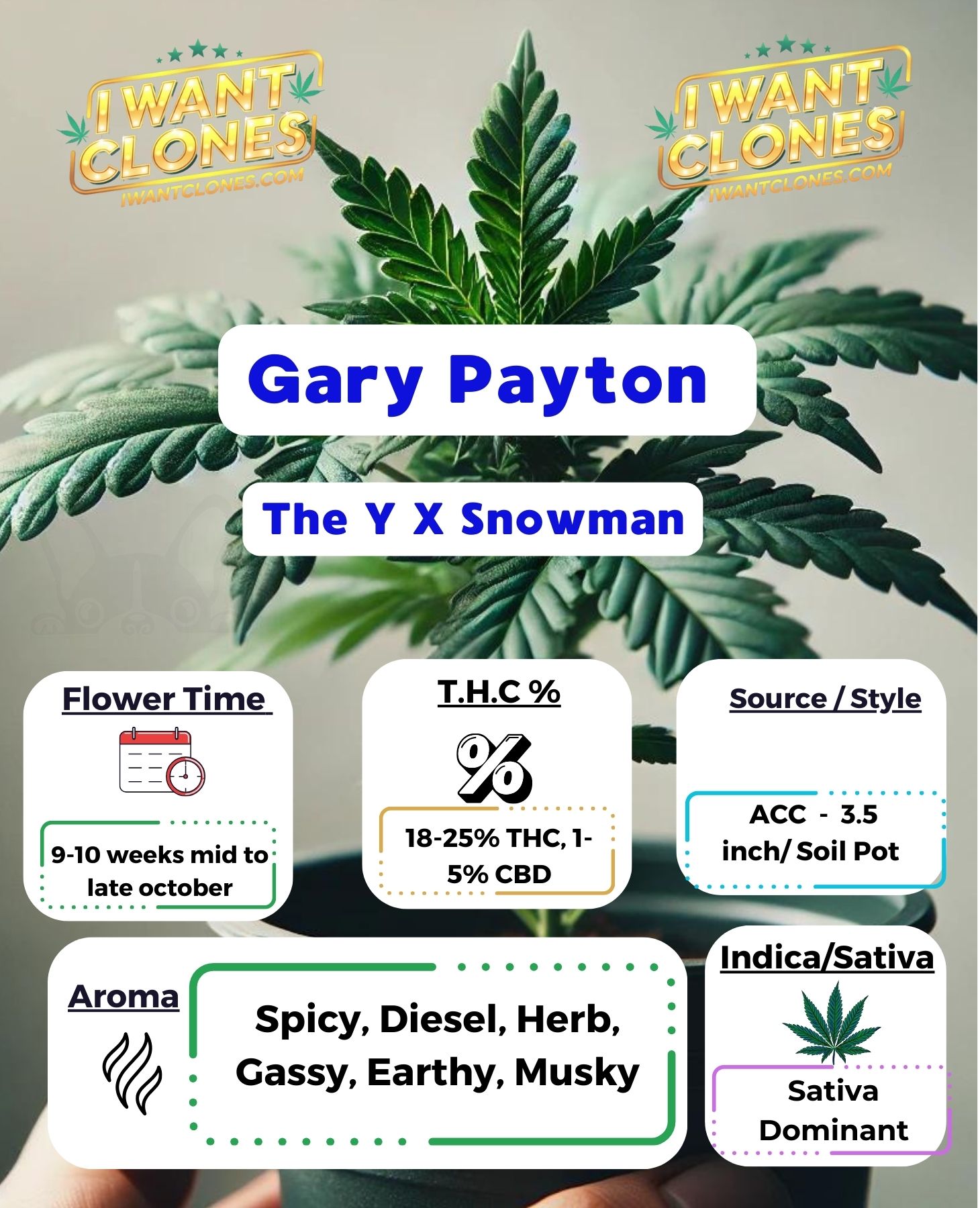
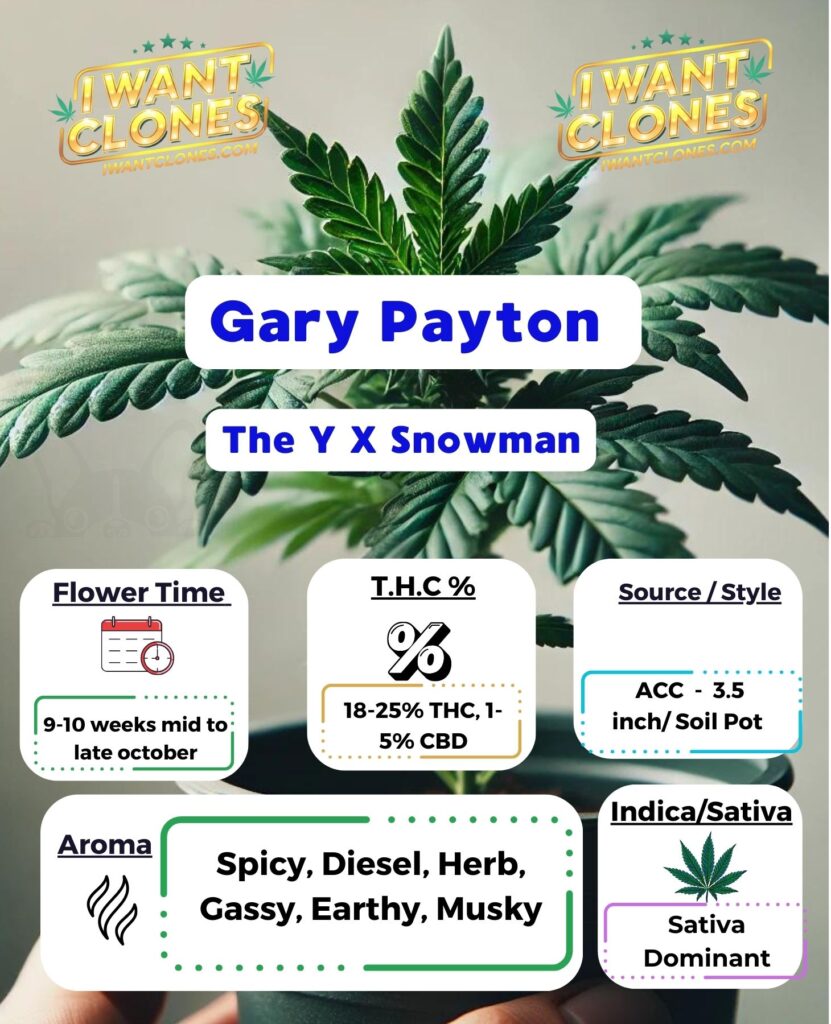
Gary Payton Strain and Clone Grow Guide: Genetics, Effects and How To Grow

The Gary Payton strain is a hybrid cannabis cultivar bred by Cookies (Berner) in collaboration with Powerzzzup Genetics. It crosses The Y and Snowman to deliver 20% to 25% THC, a fuel-forward terpene profile, and some of the densest, most resin-coated buds available today. Indoor growers can expect to harvest in 8 to 9 weeks with yields around 400 to 500g/m².

Key Takeaways

  • Gary Payton is a The Y × Snowman hybrid bred by Cookies and Powerzzzup Genetics, named after NBA Hall of Famer Gary Payton.
  • THC typically tests at 20% to 25%, with select phenotypes reaching more than 28%.
  • Dominant terpenes are caryophyllene, limonene, and myrcene, producing a fuel, pepper, and cookie-dough aroma.
  • Flowering time is 8 to 9 weeks indoors; outdoor plants can yield over 600g per plant.
  • Dense bud structure makes airflow management critical—powdery mildew is the top risk.
  • Buying a Gary Payton clone guarantees you the exact genetic expression—no male plants, no phenotype lottery.

Gary Payton Strain Genetics: The Y × Snowman

Gary Payton’s lineage reads like a boutique cannabis hall of fame. The Y is a Cookies-family cultivar prized for its trichome density and structural vigor, while Snowman is a GSC (Girl Scout Cookies) cut renowned for heavy resin and potent, well-rounded effects. When Berner and the team at Powerzzzup Genetics crossed these two elite parents, the result was a strain that could hold its own on the highest-end dispensary shelves in California and beyond.

The name itself is a collaboration—much like the strain. NBA Hall of Famer Gary Payton, known as “The Glove” for his defensive brilliance, lent his name to the cultivar through a partnership with Cookies. It’s one of the more visible celebrity cannabis collaborations in the industry, and unlike many, the strain actually lives up to its marketing. The genetics are legit, the expression is consistent, and the demand among boutique cultivators has stayed strong since its debut.

For context on the broader Cookies family of strains and how they’re defined, you can reference Wikipedia’s overview of cannabis strain development. At IWantClones.com, we’ve sourced our Gary Payton clones from verified genetics providers to make sure you’re getting the real expression—not a knock-off pheno.

Aroma, Flavor and Terpene Profile

Pop open a jar of cured Gary Payton and the first thing that hits you is fuel—a sharp, almost acrid diesel note that fills the room fast. That aroma comes primarily from caryophyllene, the spicy, peppery terpene also found in black pepper and cloves. Caryophyllene is unique among cannabis terpenes because it also acts as a CB2 receptor agonist, which may contribute to the strain’s relaxing body component.

Behind the fuel is a layer of earthiness and damp wood, then a subtle sweetness on the finish that reads almost like cookie dough. That sweet back-end comes courtesy of myrcene, the most common terpene in cannabis, which softens the sharper top notes and contributes to the strain’s body-heavy relaxation. Limonene rounds out the profile with a faint citrus brightness that lifts the overall aroma and contributes to Gary Payton’s reputation for mood elevation.

When smoked or vaped, the flavor closely mirrors the nose: diesel on the inhale, pepper mid-palate, and a surprisingly smooth, sweet exhale that lingers. It’s a complex terpene profile that experienced consumers immediately recognize as Cookies-lineage quality.

Gary Payton Strain Effects: What To Expect

Gary Payton is not a couch-lock strain, but it is not a lightweight either. The onset is fast—most users report feeling effects within minutes of the first hit. The initial wave is cerebral and euphoric: a mental clarity and mood lift that makes creative work, conversation, and physical activity feel engaging rather than overwhelming. This phase is where the limonene influence is most apparent.

As the high settles—typically 30 to 45 minutes in—the body relaxation arrives. It’s present but not incapacitating. Many users describe it as a “focused ease,” where physical tension releases without the mental fog associated with heavier indica-dominant strains. The overall experience tends to be long-lasting, often running 2 to 3 hours at moderate doses.

THC content is an important factor here. At the lower end of its range (around 20%), Gary Payton is manageable for intermediate cannabis consumers. At the top end (more than 28%), it’s a serious cultivar that deserves respect. Because potency varies between phenotypes and growing conditions, knowing your source matters. Clones from a verified cut give you a much tighter potency window than seeds from unknown pollen.

Important note: Cannabis affects individuals differently. This article describes commonly reported experiences among adult consumers. Nothing here constitutes medical advice. Use cannabis only where it is legal for adults to do so.

Gary Payton Strain Stats at a Glance

Attribute Details
Lineage The Y × Snowman (Cookies × Powerzzzup Genetics)
Classification Hybrid (slightly indica-leaning)
THC Range 20% to 25% typical; select phenos more than 28%
CBD < 1%
Dominant Terpenes Caryophyllene, Limonene, Myrcene
Aroma / Flavor Diesel, pepper, earth, sweet cookie dough
Flowering Time (Indoor) 8 to 9 weeks
Yield (Indoor) 400 to 500g/m²
Yield (Outdoor) 600g+ per plant
Plant Height Medium (3 to 5 ft indoors)
Grow Difficulty Intermediate
Best For Experienced home growers, boutique cultivators

Growing Gary Payton: What You Need To Know Before You Start

We rate Gary Payton as an intermediate-difficulty grow. It’s not punishing, but it does reward growers who pay attention. The dense bud structure that makes Gary Payton so appealing at harvest is the same reason it can punish sloppy environmental management. Nail the basics—airflow, VPD, defoliation—and this strain delivers. Neglect them and you’ll be battling powdery mildew in week six.

Before you do anything else, read through our cannabis clone growth stages guide to understand what your plant needs at each phase. If you’re new to growing from clones, our clone strain selection guide will also help you decide whether Gary Payton is the right starting point for your setup.

Plant Structure and What It Means for Your Grow

Gary Payton grows to a medium height—typically 3 to 5 feet indoors with a standard veg period. The branching structure is moderate, with a solid main stem and side branches that develop well if trained early. The plant tends to push node spacing that is tight enough for dense canopy development, but you need to stay on top of defoliation or the interior airflow drops off quickly.

Buds are dense, heavy, and coated in a thick layer of trichomes. Under cooler nighttime temperatures—especially in the last two weeks of flower—the flowers can develop vivid purple hues that make Gary Payton one of the more visually striking strains in any garden. That purple expression is not cosmetic; it reflects anthocyanin production triggered by temperature differentials of 10°F or more between day and night cycles.

Indoor Growing Tips

Indoor cultivation is where Gary Payton shines brightest. You have full control over temperature, humidity, and light spectrum—and this strain responds well to dialed-in environments. Here’s what we’ve found works best:

  • Lighting: Gary Payton thrives under high-intensity LED or HPS lighting. Target 600 to 800 µmol/m²/s during veg and 800 to 1,000 µmol/m²/s during flower. This strain has the trichome density to justify the extra wattage in late flower.
  • Temperature: Keep daytime canopy temps at 75 to 80°F during veg and early flower. Drop night temps to 65 to 68°F in weeks 6 to 9 to encourage trichome hardening and trigger that signature purple coloration.
  • Humidity: This is non-negotiable with Gary Payton. Run VPD (vapor pressure deficit) between 0.8 to 1.0 kPa during veg and tighten to 0.9 to 1.2 kPa in flower. Drop relative humidity below 45% by weeks 7 to 9 to protect those dense buds from mold and mildew.
  • Airflow: Run oscillating fans at canopy level and below. Air exchange in the room should turn the air volume over every 1 to 3 minutes. Gary Payton’s compact bud structure is its greatest liability if airflow is compromised.
  • Container size: 3- to 5-gallon fabric pots work well for an 8-week indoor run. Fabric pots promote air pruning at the root zone, which prevents root-bound stress and keeps uptake efficient through late flower.

Outdoor Growing Tips

Gary Payton is a capable outdoor producer in the right climate. The strain does best in temperate, dry conditions—think Northern California, the Pacific Northwest in a dry year, or indoor-outdoor hybrid setups. Humid coastal environments are risky given the strain’s mildew susceptibility.

Plant outdoors after the last frost, once nighttime temperatures stay consistently above 50°F. Gary Payton finishes naturally in early-to-mid October in most Northern Hemisphere climates. Outdoor plants have room to stretch and can push 600g or more per plant with proper training and a generous root zone (25- to 50-gallon smart pots or in-ground planting).

If you’re in a humid environment, prioritize airflow around the plant. Stake or support the main cola by mid-August—buds this dense will need structural support as they bulk up. Consider a late-season sulfur spray schedule to keep powdery mildew at bay if your region sees morning dew and warm afternoons.

Training Gary Payton for Maximum Yield

Gary Payton responds exceptionally well to training. Because it has moderate internode spacing and vigorous side branch development, most standard techniques apply cleanly. The goal is the same regardless of method: maximize canopy spread, increase bud sites, and keep airflow open through the flowering zone.

LST (Low-Stress Training)

Low-stress training (LST) involves bending and tying branches to keep the canopy flat and even. It’s the most beginner-friendly option and works well for Gary Payton’s moderate branching structure. Begin LST during weeks 2 to 3 of veg, once the plant has 4 to 6 nodes. Use soft plant ties or LST clips to bend the main stem and primary branches outward and down, creating a radial canopy. Check and adjust ties every 2 to 3 days as the plant grows—Gary Payton can put on growth quickly during peak veg.

Topping

Topping involves removing the apical meristem (the main growing tip) to split the plant into two main colas instead of one. For Gary Payton, we recommend topping once at the 5th or 6th node, then allowing 7 to 10 days of recovery before topping again if desired. Two rounds of topping creates a 4-cola structure that fills a standard 2×4 ft space efficiently. Combine topping with LST for a manifold-style canopy that supports heavy, dense bud development.

SCROG (Screen of Green)

A screen of green (SCROG) setup is our preferred method for maximizing Gary Payton yields indoors. Install a horizontal trellis net at 18 to 24 inches above the container tops. As the plant grows through veg, tuck branches under the net to fill the screen evenly before flipping to 12/12 lighting. By the time you flip, you want 80% to 90% of the screen filled with evenly distributed growth. The screen also provides structural support for heavy Gary Payton colas through the back half of flower.

Feeding Schedule and Nutrition for Gary Payton Clones

Gary Payton is a moderate-to-heavy feeder with a predictable nutrient curve. The strain shows a strong phosphorus and potassium demand during the mid-to-late flowering phase, which is when it’s bulking up those dense, resin-loaded buds. Nitrogen requirements taper off sharply after week 3 of flower.

For a detailed breakdown of feeding windows and product recommendations, see our cannabis clone feeding guide. Here’s the general framework we use at IWantClones.com for Gary Payton:

Veg Phase (Weeks 1 to 4 from clone)

After transplanting your Gary Payton clone, hold off on heavy feeding for the first 5 to 7 days while roots establish. Once you see new growth pushing (a clear sign roots have taken hold), introduce a balanced veg formula at half strength—typically around 200 to 400 ppm (EC 0.4 to 0.8) in a clean medium. Increase to 600 to 800 ppm (EC 1.2 to 1.6) by mid-veg. Keep nitrogen strong during this phase; Gary Payton builds its structure now, and leaf mass determines flowering potential.

Supplement with a silica product throughout veg. Gary Payton responds well to silica—it thickens cell walls, which both supports heavy bud weight and provides a passive layer of resistance against powdery mildew. Cal-Mag supplementation is important if you’re running RO water or coco coir.

Early Flower (Weeks 1 to 3 of 12/12)

Transition your nutrient formula as you flip to 12/12. Begin reducing nitrogen and increasing phosphorus and potassium. A 1-3-2 N-P-K ratio works well here. Run at 800 to 1,000 ppm. This transition window is also when you should complete any major defoliation—remove large fan leaves blocking bud sites and open up the lower canopy. Gary Payton flips into flower mode decisively; you’ll see pre-flowers and pistils within 7 to 10 days of the flip.

Peak Flower (Weeks 4 to 7)

This is the bulking phase for Gary Payton. Increase feeding to 1,000 to 1,200 ppm with a strong P-K emphasis (bloom booster formulas work well here). Add a carbohydrate/sugar supplement if you use one—Gary Payton’s terpene expression in the final 3 weeks is noticeably enhanced by carbohydrate feeding during mid-flower. Keep sulfur in your foliar program (stop foliar applications by week 5 of flower) and monitor calcium and magnesium closely. Heavy feeding at this stage can tip the plant toward Cal-Mag deficiency if you’re not supplementing.

Late Flower and Flush (Weeks 8 to 9)

Taper feeding down to 400 to 600 ppm in week 8. By day 55 to 58, begin a clean water flush if you’re growing in soil (coco and hydro growers can flush earlier and shorter). Gary Payton’s trichomes at this stage will shift from clear to cloudy, with amber trichomes appearing in the last week. Harvest when you see 10% to 20% amber for a balanced cerebral-and-body experience, or push slightly longer (20% to 30% amber) for a heavier, more sedative effect.

Common Problems When Growing Gary Payton

Powdery Mildew (PM)

This is the number-one risk with Gary Payton. Powdery mildew (PM) is a fungal pathogen that appears as a white, talcum-like powder on leaf surfaces. Gary Payton’s dense bud structure creates pockets where air stagnates, humidity pools, and mildew spores find purchase. The best defense is environmental: keep relative humidity below 50% during flower, run strong airflow, and space plants so that canopies don’t overlap.

If you spot early-stage PM, act immediately. A diluted potassium bicarbonate or hydrogen peroxide spray (applied during lights-off or in early veg) can halt progression. In flower, your options are more limited—avoid anything that could affect flavor or terpene profile. Preventive sprays are always better than reactive treatment with this strain. Our clone troubleshooting guide covers PM identification and response in detail.

Nutrient Burn

Gary Payton is a responsive feeder and can tip into nutrient burn if you’re aggressive with feeding during mid-flower. Watch for brown, crispy leaf tips—the classic sign of nitrogen or salt toxicity. Flush with clean water at the first sign and dial back your EC by 15% to 20%. The strain recovers quickly, but consistent overfeeding in weeks 4 to 6 can cost you terpene quality at harvest.

Support Failure

This sounds obvious, but Gary Payton colas get genuinely heavy. An unstoppable mid-flower growth spurt can snap branches if you haven’t staked properly. Install bamboo stakes or wire supports by week 4 of flower at the latest—don’t wait until you see branches bending. A broken cola in week 7 is a painful mistake that’s entirely preventable.

Why Buy Gary Payton as a Clone Instead of Seeds

If you’ve shopped for Gary Payton genetics before, you’ve probably come across seed options alongside clone offerings. Here’s our honest take after more than 15 years in cannabis genetics: for a boutique strain like Gary Payton, clones are the clear choice for any serious home or small commercial cultivator.

Genetic Consistency You Can Count On

Every seed, even from a stable cross, contains genetic variation. When you grow Gary Payton from seed, you’re running a phenotype lottery—some plants will express the fuel-and-pepper terpene profile you’re chasing, others may lean sweet, flat, or even skunky. A clone is a genetic copy of a known, verified mother plant. What you see in the description is what you get in your grow room, every single run.

At IWantClones.com, our Gary Payton clones are rooted cuts from verified genetics—not random seeds, not untested mothers. You’re buying the real expression of this cultivar at $98.88 per clone, shipped overnight to your door with our 3-day guarantee.

No Male Plants, No Wasted Space

Even feminized seeds aren’t 100% guaranteed. A hermaphroditic plant in your flowering room can pollinate your entire crop, turning that 500g/m² yield into a seed run you didn’t ask for. Clones are vegetative tissue from female plants—there’s no possibility of male expression, no pollen risk, no wasted grow space on plants you’ll have to cull.

Faster to Harvest

A rooted clone arrives already past the seedling stage. From a healthy, well-rooted clone, you can veg for 2 to 4 weeks and flip to flower, cutting your total time-to-harvest by 3 to 4 weeks compared to starting from seed. For a grower running multiple cycles per year, that difference compounds quickly—one extra harvest cycle annually is a significant return on investment.

If you’re evaluating other premium options alongside Gary Payton, our high-THC cannabis clone strains page is a good place to compare top-shelf genetics available as verified clones.

Who Is Gary Payton For?

Gary Payton is not the strain we recommend for first-time growers. The intermediate difficulty rating is real—this strain punishes poor environmental control more than a more forgiving cultivar like an OG or a hardy autoflower would. But if you’ve run a few cycles, understand your environment, and want to grow something genuinely exceptional, Gary Payton delivers in a way that few modern strains can match.

It’s a natural fit for boutique cultivators who prioritize quality and presentation over raw volume. The visual appeal (trichome density, purple hues, dense structure), the terpene complexity, and the potency range all position Gary Payton as a premium product whether you’re growing for personal use or producing for a licensed market. Experienced weekend growers who want a showpiece in their garden will find this strain deeply rewarding.

“We’ve placed Gary Payton in hundreds of home gardens across the US. The feedback is consistent: when the environment is dialed in, it’s one of the most satisfying strains to grow. The terpene expression at harvest is genuinely special.”
— James Bean, IWantClones.com

Harvesting, Drying, and Curing Gary Payton

Gary Payton finishes indoors at 8 to 9 weeks from flip, usually landing between days 56 to 63. Don’t rush the harvest window—this strain benefits from a full run. Early harvesting before trichomes ripen will cost you both potency and terpene complexity.

At harvest, examine trichomes under a jeweler’s loupe or digital microscope. Target a mix of cloudy and early-amber trichomes for peak cannabinoid and terpene expression. Harvest the entire plant at once—Gary Payton’s canopy tends to mature relatively evenly when trained well.

Dry at 60 to 65°F and 55% to 60% RH in a dark, ventilated space. Slow drying over 10 to 14 days is ideal for preserving Gary Payton’s complex terpene profile. Fast drying in a hot room destroys terpenes—the fuel-and-pepper complexity you grew this strain for will evaporate before it reaches the jar.

After drying, cure in glass mason jars for a minimum of 2 weeks (4 to 6 weeks for best results). Burp jars twice daily for the first week, once daily for the second, then every few days thereafter. Properly cured Gary Payton develops a depth of flavor that fresh-dried buds simply don’t have—the cookie-dough sweetness on the back end is a curing artifact as much as a genetic one.

Getting Your Gary Payton Clone: Shipping and Guarantee

At IWantClones.com, we ship Gary Payton clones overnight via FedEx Priority to legal adult-use and medical cannabis states across the US. Every clone is packaged to survive transit, arrives with a healthy root system, and is backed by our 3-day live arrival guarantee.

We charge $98.88 per Gary Payton clone—a flat, transparent price that reflects the genetics sourcing, mother plant maintenance, and careful cloning process that goes into each cut. We’re not the cheapest option on the internet, and we’re not trying to be. We’re the most reliable source for verified Gary Payton genetics that you can order from your phone and receive at your door.

Order your Gary Payton clone from IWantClones.com and put one of the best modern Cookies-family strains to work in your garden.

Frequently Asked Questions

What is the Gary Payton strain?

Gary Payton is a hybrid cannabis strain bred by Cookies (Berner) in collaboration with Powerzzzup Genetics. It crosses The Y and Snowman to produce a fuel-forward, high-THC cultivar with 20% to 25% THC, dominant caryophyllene, limonene, and myrcene terpenes, and dense, trichome-coated buds. It was named after NBA Hall of Famer Gary Payton.

How long does Gary Payton take to flower indoors?

Gary Payton flowers in 8 to 9 weeks indoors under a 12/12 light cycle. Most growers harvest between days 56 and 63 from flip. Waiting for the full run—rather than harvesting early — is important for peak potency and terpene development, especially the strain’s characteristic cookie-dough sweetness on the exhale.

Is Gary Payton hard to grow?

Gary Payton is rated intermediate difficulty. It’s not the most demanding strain, but its dense bud structure makes it susceptible to powdery mildew if airflow and humidity are not managed carefully. Growers who have completed at least one or two previous cycles and understand VPD and defoliation will have the best results with this cultivar.

What does Gary Payton smell like?

Gary Payton has a fuel-forward aroma driven by caryophyllene, with earthy and peppery mid-notes and a sweet cookie-dough finish from myrcene and limonene. When broken apart, buds release a sharp, almost acrid diesel burst followed by a lingering sweetness. The flavor on the exhale is smooth and dessert-like, contrasting the aggressive nose.

Why should I buy Gary Payton as a clone instead of seeds?

Clones guarantee the exact genetic expression of a known female plant—no phenotype variation, no male plant risk, and no wasted grow time on inferior expressions. Gary Payton clones from IWantClones.com are rooted cuts from verified mothers, priced at $98.88 with overnight shipping and a 3-day arrival guarantee. Seeds introduce genetic variability that can produce inconsistent terpene and potency results.

What yield can I expect from Gary Payton indoors?

Indoor yields for Gary Payton typically run 400 to 500g/m² under optimized conditions with training. Outdoor plants in favorable climates can exceed 600g per plant. Yield depends heavily on your light intensity, canopy management, and feeding program. SCROG training with a full 3- to 4-week veg period reliably pushes Gary Payton toward the top of its indoor yield range.

Share

Comments are closed.

Also recommended

Gary Payton Strain and Clone Grow Guide: Genetics, Effects and How To Grow

June 25, 2026

The Gary Payton strain is a hybrid cannabis cultivar bred by Cookies (Berner) in collaboration with Powerzzzup Genetics. It crosses The Y and Snowman to deliver 20% to 25% THC, a fuel-forward terpene profile, and some of the densest, most resin-coated buds available today. Indoor growers can expect to harvest in 8 to 9 weeks with yields around 400 to 500g/m².

Key Takeaways

  • Gary Payton is a The Y × Snowman hybrid bred by Cookies and Powerzzzup Genetics, named after NBA Hall of Famer Gary Payton.
  • THC typically tests at 20% to 25%, with select phenotypes reaching more than 28%.
  • Dominant terpenes are caryophyllene, limonene, and myrcene, producing a fuel, pepper, and cookie-dough aroma.
  • Flowering time is 8 to 9 weeks indoors; outdoor plants can yield over 600g per plant.
  • Dense bud structure makes airflow management critical—powdery mildew is the top risk.
  • Buying a Gary Payton clone guarantees you the exact genetic expression—no male plants, no phenotype lottery.

Gary Payton Strain Genetics: The Y × Snowman

Gary Payton’s lineage reads like a boutique cannabis hall of fame. The Y is a Cookies-family cultivar prized for its trichome density and structural vigor, while Snowman is a GSC (Girl Scout Cookies) cut renowned for heavy resin and potent, well-rounded effects. When Berner and the team at Powerzzzup Genetics crossed these two elite parents, the result was a strain that could hold its own on the highest-end dispensary shelves in California and beyond.

The name itself is a collaboration—much like the strain. NBA Hall of Famer Gary Payton, known as “The Glove” for his defensive brilliance, lent his name to the cultivar through a partnership with Cookies. It’s one of the more visible celebrity cannabis collaborations in the industry, and unlike many, the strain actually lives up to its marketing. The genetics are legit, the expression is consistent, and the demand among boutique cultivators has stayed strong since its debut.

For context on the broader Cookies family of strains and how they’re defined, you can reference Wikipedia’s overview of cannabis strain development. At IWantClones.com, we’ve sourced our Gary Payton clones from verified genetics providers to make sure you’re getting the real expression—not a knock-off pheno.

Aroma, Flavor and Terpene Profile

Pop open a jar of cured Gary Payton and the first thing that hits you is fuel—a sharp, almost acrid diesel note that fills the room fast. That aroma comes primarily from caryophyllene, the spicy, peppery terpene also found in black pepper and cloves. Caryophyllene is unique among cannabis terpenes because it also acts as a CB2 receptor agonist, which may contribute to the strain’s relaxing body component.

Behind the fuel is a layer of earthiness and damp wood, then a subtle sweetness on the finish that reads almost like cookie dough. That sweet back-end comes courtesy of myrcene, the most common terpene in cannabis, which softens the sharper top notes and contributes to the strain’s body-heavy relaxation. Limonene rounds out the profile with a faint citrus brightness that lifts the overall aroma and contributes to Gary Payton’s reputation for mood elevation.

When smoked or vaped, the flavor closely mirrors the nose: diesel on the inhale, pepper mid-palate, and a surprisingly smooth, sweet exhale that lingers. It’s a complex terpene profile that experienced consumers immediately recognize as Cookies-lineage quality.

Gary Payton Strain Effects: What To Expect

Gary Payton is not a couch-lock strain, but it is not a lightweight either. The onset is fast—most users report feeling effects within minutes of the first hit. The initial wave is cerebral and euphoric: a mental clarity and mood lift that makes creative work, conversation, and physical activity feel engaging rather than overwhelming. This phase is where the limonene influence is most apparent.

As the high settles—typically 30 to 45 minutes in—the body relaxation arrives. It’s present but not incapacitating. Many users describe it as a “focused ease,” where physical tension releases without the mental fog associated with heavier indica-dominant strains. The overall experience tends to be long-lasting, often running 2 to 3 hours at moderate doses.

THC content is an important factor here. At the lower end of its range (around 20%), Gary Payton is manageable for intermediate cannabis consumers. At the top end (more than 28%), it’s a serious cultivar that deserves respect. Because potency varies between phenotypes and growing conditions, knowing your source matters. Clones from a verified cut give you a much tighter potency window than seeds from unknown pollen.

Important note: Cannabis affects individuals differently. This article describes commonly reported experiences among adult consumers. Nothing here constitutes medical advice. Use cannabis only where it is legal for adults to do so.

Gary Payton Strain Stats at a Glance

Attribute Details
Lineage The Y × Snowman (Cookies × Powerzzzup Genetics)
Classification Hybrid (slightly indica-leaning)
THC Range 20% to 25% typical; select phenos more than 28%
CBD < 1%
Dominant Terpenes Caryophyllene, Limonene, Myrcene
Aroma / Flavor Diesel, pepper, earth, sweet cookie dough
Flowering Time (Indoor) 8 to 9 weeks
Yield (Indoor) 400 to 500g/m²
Yield (Outdoor) 600g+ per plant
Plant Height Medium (3 to 5 ft indoors)
Grow Difficulty Intermediate
Best For Experienced home growers, boutique cultivators

Growing Gary Payton: What You Need To Know Before You Start

We rate Gary Payton as an intermediate-difficulty grow. It’s not punishing, but it does reward growers who pay attention. The dense bud structure that makes Gary Payton so appealing at harvest is the same reason it can punish sloppy environmental management. Nail the basics—airflow, VPD, defoliation—and this strain delivers. Neglect them and you’ll be battling powdery mildew in week six.

Before you do anything else, read through our cannabis clone growth stages guide to understand what your plant needs at each phase. If you’re new to growing from clones, our clone strain selection guide will also help you decide whether Gary Payton is the right starting point for your setup.

Plant Structure and What It Means for Your Grow

Gary Payton grows to a medium height—typically 3 to 5 feet indoors with a standard veg period. The branching structure is moderate, with a solid main stem and side branches that develop well if trained early. The plant tends to push node spacing that is tight enough for dense canopy development, but you need to stay on top of defoliation or the interior airflow drops off quickly.

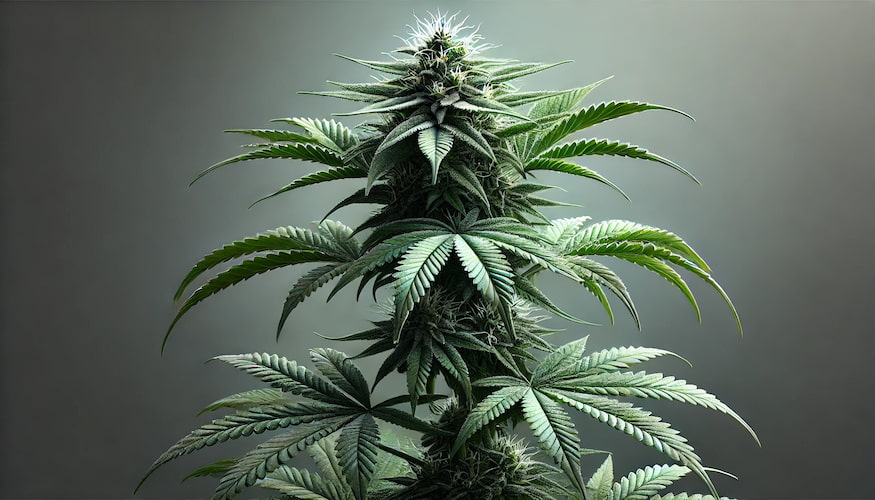
Buds are dense, heavy, and coated in a thick layer of trichomes. Under cooler nighttime temperatures—especially in the last two weeks of flower—the flowers can develop vivid purple hues that make Gary Payton one of the more visually striking strains in any garden. That purple expression is not cosmetic; it reflects anthocyanin production triggered by temperature differentials of 10°F or more between day and night cycles.

Indoor Growing Tips

Indoor cultivation is where Gary Payton shines brightest. You have full control over temperature, humidity, and light spectrum—and this strain responds well to dialed-in environments. Here’s what we’ve found works best:

  • Lighting: Gary Payton thrives under high-intensity LED or HPS lighting. Target 600 to 800 µmol/m²/s during veg and 800 to 1,000 µmol/m²/s during flower. This strain has the trichome density to justify the extra wattage in late flower.
  • Temperature: Keep daytime canopy temps at 75 to 80°F during veg and early flower. Drop night temps to 65 to 68°F in weeks 6 to 9 to encourage trichome hardening and trigger that signature purple coloration.
  • Humidity: This is non-negotiable with Gary Payton. Run VPD (vapor pressure deficit) between 0.8 to 1.0 kPa during veg and tighten to 0.9 to 1.2 kPa in flower. Drop relative humidity below 45% by weeks 7 to 9 to protect those dense buds from mold and mildew.
  • Airflow: Run oscillating fans at canopy level and below. Air exchange in the room should turn the air volume over every 1 to 3 minutes. Gary Payton’s compact bud structure is its greatest liability if airflow is compromised.
  • Container size: 3- to 5-gallon fabric pots work well for an 8-week indoor run. Fabric pots promote air pruning at the root zone, which prevents root-bound stress and keeps uptake efficient through late flower.

Outdoor Growing Tips

Gary Payton is a capable outdoor producer in the right climate. The strain does best in temperate, dry conditions—think Northern California, the Pacific Northwest in a dry year, or indoor-outdoor hybrid setups. Humid coastal environments are risky given the strain’s mildew susceptibility.

Plant outdoors after the last frost, once nighttime temperatures stay consistently above 50°F. Gary Payton finishes naturally in early-to-mid October in most Northern Hemisphere climates. Outdoor plants have room to stretch and can push 600g or more per plant with proper training and a generous root zone (25- to 50-gallon smart pots or in-ground planting).

If you’re in a humid environment, prioritize airflow around the plant. Stake or support the main cola by mid-August—buds this dense will need structural support as they bulk up. Consider a late-season sulfur spray schedule to keep powdery mildew at bay if your region sees morning dew and warm afternoons.

Training Gary Payton for Maximum Yield

Gary Payton responds exceptionally well to training. Because it has moderate internode spacing and vigorous side branch development, most standard techniques apply cleanly. The goal is the same regardless of method: maximize canopy spread, increase bud sites, and keep airflow open through the flowering zone.

LST (Low-Stress Training)

Low-stress training (LST) involves bending and tying branches to keep the canopy flat and even. It’s the most beginner-friendly option and works well for Gary Payton’s moderate branching structure. Begin LST during weeks 2 to 3 of veg, once the plant has 4 to 6 nodes. Use soft plant ties or LST clips to bend the main stem and primary branches outward and down, creating a radial canopy. Check and adjust ties every 2 to 3 days as the plant grows—Gary Payton can put on growth quickly during peak veg.

Topping

Topping involves removing the apical meristem (the main growing tip) to split the plant into two main colas instead of one. For Gary Payton, we recommend topping once at the 5th or 6th node, then allowing 7 to 10 days of recovery before topping again if desired. Two rounds of topping creates a 4-cola structure that fills a standard 2×4 ft space efficiently. Combine topping with LST for a manifold-style canopy that supports heavy, dense bud development.

SCROG (Screen of Green)

A screen of green (SCROG) setup is our preferred method for maximizing Gary Payton yields indoors. Install a horizontal trellis net at 18 to 24 inches above the container tops. As the plant grows through veg, tuck branches under the net to fill the screen evenly before flipping to 12/12 lighting. By the time you flip, you want 80% to 90% of the screen filled with evenly distributed growth. The screen also provides structural support for heavy Gary Payton colas through the back half of flower.

Feeding Schedule and Nutrition for Gary Payton Clones

Gary Payton is a moderate-to-heavy feeder with a predictable nutrient curve. The strain shows a strong phosphorus and potassium demand during the mid-to-late flowering phase, which is when it’s bulking up those dense, resin-loaded buds. Nitrogen requirements taper off sharply after week 3 of flower.

For a detailed breakdown of feeding windows and product recommendations, see our cannabis clone feeding guide. Here’s the general framework we use at IWantClones.com for Gary Payton:

Veg Phase (Weeks 1 to 4 from clone)

After transplanting your Gary Payton clone, hold off on heavy feeding for the first 5 to 7 days while roots establish. Once you see new growth pushing (a clear sign roots have taken hold), introduce a balanced veg formula at half strength—typically around 200 to 400 ppm (EC 0.4 to 0.8) in a clean medium. Increase to 600 to 800 ppm (EC 1.2 to 1.6) by mid-veg. Keep nitrogen strong during this phase; Gary Payton builds its structure now, and leaf mass determines flowering potential.

Supplement with a silica product throughout veg. Gary Payton responds well to silica—it thickens cell walls, which both supports heavy bud weight and provides a passive layer of resistance against powdery mildew. Cal-Mag supplementation is important if you’re running RO water or coco coir.

Early Flower (Weeks 1 to 3 of 12/12)

Transition your nutrient formula as you flip to 12/12. Begin reducing nitrogen and increasing phosphorus and potassium. A 1-3-2 N-P-K ratio works well here. Run at 800 to 1,000 ppm. This transition window is also when you should complete any major defoliation—remove large fan leaves blocking bud sites and open up the lower canopy. Gary Payton flips into flower mode decisively; you’ll see pre-flowers and pistils within 7 to 10 days of the flip.

Peak Flower (Weeks 4 to 7)

This is the bulking phase for Gary Payton. Increase feeding to 1,000 to 1,200 ppm with a strong P-K emphasis (bloom booster formulas work well here). Add a carbohydrate/sugar supplement if you use one—Gary Payton’s terpene expression in the final 3 weeks is noticeably enhanced by carbohydrate feeding during mid-flower. Keep sulfur in your foliar program (stop foliar applications by week 5 of flower) and monitor calcium and magnesium closely. Heavy feeding at this stage can tip the plant toward Cal-Mag deficiency if you’re not supplementing.

Late Flower and Flush (Weeks 8 to 9)

Taper feeding down to 400 to 600 ppm in week 8. By day 55 to 58, begin a clean water flush if you’re growing in soil (coco and hydro growers can flush earlier and shorter). Gary Payton’s trichomes at this stage will shift from clear to cloudy, with amber trichomes appearing in the last week. Harvest when you see 10% to 20% amber for a balanced cerebral-and-body experience, or push slightly longer (20% to 30% amber) for a heavier, more sedative effect.

Common Problems When Growing Gary Payton

Powdery Mildew (PM)

This is the number-one risk with Gary Payton. Powdery mildew (PM) is a fungal pathogen that appears as a white, talcum-like powder on leaf surfaces. Gary Payton’s dense bud structure creates pockets where air stagnates, humidity pools, and mildew spores find purchase. The best defense is environmental: keep relative humidity below 50% during flower, run strong airflow, and space plants so that canopies don’t overlap.

If you spot early-stage PM, act immediately. A diluted potassium bicarbonate or hydrogen peroxide spray (applied during lights-off or in early veg) can halt progression. In flower, your options are more limited—avoid anything that could affect flavor or terpene profile. Preventive sprays are always better than reactive treatment with this strain. Our clone troubleshooting guide covers PM identification and response in detail.

Nutrient Burn

Gary Payton is a responsive feeder and can tip into nutrient burn if you’re aggressive with feeding during mid-flower. Watch for brown, crispy leaf tips—the classic sign of nitrogen or salt toxicity. Flush with clean water at the first sign and dial back your EC by 15% to 20%. The strain recovers quickly, but consistent overfeeding in weeks 4 to 6 can cost you terpene quality at harvest.

Support Failure

This sounds obvious, but Gary Payton colas get genuinely heavy. An unstoppable mid-flower growth spurt can snap branches if you haven’t staked properly. Install bamboo stakes or wire supports by week 4 of flower at the latest—don’t wait until you see branches bending. A broken cola in week 7 is a painful mistake that’s entirely preventable.

Why Buy Gary Payton as a Clone Instead of Seeds

If you’ve shopped for Gary Payton genetics before, you’ve probably come across seed options alongside clone offerings. Here’s our honest take after more than 15 years in cannabis genetics: for a boutique strain like Gary Payton, clones are the clear choice for any serious home or small commercial cultivator.

Genetic Consistency You Can Count On

Every seed, even from a stable cross, contains genetic variation. When you grow Gary Payton from seed, you’re running a phenotype lottery—some plants will express the fuel-and-pepper terpene profile you’re chasing, others may lean sweet, flat, or even skunky. A clone is a genetic copy of a known, verified mother plant. What you see in the description is what you get in your grow room, every single run.

At IWantClones.com, our Gary Payton clones are rooted cuts from verified genetics—not random seeds, not untested mothers. You’re buying the real expression of this cultivar at $98.88 per clone, shipped overnight to your door with our 3-day guarantee.

No Male Plants, No Wasted Space

Even feminized seeds aren’t 100% guaranteed. A hermaphroditic plant in your flowering room can pollinate your entire crop, turning that 500g/m² yield into a seed run you didn’t ask for. Clones are vegetative tissue from female plants—there’s no possibility of male expression, no pollen risk, no wasted grow space on plants you’ll have to cull.

Faster to Harvest

A rooted clone arrives already past the seedling stage. From a healthy, well-rooted clone, you can veg for 2 to 4 weeks and flip to flower, cutting your total time-to-harvest by 3 to 4 weeks compared to starting from seed. For a grower running multiple cycles per year, that difference compounds quickly—one extra harvest cycle annually is a significant return on investment.

If you’re evaluating other premium options alongside Gary Payton, our high-THC cannabis clone strains page is a good place to compare top-shelf genetics available as verified clones.

Who Is Gary Payton For?

Gary Payton is not the strain we recommend for first-time growers. The intermediate difficulty rating is real—this strain punishes poor environmental control more than a more forgiving cultivar like an OG or a hardy autoflower would. But if you’ve run a few cycles, understand your environment, and want to grow something genuinely exceptional, Gary Payton delivers in a way that few modern strains can match.

It’s a natural fit for boutique cultivators who prioritize quality and presentation over raw volume. The visual appeal (trichome density, purple hues, dense structure), the terpene complexity, and the potency range all position Gary Payton as a premium product whether you’re growing for personal use or producing for a licensed market. Experienced weekend growers who want a showpiece in their garden will find this strain deeply rewarding.

“We’ve placed Gary Payton in hundreds of home gardens across the US. The feedback is consistent: when the environment is dialed in, it’s one of the most satisfying strains to grow. The terpene expression at harvest is genuinely special.”
— James Bean, IWantClones.com

Harvesting, Drying, and Curing Gary Payton

Gary Payton finishes indoors at 8 to 9 weeks from flip, usually landing between days 56 to 63. Don’t rush the harvest window—this strain benefits from a full run. Early harvesting before trichomes ripen will cost you both potency and terpene complexity.

At harvest, examine trichomes under a jeweler’s loupe or digital microscope. Target a mix of cloudy and early-amber trichomes for peak cannabinoid and terpene expression. Harvest the entire plant at once—Gary Payton’s canopy tends to mature relatively evenly when trained well.

Dry at 60 to 65°F and 55% to 60% RH in a dark, ventilated space. Slow drying over 10 to 14 days is ideal for preserving Gary Payton’s complex terpene profile. Fast drying in a hot room destroys terpenes—the fuel-and-pepper complexity you grew this strain for will evaporate before it reaches the jar.

After drying, cure in glass mason jars for a minimum of 2 weeks (4 to 6 weeks for best results). Burp jars twice daily for the first week, once daily for the second, then every few days thereafter. Properly cured Gary Payton develops a depth of flavor that fresh-dried buds simply don’t have—the cookie-dough sweetness on the back end is a curing artifact as much as a genetic one.

Getting Your Gary Payton Clone: Shipping and Guarantee

At IWantClones.com, we ship Gary Payton clones overnight via FedEx Priority to legal adult-use and medical cannabis states across the US. Every clone is packaged to survive transit, arrives with a healthy root system, and is backed by our 3-day live arrival guarantee.

We charge $98.88 per Gary Payton clone—a flat, transparent price that reflects the genetics sourcing, mother plant maintenance, and careful cloning process that goes into each cut. We’re not the cheapest option on the internet, and we’re not trying to be. We’re the most reliable source for verified Gary Payton genetics that you can order from your phone and receive at your door.

Order your Gary Payton clone from IWantClones.com and put one of the best modern Cookies-family strains to work in your garden.

Frequently Asked Questions

What is the Gary Payton strain?

Gary Payton is a hybrid cannabis strain bred by Cookies (Berner) in collaboration with Powerzzzup Genetics. It crosses The Y and Snowman to produce a fuel-forward, high-THC cultivar with 20% to 25% THC, dominant caryophyllene, limonene, and myrcene terpenes, and dense, trichome-coated buds. It was named after NBA Hall of Famer Gary Payton.

How long does Gary Payton take to flower indoors?

Gary Payton flowers in 8 to 9 weeks indoors under a 12/12 light cycle. Most growers harvest between days 56 and 63 from flip. Waiting for the full run—rather than harvesting early — is important for peak potency and terpene development, especially the strain’s characteristic cookie-dough sweetness on the exhale.

Is Gary Payton hard to grow?

Gary Payton is rated intermediate difficulty. It’s not the most demanding strain, but its dense bud structure makes it susceptible to powdery mildew if airflow and humidity are not managed carefully. Growers who have completed at least one or two previous cycles and understand VPD and defoliation will have the best results with this cultivar.

What does Gary Payton smell like?

Gary Payton has a fuel-forward aroma driven by caryophyllene, with earthy and peppery mid-notes and a sweet cookie-dough finish from myrcene and limonene. When broken apart, buds release a sharp, almost acrid diesel burst followed by a lingering sweetness. The flavor on the exhale is smooth and dessert-like, contrasting the aggressive nose.

Why should I buy Gary Payton as a clone instead of seeds?

Clones guarantee the exact genetic expression of a known female plant—no phenotype variation, no male plant risk, and no wasted grow time on inferior expressions. Gary Payton clones from IWantClones.com are rooted cuts from verified mothers, priced at $98.88 with overnight shipping and a 3-day arrival guarantee. Seeds introduce genetic variability that can produce inconsistent terpene and potency results.

What yield can I expect from Gary Payton indoors?

Indoor yields for Gary Payton typically run 400 to 500g/m² under optimized conditions with training. Outdoor plants in favorable climates can exceed 600g per plant. Yield depends heavily on your light intensity, canopy management, and feeding program. SCROG training with a full 3- to 4-week veg period reliably pushes Gary Payton toward the top of its indoor yield range.

Written by James Bean

Recent Posts

Cannabis Clones vs Seeds: Which Is Better for Your Grow?

Clones or seeds? Compare time, cost, genetics, and risk side by side. Learn when each makes sense and why clones win for most home growers. Shop at IWantClones.com.

Read More
Gary Payton Strain and Clone Grow Guide: Genetics, Effects and How To Grow

Gary Payton strain delivers 20-25% THC, fuel-forward flavor, and dense resin-coated buds. Get our full clone grow guide + buy verified Gary Payton clones.

Read More
Cannabis Rescheduling, the Hemp Loophole, and What Schedule 3 Really Means

Cannabis attorney Thomas Howard breaks down Schedule 3 rescheduling, the THCA hemp loophole, Farm Bill changes, and how federal cannabis reform will impact growers, dispensaries, and consumers.

Read More

Subscribe Today!

Get 10% off when you sign up for our weekly updates!

About Us

At IWantClones.com, we are dedicated to providing top-quality cannabis clones to growers of all levels.

Subscribe Today!

Subscribe our newsletter to get our latest update & news
We currently accept credit/debit card payments, cash, check, money order, bitcoin (BTC), litecoin (LTE), bitcoin cash (BCH), and dogecoin (DOGE).
© 2026 seedsherenow.com All Rights Reserved
magnifiercross linkedin facebook pinterest youtube rss twitter instagram facebook-blank rss-blank linkedin-blank pinterest youtube twitter instagram