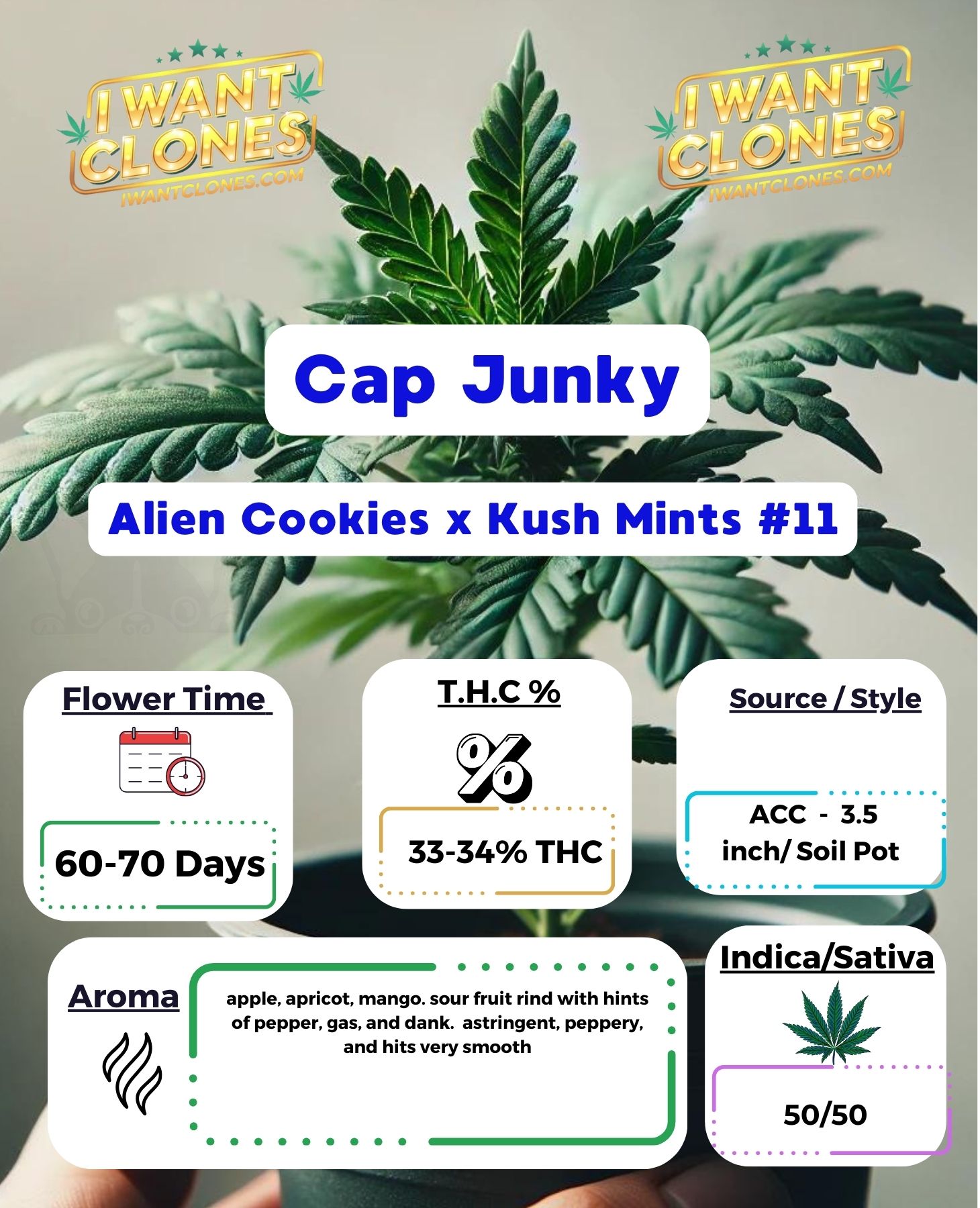
Cap Junky is a high-octane hybrid bred from Alien Cookies and Kush Mints, delivering 28% to 35% THC with a fuel-forward terpene profile and a full-body effect that earns its reputation as one of the most potent strains available. It was built through a collaboration between breeder Capulator (CAP) and Seed Junky Genetics’ JBeezy—two names that carry serious weight in the premium cannabis world. At IWantClones.com, we carry verified Cap Junky clones so you get the exact phenotype, not a seedling lottery.
Key Takeaways
- Cap Junky strain is a cross of Alien Cookies x Kush Mints, bred by Capulator and JBeezy of Seed Junky Genetics.
- THC content typically runs 28% to 35%, placing it firmly among elite high-THC strains.
- Flowering time is 8 to 9 weeks (56 to 63 days) with a moderate-to-high indoor yield of 400 to 550g/m².
- Cap Junky feeds heavy but is sensitive to overfeeding—EC monitoring is non-negotiable.
- Dense bud structure demands humidity below 45% RH in late flower to prevent bud rot.
- Only a verified Cap Junky clone guarantees true-to-type genetics; seed-grown plants vary widely.
Lineage and Breeding Background
To understand the cap junky strain, you have to trace both sides of its family tree. The mother line, Alien Cookies, was built by crossing Girl Scout Cookies with Alien Dawg. GSC brought the sweet, earthy cookie baseline that the cannabis world already loved. Alien Dawg—a Chemdawg derivative with heavy fuel notes—sharpened the whole profile and pushed potency into a higher register. The result was a strain that hit with both flavor complexity and serious THC weight.
The father side comes from Kush Mints, a cross of Animal Mints and Bubba Kush. Animal Mints layers in a cool, herbal mint character alongside a gassy punch. Bubba Kush grounds everything with sedative indica body depth. Together, these two parent strains gave Kush Mints a profile that felt distinct from the cookie wave—colder, heavier, more narcotic in the back end.
When Capulator (the breeder behind the legendary MAC strain) brought these two together with JBeezy, the goal was a strain that would stand apart from the sea of GSC crosses. Capulator is known for working with Alien Cookies genetics in particular, and JBeezy’s Seed Junky library brought the Kush Mints side. The collaboration produced the cap junky strain: a plant that carries forward the best traits from both lineages without feeling like a remix of something you’ve already seen.
You can review additional lineage context through resources like Leafly’s Cap Junky profile. For our purposes as growers, what matters most is understanding that this strain carries dominant traits from multiple elite lines—which means it demands respect in the grow room.
Terpene Profile and Aroma
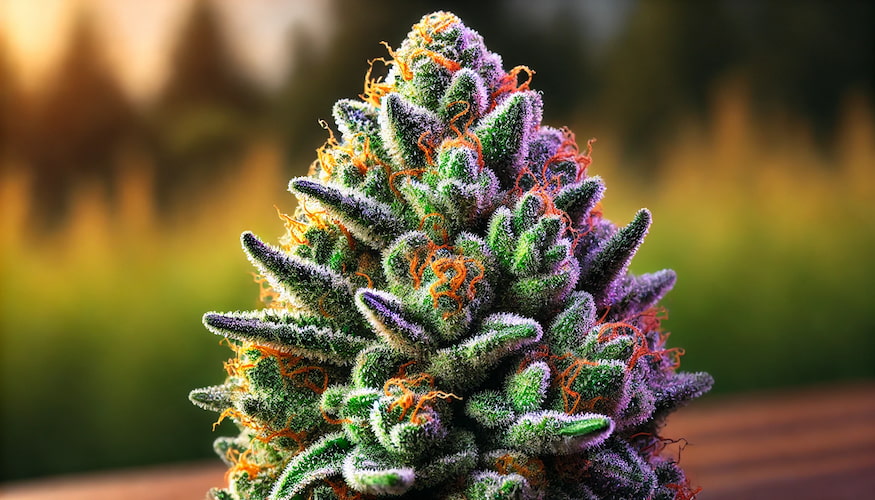
Cap Junky’s terpene profile is one of the things that separates it from similar high-THC hybrids. The nose opens with a sharp gassy fuel note—unmistakably from the Alien Dawg and Kush Mints side—but it doesn’t stop there. Behind the gas, you get a sweet cookie dough base that softens the sharpness. The finish is a clean mint exhale that makes the whole experience feel more refined than a standard diesel strain.
The three dominant terpenes driving this profile are:
- Caryophyllene—contributes the spicy, peppery bite and is also studied for potential stress-relief properties (note: this is not a medical claim).
- Limonene—adds a light citrus brightness that lifts the cookie notes and contributes to the uplifting cerebral onset.
- Myrcene—the most common cannabis terpene, myrcene here adds a herbal musk that ties together the gas and sweetness and deepens the body effect.
This trio creates a layered, complex smell that fills a room during late flower. Plan for serious odor control—a quality carbon filter is essential when running the cap junky strain, especially in the last two weeks before harvest.
Effects and Consumer Experience
This is not a strain for casual consumers or anyone new to high-potency cannabis. Cap Junky THC levels of 28% to 35% mean the onset is fast and unmistakable. The first wave is cerebral—a sharp euphoric buzz that many consumers describe as expansive and lucid at first. You feel switched on. Colors may feel more vivid. Conversation flows.
Within 20 to 30 minutes, the body effect starts to arrive. The Bubba Kush lineage makes itself known here: a warm, progressive heaviness settles into the limbs and lower back. By the time you’re an hour in, most experienced consumers find themselves deeply relaxed and disinclined to do anything that requires physical effort. The high lasts longer than most strains at this THC range—expect 2 to 3 hours of notable effect.
Because of that potency ceiling, Cap Junky is best suited for evening or end-of-day use. It pairs well with rest, creative wind-down, or social settings where you’re not expected to be sharp. For legal adult use where cannabis is permitted, the cap junky strain is frequently sought out by high-tolerance consumers who feel that lighter strains no longer deliver.
Strain Specs at a Glance
| Spec | Detail |
|---|---|
| Genetics | Alien Cookies x Kush Mints |
| Breeders | Capulator (CAP) x Seed Junky Genetics (JBeezy) |
| Type | Hybrid (indica-leaning) |
| THC Range | 28% to 35% |
| CBD | <1% |
| Dominant Terpenes | Caryophyllene, Limonene, Myrcene |
| Flowering Type | Photoperiod |
| Flowering Time | 8 to 9 weeks (56 to 63 days) |
| Indoor Yield | 400 to 550g/m² |
| Plant Height (flower) | Medium-tall; 50% to 75% stretch from flip |
| Grow Difficulty | Intermediate to Advanced |
| Ideal pH (soil) | 6.0 to 6.5 |
| Ideal pH (hydro) | 5.8 to 6.0 |
| VPD—Veg | 0.8 to 1.0 kPa |
| VPD—Flower | 1.0 to 1.5 kPa |
| Late Flower RH Target | Below 45% |
Why a Verified Clone Is the Only Way To Grow Cap Junky Right
The cap junky strain has a reputation problem—not with quality, but with fakes. Any strain this hyped attracts sellers who move questionable seeds under the same name. Seed-grown Cap Junky plants also introduce phenotype variation: some phenos lean more toward the Kush Mints structure, others express more Alien Cookies character. You might crack ten seeds and get ten plants that technically share the same lineage but perform differently in every way that matters—yield, potency, structure, terpene expression.
A verified clone eliminates that uncertainty. When you start with a Cap Junky clone from a trusted source, you’re working with a genetically identical cutting from a verified mother. The plant you harvest will be the same plant the mother was. You know the growth pattern before you ever flip to flower. You can dial in your feeding schedule around proven data, not guesswork.
At IWantClones.com, we test every mother plant and keep our verified library of rare cannabis clone strains to a standard that rules out misrepresented genetics. For a strain as phenotype-specific as Cap Junky, that matters more than it does for simpler, more stable genetics.
Vegetative Stage: Building the Right Structure
Cap Junky starts veg with tight internode spacing, which can mislead newer growers into thinking they’re working with a compact, manageable plant. Do not let that fool you. Once you flip to 12/12, this strain stretches 50% to 75% above its flip height. A plant vegged to 18 inches can easily reach 30 to 31 inches by mid-flower. Plan your canopy height with that stretch accounted for.
During veg, the goal is building a strong lateral framework that will support heavy flower development. Cap Junky responds exceptionally well to training. Our recommended approach:
- Top early—top at the 4th or 5th node to create two main colas, then top those two again after they extend. This gives you 4 to 8 even colas to work with.
- LST (low-stress training)—tie down branches after each topping to encourage horizontal spread. Cap Junky’s stems are sturdy enough to handle LST without snapping during early growth.
- ScrOG—a screen of green setup works extremely well for this strain. With a ScrOG net set at canopy height, you can fill the net evenly over 3 to 4 weeks of veg and flip once 70% to 80% of the screen is covered.
- FIM (f*** I missed)—if you want to retain more of the apical tip while still promoting lateral branching, FIMing works. It produces slightly less even results than topping but is a valid option.
Aim for 4 to 6 weeks of veg from the time your clone roots and is transplanted, depending on container size and your target canopy dimensions. Do not rush to flip. Cap Junky plants that are underdeveloped at flip time will stretch hard and produce smaller, looser buds at the top of the canopy.
Feeding Strategy: Heavy Appetite, Low Forgiveness
The cap junky strain is a heavy feeder—one of the heavier feeders in the premium strain market—but it is also sensitive to overfeeding in ways that can cost you weeks of recovery time. These two facts live in tension, and managing that tension is the core skill required to grow Cap Junky well.
Here is what we’ve learned from growing this strain and talking to cultivators who run it at scale:
Vegetative Feeding
In veg, Cap Junky wants a balanced nitrogen-forward feed. Start at a moderate EC (around 1.2 to 1.6 mS/cm in hydro, or following the lower range on your soil nutrient schedule) and observe how the plant responds. Look for dark green foliage without glossy, waxy leaf tips—that sheen is an early overfeeding signal. Ramp EC slowly, never jumping more than 0.2 to 0.3 points per feeding week.
Cal-mag is critical with this strain regardless of media type. If you’re in coco or hydro, supplement at 2 to 5 mL/gal depending on your base water hardness. In soil, a lighter 1 to 2 mL/gal addition through veg keeps deficiencies from surfacing. For a full breakdown of nutrient timing by stage, our cannabis clone feeding guide has the detail you need.
Transition and Early Flower
At the flip and through the first two weeks of flower, reduce nitrogen and begin ramping phosphorus and potassium. Cap Junky’s stretch phase coincides with this transition, and the plant is prioritizing structural growth over bud development at this point. Keep EC around 1.6 to 2.0 mS/cm in hydro. Watch for any early signs of phosphorus deficiency (purple-tinged lower fan leaves)—address it fast because it compounds quickly in a stretching plant.
Mid and Late Flower
From weeks 3 to 7 of flower, Cap Junky wants its highest EC levels—typically 2.0 to 2.4 mS/cm in hydro. This is where the dense, resin-laden buds develop, and the plant’s demand for phosphorus, potassium, and micronutrients peaks. Continue cal-mag throughout—Cap Junky is notably prone to calcium deficiency in the second half of flower if it’s under-supplemented.
In the final 10 to 14 days before harvest, flush or taper your feeding to clear residual salts. Soil growers can begin reducing feed at week 7. Coco and hydro growers typically do a hard flush transition at week 8. This is one of the areas where choosing the right clone strain selection pays off—with known genetics, you can time your flush to a verified flower window rather than guessing when the plant is actually ready.
pH Management
Cap Junky is less forgiving of pH swings than many strains. A pH drift outside the optimal window for more than a feeding cycle or two will lock out micronutrients and produce a deficiency cascade that looks like overfeeding but is actually the opposite. Hold pH at 6.0 to 6.5 in soil and organic media. In hydro and coco, 5.8 to 6.0 is the target. Check runoff pH at every watering during flower. If runoff drifts more than 0.3 points from input pH, flush immediately and recalibrate.
Environmental Controls: VPD, Temperature and Humidity
Cap Junky’s dense bud structure is a double-edged sword. Those tight, resin-coated nugs are exactly what you want to see at harvest—but they’re also a bud rot risk if your late-flower environment isn’t dialed. Environmental control is where intermediate growers often lose a Cap Junky run they otherwise managed well.
VPD Targets
Vapor pressure deficit (VPD) governs how efficiently your plants transpire and how hard they work to uptake water and nutrients. For Cap Junky:
- Veg: 0.8 to 1.0 kPa. At typical grow room temperatures of 75 to 80°F, this means keeping relative humidity around 60% to 70%.
- Early flower (weeks 1 to 4): 1.0 to 1.2 kPa. Drop humidity into the 55% to 60% range as lights-on temperature holds at 75 to 80°F.
- Mid to late flower (weeks more than 5): 1.2 to 1.5 kPa. This is where you begin driving humidity down aggressively.
Late Flower Humidity Protocol
By week 6 and beyond, relative humidity in your canopy must stay below 45%—and below 40% is safer when buds are fully swollen. Cap Junky buds are dense enough that moisture can accumulate in the core of a cola without being visible on the outer surface. By the time you see gray fuzz on the exterior, the rot has already penetrated. Running a dehumidifier on a target setpoint rather than a timer is the right approach for this strain. Run airflow through the canopy as well—an oscillating fan positioned below canopy height creates the turbulence that keeps moisture from settling in bud sites.
Temperature
Lights-on temperature of 75 to 80°F (24 to 27°C) is the sweet spot for Cap Junky. In late flower, many cultivators drop lights-off temperature to 65 to 68°F (18 to 20°C) to trigger anthocyanin expression and tighten terpene production. This 10°F differential is safe and beneficial. Dropping lower than that risks condensation on the buds during lights-off, which is exactly the moisture event you’re trying to avoid.
Harvest Timing and Trichome Evaluation
The 8 to 9 week (56 to 63 day) flower window is a realistic average, but harvesting by the calendar alone is a mistake with the cap junky strain. Trichome evaluation under magnification is the only reliable method. At 60x or higher magnification:
- All clear/glassy trichomes—too early. THC is still developing.
- Mostly cloudy, some amber appearing—peak THC window. Harvest here for the cerebral-dominant experience.
- 30% to 40% amber trichomes—THC is degrading to CBN. This produces a heavier, more sedative effect and is appropriate if that’s the target experience.
On average, Cap Junky hits the ideal harvest window between day 59 and day 63. Plants in slightly cooler environments or with heavy feeding programs may run a few days longer. Watch the pistils too—when 70% to 80% have darkened and retracted, you’re in the right neighborhood to pull out the loupe.
Drying and Curing Cap Junky
The work doesn’t end at the cut. Cap Junky’s density makes it one of those strains where improper drying destroys a harvest that looked perfect on the plant. The bud exterior dries faster than the core, and if you rush the process, you’ll produce outer surfaces that feel dry while the inside is still wet—leading to mold in the jar during cure.
Dry in a dark environment at 60 to 65°F and 55% to 60% RH. Hang whole branches when possible rather than cutting individual buds—the stems act as moisture reservoirs that slow the drying rate and produce a more even result. Target a 10- to 14-day dry before trimming. The smaller stems should snap rather than bend when the drying process is complete.
For cure, use glass jars at 62% RH (use Boveda 62 or equivalent). Burp jars twice daily for the first week, once daily for the second week, then every few days until flavor and effect are fully developed—typically 3 to 4 weeks minimum for Cap Junky. The mint and cookie notes that define this strain deepen considerably through a proper cure. Rushing it produces a flat, gassy smoke without the complexity the strain is capable of.
Getting Genuine Cap Junky Clones
Because Cap Junky is one of the most-hyped strains in the premium clone market, it also attracts a disproportionate share of mislabeled or low-quality material. Any time a strain carries this much name recognition, you’ll find people selling plants—or seeds—under the Cap Junky name that don’t carry the verified genetics.
At IWantClones.com, our Cap Junky clones come from tested, verified mother plants. We do not source cuts from unverified channels. If you’re ready to run this strain, the right starting point is our Cap Junky clones listing. You can also browse our full catalog of rare cannabis clone strains if you’re evaluating multiple options before committing to a run.
Starting from a verified clone means you’re building your entire grow plan on known data—known flowering time, known stretch behavior, known feeding response. That advantage compounds across every week of the grow and produces more consistent results than anything seed-grown can offer for a strain this specific.
Frequently Asked Questions
What are Cap Junkyand#8217;s parent strains?
Cap Junky is a cross of Alien Cookies and Kush Mints. Alien Cookies comes from Girl Scout Cookies x Alien Dawg. Kush Mints comes from Animal Mints x Bubba Kush. The strain was bred through a collaboration between Capulator and JBeezy of Seed Junky Genetics, combining two elite lineages into a single high-potency plant.
How much THC does the Cap Junky strain typically produce?
Cap Junky THC levels typically range from 28% to 35% in verified, well-grown plants. This places it among the most potent strains available. Results vary based on growing conditions, harvest timing, and phenotype expression. Starting with a verified clone and optimizing your environment gives you the best shot at the top of that range.
How long does Cap Junky take to flower?
Cap Junky is a photoperiod strain that finishes in 8 to 9 weeks (56–63 days) of 12/12 light cycle. Most phenotypes hit their peak trichome window between days 59 and 63. Always confirm harvest timing with a 60x loupe rather than relying on the calendar alone. Environmental factors can push the window a few days in either direction.
Is Cap Junky hard to grow?
Cap Junky leans toward intermediate-to-advanced difficulty. It feeds heavy, requires tight pH management (6.0 to 6.5 in soil, 5.8–6.0 in hydro), and its dense bud structure demands humidity below 45% in late flower to prevent bud rot. EC monitoring throughout flower is strongly recommended. It rewards experienced growers who dial in their environment but is not the best choice for a first run.
Why should I use a clone instead of seeds for Cap Junky?
Seed-grown Cap Junky plants produce significant phenotype variation—some plants express the Kush Mints structure more heavily, others lean toward Alien Cookies. A verified clone preserves the exact genetic expression of a confirmed mother plant. You also avoid the risk of purchasing mislabeled seeds, which is a real problem with hype strains this in-demand. A verified clone is the only way to guarantee you’re growing actual Cap Junky.
What does Cap Junky smell and taste like?
Cap Junky opens with sharp fuel and gas—a hallmark of the Alien Dawg lineage — followed by a sweet cookie dough note from the GSC genetics. The finish is a cool, clean mint exhale from the Kush Mints side. Dominant terpenes are caryophyllene, limonene, and myrcene. Curing for 3 to 4 weeks fully develops the mint and cookie layers that make this strain stand out from typical gas-forward hybrids.