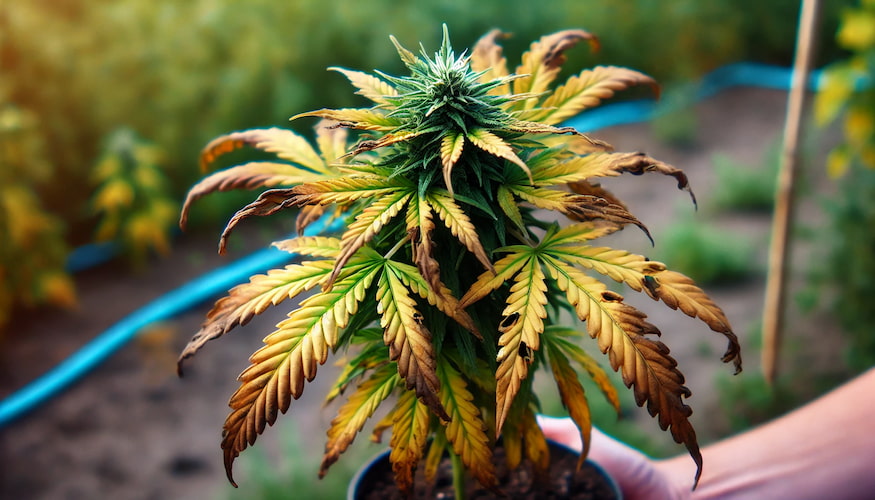
Cannabis light burn happens when your grow light delivers too much intensity or sits too close to the canopy, bleaching the uppermost leaves and buds white while the rest of the plant stays green. Heat stress, by contrast, is driven by air temperature above 85°F (29°C), causing leaves to curl upward into a taco or canoe shape and stunting growth across the whole canopy — not just the tops. The fix for each problem is different, and misdiagnosing one as the other wastes time and costs yield.
At IWantClones.com we ship rooted cannabis clones overnight across the US, and we hear about environmental problems constantly. Light-related damage is one of the top three reasons new growers struggle in the first weeks after their clones root. This guide gives you the diagnostic tools to nail down the cause and the specific fixes to get your plants back on track fast.
- Cannabis light burn bleaches the top of the canopy — uppermost leaves and bud sites turn white or pale yellow while lower leaves stay green.
- Heat stress curls leaves upward (taco/canoe shape) and affects the whole plant, not just the tops exposed to the light source.
- Nutrient burn turns leaf tips brown and crispy — it starts at the tips and margins, not the middle, and is unrelated to light position or temperature.
- Correct PPFD for veg is 400–600 µmol/m²/s; for flower it’s 600–900 µmol/m²/s. Exceeding 1,000+ µmol/m²/s without CO₂ supplementation causes light saturation and bleaching.
- Ideal canopy temperature is 70–82°F (21–28°C). Anything above 85°F for more than a few hours causes measurable heat stress.
- Raising the light, reducing intensity, improving airflow, and dialing in VPD solve the vast majority of light-and-heat issues within 48–72 hours.
Light Burn vs. Heat Stress vs. Nutrient Burn: The Diagnostic Table
The single most useful thing you can do when you see something wrong on your canopy is run a quick three-way comparison. These three problems look similar at first glance but have completely different causes and solutions.
| Symptom | Cannabis Light Burn | Heat Stress | Nutrient Burn |
|---|---|---|---|
| Primary location | Top of canopy only — closest to the light | Whole plant, usually upper half | Leaf tips and margins throughout plant |
| Leaf color change | White/pale yellow bleaching | Yellowing, sometimes reddish or bronze | Brown, crispy tips; otherwise green |
| Leaf shape | Normal shape, color lost | Upward curl (taco/canoe), edges may also roll under | Tips curl down then brown off |
| Spread pattern | Only plants/branches directly under the light | Uniform across canopy; worse under hot spots | Random or nutrient-deficiency pattern |
| Room temperature | Normal (68–82°F) | High (>85°F canopy level) | Normal |
| Light distance | Too close / intensity too high | May be contributing but not always | Irrelevant |
| PPFD reading | Often >1,000 µmol/m²/s at canopy | Varies; check temperature first | Varies; check EC/ppm first |
| Reversible? | Bleached tissue does not recover; new growth is fine | Yes — fix temps and plants bounce back within days | Yes — flush and reduce nutrients; tips stay brown |
| Speed of onset | Days to 1–2 weeks | Hours to a couple of days | Days to 1 week |
| Primary fix | Raise light or dim it | Lower temp, add airflow, lower VPD | Flush, reduce feed EC |
Use this table at the plant. If the damage is only on the tops and the room temperature is under 82°F, you are almost certainly dealing with cannabis light burn. If leaves across the whole plant are cupping upward and your thermometer reads above 85°F at canopy level, that is heat stress. Both can happen at the same time — a powerful LED too close raises both intensity and radiant heat simultaneously.
Key Takeaways
- Cannabis light burn is caused by excessive light intensity — not heat — and presents as white or pale-yellow bleaching on the uppermost leaves and bud sites closest to the light source.
- Heat stress is driven by canopy air temperature above 85°F (29°C) and causes leaves across the whole plant to curl upward into a taco or canoe shape, not just the tops.
- The two conditions can occur simultaneously when a high-power LED is positioned too close: it raises both photon flux and radiant heat at the canopy simultaneously.
- Correct PPFD targets are 400–600 µmol/m²/s during vegetative growth and 600–900 µmol/m²/s during flowering; exceeding 1,000 µmol/m²/s without CO2 supplementation causes photo-bleaching.
- Bleached tissue caused by light burn does not recover; raising the light or reducing intensity stops further damage and allows new growth to emerge healthy.
- Most light burn and heat stress problems are resolved within 48–72 hours by raising the light, improving canopy airflow, and adjusting VPD to reduce transpiration stress.
What Causes Cannabis Light Burn?
Cannabis light burn (also called photo-bleaching or light bleaching) is a photodamage response. When a plant receives more photons than its chlorophyll can process, the excess destroys chlorophyll molecules faster than the plant can rebuild them. The result is bleached, white tissue — usually at the bud sites and topmost leaves that are closest to the light source.
LED Lights Placed Too Close
Modern quantum-board and bar-style LED fixtures are powerful enough to cause light burn even at the manufacturer’s stated hanging height if the plants grow into the light during a vigorous stretch. A 600W LED at 18 inches may be fine for seedlings. That same light at 18 inches over a stretched flower canopy can deliver 1,200+ µmol/m²/s — double what the plant can use efficiently without supplemental CO₂.
The rule of thumb: measure PPFD at canopy level with a PAR meter. If you do not own a PAR meter, use the manufacturer’s light map at the hanging distance you are running. Many growers discover they are running their lights 20–40% too hot because they set the dimmer at 100% without checking the actual output.
Too Much Daily Light Integral (DLI)
DLI (Daily Light Integral) is the total amount of light a plant receives over a 24-hour period, measured in mol/m²/day. It accounts for both intensity (PPFD) and duration (hours). Cannabis in vegetative growth performs best at a DLI of 25–40 mol/m²/day. Flower stage is optimized at 40–55 mol/m²/day. Exceeding these ranges, even with a single powerful fixture, pushes plants into light saturation and eventually light burn — particularly if you are also running an 18-hour or 20-hour photoperiod.
Formula: DLI = PPFD (µmol/m²/s) × hours per day × 0.0036. A light running at 800 µmol/m²/s for 18 hours delivers a DLI of about 52 mol/m²/day — fine for most flower-stage plants. But at 1,100 µmol/m²/s for 18 hours, DLI hits 71 mol/m²/day — well above the practical ceiling for plants without CO₂.
High Temperatures Compounding the Problem
High grow room temperatures lower the threshold at which light burn occurs. Heat degrades the enzymes in the Calvin cycle (the biochemical process that fixes CO₂ using light energy). When temperatures exceed 85°F, these enzymes slow down — meaning the plant can handle even less light than normal. A combination of high intensity AND high temps is the fastest route to a destroyed canopy top.
Low Humidity and VPD
Vapor Pressure Deficit (VPD) — the difference between the moisture content of the air and the maximum moisture it could hold at that temperature — affects how plants regulate temperature through transpiration. When humidity drops and VPD climbs too high, stomata close to prevent water loss, transpirational cooling stops, and leaf surface temperature spikes. A plant that cannot cool itself through transpiration is much more vulnerable to both heat stress and light burn. Check out our detailed guide on VPD for cannabis clones for target ranges by growth stage.
What Causes Heat Stress in Cannabis?
Heat stress occurs when canopy-level air temperature exceeds approximately 85°F (29°C) for sustained periods — typically more than 2–3 hours during a lights-on cycle. At this point, enzymatic activity in the plant slows, water uptake struggles to keep pace with transpiration demand, and the plant initiates visible stress responses.
Symptoms of Heat Stress: Taco and Canoe Leaves
The most recognizable symptom is leaf curling. Cannabis leaves curl upward along their central axis — creating the “taco” shape — as the plant tries to reduce its surface area exposed to radiant heat. In severe cases, leaves will curl under at the edges (canoe shape) and eventually become crispy or show bleaching at the tips. Younger leaves near the top are usually hit first, but with sustained heat, the entire plant shows symptoms.
Other heat stress symptoms include:
- Wilting and drooping during lights-on even with adequate water
- Accelerated water consumption — plants drink fast and still droop
- Brown or rust-colored patches on leaves (often confused with cal-mag deficiency)
- In flowering plants: airy, loose buds; foxtailing (buds growing narrow elongated single-calyx spires rather than dense clusters)
- Reduced terpene production — high heat volatilizes terpenes before harvest
- Hermaphroditism risk increases significantly above 90°F (32°C)
Common Causes of High Grow Room Temperature
- Inadequate exhaust/intake airflow: Your tent or room builds up heat faster than air exchanges remove it.
- Light proximity: Even LED lights generate radiant heat at the surface — CMH and HPS generate considerably more.
- Ambient room temperature: If the room the tent is in reaches 80°F, your tent will be 85–90°F inside without active cooling.
- No oscillating fans: Stagnant hot air pockets form directly under the light.
- Summer heat: Growing outdoors or in a garage/shed without climate control during summer months is a major risk factor.
How to Fix Cannabis Light Burn
Light burn fixes are simple but must be done carefully — moving a light too abruptly can stress the plant in the other direction (insufficient light).
Step 1: Raise the Light or Dim It
Raise your fixture in 2-inch increments and recheck PPFD at canopy level. Target the ranges in the table below. If your light has a dimmer, it is often faster to reduce intensity to 75–80% and remeasure. Do not both raise and dim simultaneously — change one variable at a time so you know which adjustment fixed the problem.
Step 2: Remove Bleached Tissue
Bleached leaves and bud sites will not recover their chlorophyll. Remove severely bleached fan leaves to redirect plant energy. Bleached bud sites should be harvested early if they are isolated — they will not ripen correctly and may signal the surrounding buds to follow. If only the very tip of a cola is bleached, raising the light and letting the plant continue is usually the right call for most of the harvest.
Step 3: Recheck Your DLI
If you fixed the light distance but are still getting bleaching, calculate your DLI. Reduce your photoperiod by 1–2 hours or dim the fixture until DLI falls into the target range for the growth stage. See our cannabis clone light requirements guide and optimal light schedules for cannabis for detailed photoperiod recommendations.
How to Fix Heat Stress in Cannabis
Cool the Canopy First
The single most effective immediate action is to increase air exchange. Open tent vents, boost your inline fan speed, or add a portable AC unit. Aim for canopy temperature between 72–82°F (22–28°C) during lights-on. Even a 3–4°F drop provides measurable relief within hours — you will see leaves start to uncurl within 24 hours of bringing temps under control.
Add Oscillating Fans
Direct a small clip fan across (not directly at) the canopy to break up the hot air layer that forms under the light. Gentle air movement reduces leaf surface temperature by 3–6°F and improves CO₂ delivery to stomata at the same time.
Address Humidity and VPD
Heat and low humidity together are a one-two punch. Raise relative humidity to push VPD into the optimal range — 0.8–1.0 kPa for vegetative growth, 1.0–1.5 kPa for flower. Misting the walls of a tent (not the plants) or running a small humidifier helps. Check our full breakdown on climate and environment for cannabis clones for a complete VPD and humidity management guide.
Consider Timing Your Lights
If you are growing in a room or garage that heats up during the day, flip your light schedule so the lights are ON at night and OFF during the hottest part of the afternoon. This is one of the easiest free solutions for summer grows.
Correct Light Distance and PPFD by Growth Stage
Every LED is different — manufacturer specs vary widely. Always use a PAR meter for precise measurement, and treat these ranges as targets rather than absolutes. That said, the table below covers the most common scenarios for a 400–600W LED fixture in a 4×4 tent.
| Growth Stage | Recommended PPFD (µmol/m²/s) | Target DLI (mol/m²/day) | Typical LED Distance (inches) | Photoperiod |
|---|---|---|---|---|
| Rooting / Propagation | 100–250 | 8–15 | 24–36 in | 18/6 or 20/4 |
| Early Veg (weeks 1–3) | 250–450 | 18–28 | 20–28 in | 18/6 |
| Late Veg (weeks 3–6) | 400–600 | 25–40 | 18–24 in | 18/6 |
| Early Flower (weeks 1–3) | 600–800 | 35–45 | 16–22 in | 12/12 |
| Mid/Late Flower (weeks 4–8+) | 800–1,000 | 40–55 | 14–20 in | 12/12 |
| With Supplemental CO₂ (1,200–1,500 ppm) | 1,000–1,500 | Up to 65 | 12–18 in | 12/12 |
Important note: These distances assume a quality quantum-board or bar-style LED at the wattage specified. HPS and CMH fixtures produce significantly more radiant heat and generally need to be 18–24 inches above canopy regardless of PPFD to avoid heat stress. If you are uncertain about your specific fixture, consult the manufacturer’s light map or use a PAR meter.
Light Burn During Flowering: Extra Risks
Light burn in the flowering stage is more damaging than in veg because it directly affects bud quality and final yield. Bleached bud sites lose their trichomes, cannabinoids, and terpenes. A cola tip that turns completely white from light burn will test dramatically lower in THC and have almost no aroma.
If you catch light burn early in flower (weeks 1–3), raising the light and letting the plant continue usually saves most of the harvest. If you catch it in week 5 or later, consider whether selectively harvesting the bleached tops early while letting the lower buds finish is worth the risk. We cover optimal timing in our cannabis harvest timing guide.
Also watch for foxtailing — a specific heat/light stress symptom in late flower where buds grow long, narrow, single-calyx spires instead of dense clusters. Foxtailing triggered by stress (as opposed to genetic foxtailing, which some sativas do naturally) is a sign your environment is too hot and bright and needs immediate correction. Foxtailed buds from stress are airy, lower-potency, and harder to trim.
Prevention: Building a Light-Stress-Proof Environment
Use a PAR Meter or Light Map
This is non-negotiable if you are running any LED above 300W. You do not need an expensive meter — decent Apogee or Photone app readings (using the phone camera) are accurate enough to confirm you are in the right PPFD range. Take readings at multiple canopy points, not just directly under the light, to identify hot spots.
Train Your Canopy Flat
A flat, even canopy means all bud sites receive similar PPFD. A tall, uneven canopy means the tops are being burned while the lower buds are underpowered. LST (low-stress training), ScrOG, and topping all help flatten the canopy and maximize light use efficiency. See our cannabis clone troubleshooting guide for training tips and additional environmental problem-solving.
Monitor Canopy Temperature Separately from Room Temperature
An infrared thermometer pointed at the top of the canopy gives you the most accurate heat stress reading. Room air temperature at eye level can be 5–8°F cooler than the leaf surface directly under an LED. If you are relying on a wall-mounted thermometer, you may be underestimating canopy temperature significantly.
Dial In VPD Before Cranking Up the Light
A plant with optimal VPD (open stomata, active transpiration, efficient cooling) can handle meaningfully higher light intensity than a plant in a hot, dry environment. Get your VPD dialed in for your cannabis clones first, then incrementally increase PPFD as the plant demonstrates it can handle the intensity (measured by healthy growth rate and no stress symptoms).
Stage Intensity Increases Gradually
Do not flip freshly rooted clones from propagation-level PPFD (200 µmol/m²/s) directly to veg-level intensity (500 µmol/m²/s) overnight. Increase light intensity by 10–15% every 2–3 days as plants adjust. This is especially important for clones that have been under low-light propagation domes and are now entering their main grow environment.
When It Is Not Light Burn or Heat Stress
If you have ruled out light distance and temperature and still see bleaching or leaf abnormalities, consider these alternatives:
- Calcium deficiency: Brown or rust spots on mid-canopy leaves, not bleaching from the top. Common in coco and hydro. Fix with cal-mag.
- Iron deficiency: Interveinal yellowing on new growth — the veins stay green but the tissue between them turns pale. Often pH-related.
- Root zone problems: Overwatering, root rot, or pH out of range (below 5.5 or above 7.0) can cause wilting, yellowing, and leaf curling that mimics stress symptoms.
- Genetic variation: Some strains naturally produce lighter-colored or even variegated growth. If only one plant in a group is showing light-colored leaves and the others look fine, genetics may be the explanation.
For a full diagnostic rundown on clone-specific problems, see our cannabis clone troubleshooting guide.
Light Burn and Heat Stress with Cannabis Clones Specifically
Freshly rooted cannabis clones are more vulnerable to both light burn and heat stress than established plants for two reasons. First, their root systems are small and cannot deliver water fast enough to support high-transpiration cooling. Second, clones that have been under a humidity dome for 10–14 days are acclimated to low-light, high-humidity conditions. Moving them directly into a high-intensity veg environment without a hardening-off period is a fast way to cause both problems simultaneously.
We recommend a 5–7 day hardening-off period for all incoming clones — see our hardening off cannabis clones guide for the step-by-step process. During this window, keep PPFD under 300 µmol/m²/s, maintain temperatures in the 72–78°F range, and keep humidity between 60–70% RH. Once clones are showing new growth and standing upright without wilting during lights-on, you can begin ramping up light intensity.
Ready to grow proven genetics that respond predictably to dialed-in environments? Browse our verified cannabis clone catalog at IWantClones.com/shop — all clones ship overnight with our 3-day no-bullshit guarantee.
Frequently Asked Questions
How do I tell the difference between cannabis light burn and nutrient burn?
Light burn bleaches the uppermost leaves and bud sites white or pale yellow, starting from the tissue closest to the light source. Nutrient burn causes brown, crispy tips on leaves throughout the plant. Light burn is caused by excess PPFD or DLI; nutrient burn is caused by excess fertilizer salts. Check your PPFD reading and your nutrient EC/ppm to confirm which problem you have.
Can cannabis recover from light burn?
Bleached tissue does not recover — destroyed chlorophyll cannot be rebuilt. However, once you raise the light or reduce intensity, new growth comes in healthy. The plant as a whole recovers fully. Bleached bud sites are the exception: they will not ripen correctly and should be monitored carefully or harvested early if they are isolated from the rest of the cola.
What temperature causes heat stress in cannabis?
Sustained canopy temperatures above 85°F (29°C) cause measurable heat stress. Symptoms — taco-shaped leaf curl, wilting, accelerated water consumption — typically appear within 12–24 hours of exposure. Temperatures above 90°F (32°C) for extended periods risk hermaphroditism and permanent growth setback, especially in sensitive strains during mid-to-late flower.
How far should I hang my LED light above cannabis plants?
Distance depends on the fixture wattage and manufacturer specs, but a general starting point for a 400–600W LED is 18–24 inches during veg and 16–20 inches during flower. Use a PAR meter to confirm PPFD at canopy level — target 400–600 µmol/m²/s in veg and 600–900 µmol/m²/s in flower. Always adjust based on your actual readings, not just distance.
What does a cannabis taco leaf mean?
Taco leaves — cannabis leaves that curl upward along their central axis — are the primary visual symptom of heat stress. The plant curls its leaves to reduce the surface area exposed to heat. The fix is to lower canopy temperature below 82°F, improve airflow, and raise humidity if VPD is too high. Leaves uncurl within 24–48 hours once conditions improve.
Can too much light cause hermaphroditism in cannabis?
Extreme light stress — especially in combination with heat above 90°F during the flowering stage — can trigger hermaphroditism (the production of male pollen sacs on a female plant). This is more common with stressed clones from genetics that are already hermaphrodite-prone. Keeping PPFD, temperature, and VPD within the target ranges throughout flower is the most reliable prevention.