
SCROG vs SOG: Which Training Method Is Right for Your Clones?

Best light types for cannabis clones

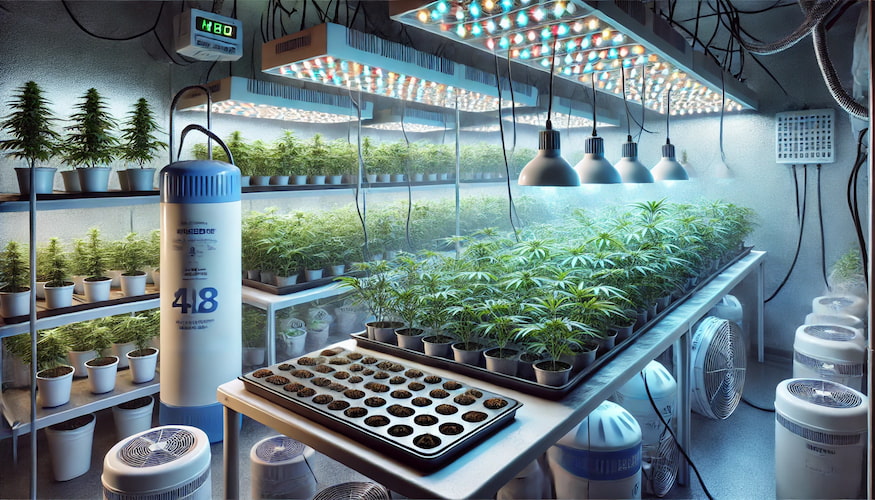
SCROG vs SOG is one of the most debated questions in indoor cannabis cultivation. SCROG (Screen of Green) trains a small number of plants through a horizontal net to build a wide, even canopy — it takes more veg time but extracts maximum yield from each plant. SOG (Sea of Green) packs many small plants into the same space and flips them to flower quickly — it trades yield per plant for faster harvests and more efficient use of your footprint. Both methods work extremely well with clones.

At IWantClones.com, we’ve seen growers succeed with both approaches — and fail with both when they pick the wrong method for their setup. This guide breaks down exactly how each works, who each is best for, and what you need to get started.

Key Takeaways

  • SCROG uses 1-4 plants per 4×4 area trained through a horizontal screen; SOG uses 9-16 or more plants per 4×4 in smaller containers with minimal veg time.
  • SCROG requires 4-8 weeks of vegetative growth to fill the net; SOG can flip clones to flower within 1-2 weeks of rooting, or immediately upon transplant.
  • SOG produces faster harvests — sometimes shaving 3-5 weeks off the total cycle — but requires more plants, which matters in states with plant count limits.
  • SCROG is more forgiving for beginners because you’re managing fewer plants; SOG requires watering, feeding, and monitoring more plants simultaneously.
  • Clones are the ideal candidate for SOG because genetic uniformity creates a level canopy — seed-grown plants vary in height and timing, which disrupts a SOG.
  • SCROG suits growers who want to maximize yield from a small plant count; SOG suits growers optimizing for harvest frequency and canopy efficiency.

What Is SCROG (Screen of Green)?

SCROG stands for Screen of Green. The technique uses a horizontal mesh net or screen — typically positioned 8-16 inches above the top of the growing medium — to intercept plant branches as they grow upward. Rather than letting branches grow vertically, you weave or tuck them horizontally through the screen openings as they develop. Over 4-8 weeks of vegetation, the plant’s canopy spreads across the entire screen, creating an even, horizontal surface of bud sites that all sit at the same distance from the light.

The result is a flat, uniform canopy where every bud site receives direct, intense light — no tops shading the rest, no wasted lumens bouncing off leaves at odd angles. SCROG is an evolution of low-stress training (LST) taken to a systematic, space-filling level.

How SCROG Works in Practice

You typically start with 1-4 plants in a 4×4 tent. The plants go through a full vegetative period — often 4-8 weeks — during which you top them multiple times to create many branch tips, then LST those branches outward and under the net as they reach screen height. When roughly 70-80% of the screen is filled with growing tips, you flip to 12/12 to trigger flowering.

During the first 2 weeks of flower (the “stretch”), you continue tucking new growth under the screen. Once the stretch is complete — usually by day 14-18 of flower — you stop tucking and let the plant rise through the remaining screen openings. Everything below the screen gets stripped (lollipopped) since it will only produce larf. What remains above the screen is a dense, even grid of bud sites, all roughly 18-24 inches from your light.

What Is SOG (Sea of Green)?

SOG stands for Sea of Green. The concept is the opposite of SCROG in almost every way. Instead of training a few large plants to fill a space, you pack the space with many small plants that you flip to flower quickly — often within 1-2 weeks of rooting, or sometimes immediately. Each plant produces one or two main colas rather than many. The canopy looks like a sea of uniform green tops — thus the name.

SOG exploits the fact that cannabis, when given sufficient light, can produce impressive yields from small plants in tiny containers. A 6-inch rockwool cube or a 1-gallon pot is enough for a SOG plant. You fit more plants per square foot, flip fast, and harvest frequently. Experienced SOG growers run perpetual harvests — staggering multiple rounds so there’s always something coming down while the next batch is rooting.

How SOG Works in Practice

In a 4×4 space, a SOG might have 9-25 plants in 1-2 gallon containers, depending on the strain’s natural width. The plants are clones — genetic copies of the same mother — so they grow at identical rates and reach identical heights. You flip them to 12/12 as soon as they’ve rooted and have a couple of nodes of growth. Each plant stretches, produces one main cola (or two if lightly topped once), and finishes. Because the plants are small, flower time is the same as any photoperiod plant — 8-10 weeks depending on strain — but there’s virtually no veg time eating into your cycle.

The uniformity of clones is non-negotiable for a functioning SOG. Seed-grown plants vary in height, stretch rate, and finishing time — a mixed-height SOG means your light is too far from the short plants and burning the tall ones. Clones remove that variable entirely.

SCROG vs SOG: The Key Differences

Factor SCROG SOG
Plants per 4×4 1-4 plants 9-25 plants
Veg time needed 4-8 weeks 1-2 weeks (or immediate flip)
Skill level Beginner-friendly Intermediate (more plants to manage)
Best for Max yield from few plants; growers with plant count limits Fast harvests; perpetual cycles; efficiency growers
Yield per plant High (3-6 oz+ per plant possible) Lower per plant (0.5-2 oz per plant typical)
Yield per sq ft Competitive — 1-2 oz/sqft with good technique Competitive — 1-2 oz/sqft, sometimes more with fast cycling
Training required Extensive (topping, LST, screen weaving) Minimal (top once optionally; mostly hands-off)
Clone-friendly Yes — fewer clones needed per run Essential — SOG requires genetic uniformity
Harvest frequency Every 12-16+ weeks (long veg) Every 9-11 weeks; perpetual possible
Container size 5-10 gallon pots typical 1-3 gallon pots typical

Plant Count and Legal Considerations

This comparison matters enormously for US home growers. Most states that allow home cultivation cap plant counts — commonly 3-6 plants per household for recreational, sometimes more for medical. SCROG is purpose-built for low plant counts: you extract as much yield as legally possible from each plant by giving it maximum space and time to develop.

SOG, by contrast, needs more plants. In a 4×4 SOG, you might have 12-16 plants. That’s possible in states with higher caps (some medical states allow 12-24 plants), but it will put recreational home growers over the limit in most states. Always verify your state’s plant count rules before choosing a method. Check our state laws on cannabis clones page for current limits.

Legal adult-use cannabis cultivation is permitted in a growing number of US states — but laws vary significantly by state and municipality. Always confirm what’s legal in your jurisdiction before growing.

SCROG: How to Set Up Your Screen

Setting up a SCROG correctly the first time saves weeks of frustration. Here’s exactly how to do it:

Step 1: Build or Buy Your Screen

SCROG nets come in standard sizes matching common tent dimensions: 2×2, 4×4, 5×5, 4×8. You can also build your own from PVC pipe and garden netting. The ideal mesh opening size is 2 inches x 2 inches — large enough to tuck branches through easily, small enough to provide meaningful support structure. Smaller openings (1 inch) make weaving tedious; larger ones (4 inches) don’t provide enough structure.

Step 2: Set the Screen Height

Position the screen 10-14 inches above the top of the growing medium (the top of the pot). This gives the plant enough vertical stem to develop before hitting the screen, and puts the future canopy at the right distance from the light. If your light needs to sit 18-24 inches above the canopy, and your tent is 7 feet tall, you have plenty of headroom — plan accordingly.

Step 3: Train Plants Into the Screen

As branches grow up and reach the screen, gently bend them horizontal and tuck them through the nearest opening. Use soft plant ties if branches resist staying flat. Work from the center outward — push growth toward the empty edges of the screen. Do not remove healthy branches at this stage; the goal is to fill the screen, not reduce the plant.

Step 4: Top Early, Often

SCROG works best on plants that have been topped 2-4 times in early-to-mid veg. Each topping doubles the number of main colas — a once-topped plant has 2 mains, twice-topped has 4, three times has 8. More tops means more branches to weave, which fills the screen faster and creates more bud sites. See our detailed guide on topping and LST techniques for cannabis for the exact process.

Step 5: Flip When the Screen Is 70-80% Full

Resist the urge to flip too early. The screen should be roughly 70-80% covered with growing tips before you trigger flower. During the stretch (first 2-3 weeks of 12/12), the plant will fill the remaining 20-30% naturally. A screen that’s only 50% filled at flip will produce a patchy canopy with uneven yields.

Step 6: Lollipop Everything Below the Screen

Once the stretch is complete (around day 14-21 of flower), strip everything below the screen. Every branch below the net that doesn’t reach the screen will produce only larf — small, loose, underdeveloped buds not worth the plant’s energy. A clean lollipop at this stage dramatically improves what the top canopy produces.

SOG: How to Run It With Clones

SOG is the method clones were made for. The process is simpler than SCROG in terms of training, but requires tight operational discipline — you’re managing more plants, more containers, and more watering events.

Step 1: Root Your Clones

You need a steady supply of rooted clones from a single mother plant (or multiple mothers of the same strain). All plants should be the same age and size when you start the SOG — within 1-2 inches of each other in height. This uniformity is everything. If you’re ordering clones from us, they arrive pre-rooted and ready for transplant, which makes timing a SOG run much simpler.

Step 2: Transplant Into Small Containers

Use 1-2 gallon containers for most SOG strains. Some wide-spreading sativas may need 2-3 gallons, but indicas and indica-dominant hybrids do well in 1 gallon. Space containers so the tops of the plants are 6-8 inches apart — close enough to form a continuous canopy when they hit their mature height, but not so close that airflow is choked off at the base.

Step 3: Flip Immediately or After Minimal Veg

For a true SOG, you flip clones to 12/12 within 1-2 weeks of rooting — some growers flip on day 1 of transplant. The clones will stretch significantly during early flower (often doubling in height), so what looks like a small plant at flip becomes a full-height plant with one main cola at harvest. In a 4×4 under a 600-1000W light, 12-16 plants flipped at 6-8 inches tall will finish at 18-24 inches — a workable, manageable height.

Step 4: Minimal Training

SOG plants typically need no training beyond removing the lowest 2-3 nodes of growth once they’ve stretched (a light lollipop). Some growers top once very early to create two main colas per plant — this works well with slightly more veg time (2-3 weeks). Extensive topping or LST in a SOG defeats the purpose; you’re trying to keep the cycle short, not build a giant trained plant.

Step 5: Run Perpetual Harvests

The real power of SOG emerges in a perpetual setup. While one batch is in late flower, you’re rooting the next batch. When batch 1 comes down, batch 2 goes in. With a 9-10 week flower time and 2 weeks of rooting/early veg, you can harvest every 9-10 weeks continuously — roughly 5 harvests per year from the same space. Compare that to a SCROG cycle with 6-8 weeks of veg plus 9-10 weeks of flower: roughly 3 harvests per year.

Which Method Produces More Yield?

The honest answer: both methods can hit the same grams-per-watt efficiency with good execution. The difference is in the path to get there.

A well-executed SCROG in a 4×4 under a 600W LED can yield 400-600g per run, with a total cycle of 14-18 weeks (veg + flower). That’s roughly 1-2 oz per square foot per run, or about 25-35g per week when you factor in the full cycle length.

A well-executed SOG in the same space under the same light might yield 300-500g per run, with a total cycle of 10-12 weeks. That’s slightly less per run, but you run it 5 times per year instead of 3-4. Annual output from SOG typically exceeds SCROG by 20-30% purely because of harvest frequency — if you have the plant count allowance for it.

Light Requirements for Both Methods

Both SCROG and SOG benefit from the same principle: even, intense light coverage across the entire canopy. The difference is that SCROG creates a horizontal canopy by training, while SOG creates it through plant density. In both cases, the goal is to have every bud site within a few inches of the same distance from the light source.

For a 4×4 grow area, 400-600W of quality LED (equivalent to 600-1000W HPS in coverage) is appropriate for either method. See our complete breakdown of light requirements for cannabis clones for specific PPFD targets by growth stage.

One nuance: SOG creates a more three-dimensional canopy than a flat SCROG — the tops are even, but there’s more vertical depth to each plant. This means light penetration through the canopy matters more in SOG. High-quality LEDs with strong deep-canopy penetration (Samsung LM301B or LM301H diodes, for example) outperform blurple or lower-quality fixtures in a SOG context.

Best Strains for SCROG and SOG

Not every strain suits every method. Here’s a practical guide:

Best for SCROG

  • Vigorous hybrids with long internodes that branch readily: Gelato crosses, Gorilla Glue, Bruce Banner, most OG Kush descendants
  • Strains that respond well to topping and LST — they need to fill a screen, so they need to branch
  • Longer-flowering strains (9-11 weeks) where the extended veg of SCROG doesn’t feel like a waste

Best for SOG

  • Short, compact indica-dominant strains that don’t stretch excessively: most Kush varieties, Mendo Breath, compact OG phenotypes
  • Strains with a single dominant apical tip rather than natural heavy branching
  • Strains with a short, predictable stretch (less than 2x height during flower) so your SOG canopy stays manageable
  • Any strain where you have a reliable clone source — consistency is everything

For small spaces and efficiency-focused growing, see our guide to the best cannabis clones for small spaces — it covers which cultivars we recommend for compact, high-yield setups.

Which Method Is Right for You?

Choose SCROG if:

  • Your state limits you to 6 or fewer plants
  • You’re new to advanced training and want to learn on fewer plants
  • You’re growing in a 4×4 or larger tent and want to maximize yield per run
  • You have 14-18 weeks available for a full cycle and aren’t in a hurry
  • You enjoy the hands-on process of training and canopy management

Choose SOG if:

  • Your state allows 12+ plants or you have a medical allowance
  • You have a reliable clone source (like IWantClones.com) that gives you genetic uniformity every run
  • You want to harvest more frequently — 4-5 times per year vs 3-4
  • You’re growing primarily indica or compact hybrids that suit small containers
  • You’re comfortable managing a higher number of plants simultaneously

Either way, understanding your clone’s growth stages is essential — both SCROG and SOG require precise timing around the vegetative-to-flower transition to work properly.

Ready to start your first SCROG or SOG run? Browse our current clone selection at IWantClones.com — every clone is from a verified, genetically stable mother plant and arrives pre-rooted and ready to train. $98.88 per clone, overnight delivery, 3-day guarantee.

Frequently Asked Questions

What does SCROG stand for and how does it work?

SCROG stands for Screen of Green. It works by positioning a horizontal mesh screen 10-14 inches above the growing medium and weaving cannabis branches through the openings as the plant grows. This creates a flat, even canopy where every bud site receives direct light. Most SCROG setups use 1-4 plants in a 4×4 area with 4-8 weeks of vegetative growth to fill the screen.

What does SOG stand for and how is it different from SCROG?

SOG stands for Sea of Green. It uses many small plants — typically 9-25 per 4×4 area — flipped to flower quickly after minimal veg time. Each plant produces one or two main colas rather than a large trained canopy. SOG harvests faster but requires more plants; SCROG extracts more yield per plant but takes longer per run. Both can achieve similar grams-per-watt efficiency.

How many plants do I need for SOG?

For a 4×4 grow space, a typical SOG uses 9-16 plants in 1-2 gallon containers, spaced so their canopies overlap slightly at maturity. Some growers run 25 plants in very small (0.5 gallon) containers for faster cycles, though this requires precise watering discipline. Always check your state’s plant count limits before planning a SOG setup.

Can I use seeds for SOG instead of clones?

Technically yes, but it’s far less effective. SOG depends on every plant being the same height, stretching at the same rate, and finishing at the same time. Seed-grown plants — even from the same pack — vary significantly in height and timing. A mixed-height SOG creates an uneven canopy that wastes light on the shorter plants. Clones from a single mother are the standard for SOG precisely because they eliminate that variation.

What mesh size should a SCROG net be?

The ideal SCROG net has 2-inch square openings. This size is easy to weave branches through during training, provides meaningful structural support for the branches, and gives you enough anchor points across the net to guide growth evenly. Nets with 1-inch openings are harder to work with; 4-inch openings don’t offer enough structure. Most commercial SCROG nets use 2-inch spacing for this reason.

Which method gives a bigger yield per square foot — SCROG or SOG?

Both methods can reach 1-2 oz per square foot per run with quality genetics and good technique. SOG typically produces slightly less per run but runs more cycles per year (5 vs 3-4), often resulting in 20-30% more annual yield from the same space. SCROG delivers more per individual run. The better method for total annual yield depends on how many plants you’re legally allowed to grow.

Share

Comments are closed.

Also recommended

SCROG vs SOG: Which Training Method Is Right for Your Clones?

July 12, 2026
Best light types for cannabis clones

SCROG vs SOG is one of the most debated questions in indoor cannabis cultivation. SCROG (Screen of Green) trains a small number of plants through a horizontal net to build a wide, even canopy — it takes more veg time but extracts maximum yield from each plant. SOG (Sea of Green) packs many small plants into the same space and flips them to flower quickly — it trades yield per plant for faster harvests and more efficient use of your footprint. Both methods work extremely well with clones.

At IWantClones.com, we’ve seen growers succeed with both approaches — and fail with both when they pick the wrong method for their setup. This guide breaks down exactly how each works, who each is best for, and what you need to get started.

Key Takeaways

  • SCROG uses 1-4 plants per 4×4 area trained through a horizontal screen; SOG uses 9-16 or more plants per 4×4 in smaller containers with minimal veg time.
  • SCROG requires 4-8 weeks of vegetative growth to fill the net; SOG can flip clones to flower within 1-2 weeks of rooting, or immediately upon transplant.
  • SOG produces faster harvests — sometimes shaving 3-5 weeks off the total cycle — but requires more plants, which matters in states with plant count limits.
  • SCROG is more forgiving for beginners because you’re managing fewer plants; SOG requires watering, feeding, and monitoring more plants simultaneously.
  • Clones are the ideal candidate for SOG because genetic uniformity creates a level canopy — seed-grown plants vary in height and timing, which disrupts a SOG.
  • SCROG suits growers who want to maximize yield from a small plant count; SOG suits growers optimizing for harvest frequency and canopy efficiency.

What Is SCROG (Screen of Green)?

SCROG stands for Screen of Green. The technique uses a horizontal mesh net or screen — typically positioned 8-16 inches above the top of the growing medium — to intercept plant branches as they grow upward. Rather than letting branches grow vertically, you weave or tuck them horizontally through the screen openings as they develop. Over 4-8 weeks of vegetation, the plant’s canopy spreads across the entire screen, creating an even, horizontal surface of bud sites that all sit at the same distance from the light.

The result is a flat, uniform canopy where every bud site receives direct, intense light — no tops shading the rest, no wasted lumens bouncing off leaves at odd angles. SCROG is an evolution of low-stress training (LST) taken to a systematic, space-filling level.

How SCROG Works in Practice

You typically start with 1-4 plants in a 4×4 tent. The plants go through a full vegetative period — often 4-8 weeks — during which you top them multiple times to create many branch tips, then LST those branches outward and under the net as they reach screen height. When roughly 70-80% of the screen is filled with growing tips, you flip to 12/12 to trigger flowering.

During the first 2 weeks of flower (the “stretch”), you continue tucking new growth under the screen. Once the stretch is complete — usually by day 14-18 of flower — you stop tucking and let the plant rise through the remaining screen openings. Everything below the screen gets stripped (lollipopped) since it will only produce larf. What remains above the screen is a dense, even grid of bud sites, all roughly 18-24 inches from your light.

What Is SOG (Sea of Green)?

SOG stands for Sea of Green. The concept is the opposite of SCROG in almost every way. Instead of training a few large plants to fill a space, you pack the space with many small plants that you flip to flower quickly — often within 1-2 weeks of rooting, or sometimes immediately. Each plant produces one or two main colas rather than many. The canopy looks like a sea of uniform green tops — thus the name.

SOG exploits the fact that cannabis, when given sufficient light, can produce impressive yields from small plants in tiny containers. A 6-inch rockwool cube or a 1-gallon pot is enough for a SOG plant. You fit more plants per square foot, flip fast, and harvest frequently. Experienced SOG growers run perpetual harvests — staggering multiple rounds so there’s always something coming down while the next batch is rooting.

How SOG Works in Practice

In a 4×4 space, a SOG might have 9-25 plants in 1-2 gallon containers, depending on the strain’s natural width. The plants are clones — genetic copies of the same mother — so they grow at identical rates and reach identical heights. You flip them to 12/12 as soon as they’ve rooted and have a couple of nodes of growth. Each plant stretches, produces one main cola (or two if lightly topped once), and finishes. Because the plants are small, flower time is the same as any photoperiod plant — 8-10 weeks depending on strain — but there’s virtually no veg time eating into your cycle.

The uniformity of clones is non-negotiable for a functioning SOG. Seed-grown plants vary in height, stretch rate, and finishing time — a mixed-height SOG means your light is too far from the short plants and burning the tall ones. Clones remove that variable entirely.

SCROG vs SOG: The Key Differences

Factor SCROG SOG
Plants per 4×4 1-4 plants 9-25 plants
Veg time needed 4-8 weeks 1-2 weeks (or immediate flip)
Skill level Beginner-friendly Intermediate (more plants to manage)
Best for Max yield from few plants; growers with plant count limits Fast harvests; perpetual cycles; efficiency growers
Yield per plant High (3-6 oz+ per plant possible) Lower per plant (0.5-2 oz per plant typical)
Yield per sq ft Competitive — 1-2 oz/sqft with good technique Competitive — 1-2 oz/sqft, sometimes more with fast cycling
Training required Extensive (topping, LST, screen weaving) Minimal (top once optionally; mostly hands-off)
Clone-friendly Yes — fewer clones needed per run Essential — SOG requires genetic uniformity
Harvest frequency Every 12-16+ weeks (long veg) Every 9-11 weeks; perpetual possible
Container size 5-10 gallon pots typical 1-3 gallon pots typical

Plant Count and Legal Considerations

This comparison matters enormously for US home growers. Most states that allow home cultivation cap plant counts — commonly 3-6 plants per household for recreational, sometimes more for medical. SCROG is purpose-built for low plant counts: you extract as much yield as legally possible from each plant by giving it maximum space and time to develop.

SOG, by contrast, needs more plants. In a 4×4 SOG, you might have 12-16 plants. That’s possible in states with higher caps (some medical states allow 12-24 plants), but it will put recreational home growers over the limit in most states. Always verify your state’s plant count rules before choosing a method. Check our state laws on cannabis clones page for current limits.

Legal adult-use cannabis cultivation is permitted in a growing number of US states — but laws vary significantly by state and municipality. Always confirm what’s legal in your jurisdiction before growing.

SCROG: How to Set Up Your Screen

Setting up a SCROG correctly the first time saves weeks of frustration. Here’s exactly how to do it:

Step 1: Build or Buy Your Screen

SCROG nets come in standard sizes matching common tent dimensions: 2×2, 4×4, 5×5, 4×8. You can also build your own from PVC pipe and garden netting. The ideal mesh opening size is 2 inches x 2 inches — large enough to tuck branches through easily, small enough to provide meaningful support structure. Smaller openings (1 inch) make weaving tedious; larger ones (4 inches) don’t provide enough structure.

Step 2: Set the Screen Height

Position the screen 10-14 inches above the top of the growing medium (the top of the pot). This gives the plant enough vertical stem to develop before hitting the screen, and puts the future canopy at the right distance from the light. If your light needs to sit 18-24 inches above the canopy, and your tent is 7 feet tall, you have plenty of headroom — plan accordingly.

Step 3: Train Plants Into the Screen

As branches grow up and reach the screen, gently bend them horizontal and tuck them through the nearest opening. Use soft plant ties if branches resist staying flat. Work from the center outward — push growth toward the empty edges of the screen. Do not remove healthy branches at this stage; the goal is to fill the screen, not reduce the plant.

Step 4: Top Early, Often

SCROG works best on plants that have been topped 2-4 times in early-to-mid veg. Each topping doubles the number of main colas — a once-topped plant has 2 mains, twice-topped has 4, three times has 8. More tops means more branches to weave, which fills the screen faster and creates more bud sites. See our detailed guide on topping and LST techniques for cannabis for the exact process.

Step 5: Flip When the Screen Is 70-80% Full

Resist the urge to flip too early. The screen should be roughly 70-80% covered with growing tips before you trigger flower. During the stretch (first 2-3 weeks of 12/12), the plant will fill the remaining 20-30% naturally. A screen that’s only 50% filled at flip will produce a patchy canopy with uneven yields.

Step 6: Lollipop Everything Below the Screen

Once the stretch is complete (around day 14-21 of flower), strip everything below the screen. Every branch below the net that doesn’t reach the screen will produce only larf — small, loose, underdeveloped buds not worth the plant’s energy. A clean lollipop at this stage dramatically improves what the top canopy produces.

SOG: How to Run It With Clones

SOG is the method clones were made for. The process is simpler than SCROG in terms of training, but requires tight operational discipline — you’re managing more plants, more containers, and more watering events.

Step 1: Root Your Clones

You need a steady supply of rooted clones from a single mother plant (or multiple mothers of the same strain). All plants should be the same age and size when you start the SOG — within 1-2 inches of each other in height. This uniformity is everything. If you’re ordering clones from us, they arrive pre-rooted and ready for transplant, which makes timing a SOG run much simpler.

Step 2: Transplant Into Small Containers

Use 1-2 gallon containers for most SOG strains. Some wide-spreading sativas may need 2-3 gallons, but indicas and indica-dominant hybrids do well in 1 gallon. Space containers so the tops of the plants are 6-8 inches apart — close enough to form a continuous canopy when they hit their mature height, but not so close that airflow is choked off at the base.

Step 3: Flip Immediately or After Minimal Veg

For a true SOG, you flip clones to 12/12 within 1-2 weeks of rooting — some growers flip on day 1 of transplant. The clones will stretch significantly during early flower (often doubling in height), so what looks like a small plant at flip becomes a full-height plant with one main cola at harvest. In a 4×4 under a 600-1000W light, 12-16 plants flipped at 6-8 inches tall will finish at 18-24 inches — a workable, manageable height.

Step 4: Minimal Training

SOG plants typically need no training beyond removing the lowest 2-3 nodes of growth once they’ve stretched (a light lollipop). Some growers top once very early to create two main colas per plant — this works well with slightly more veg time (2-3 weeks). Extensive topping or LST in a SOG defeats the purpose; you’re trying to keep the cycle short, not build a giant trained plant.

Step 5: Run Perpetual Harvests

The real power of SOG emerges in a perpetual setup. While one batch is in late flower, you’re rooting the next batch. When batch 1 comes down, batch 2 goes in. With a 9-10 week flower time and 2 weeks of rooting/early veg, you can harvest every 9-10 weeks continuously — roughly 5 harvests per year from the same space. Compare that to a SCROG cycle with 6-8 weeks of veg plus 9-10 weeks of flower: roughly 3 harvests per year.

Which Method Produces More Yield?

The honest answer: both methods can hit the same grams-per-watt efficiency with good execution. The difference is in the path to get there.

A well-executed SCROG in a 4×4 under a 600W LED can yield 400-600g per run, with a total cycle of 14-18 weeks (veg + flower). That’s roughly 1-2 oz per square foot per run, or about 25-35g per week when you factor in the full cycle length.

A well-executed SOG in the same space under the same light might yield 300-500g per run, with a total cycle of 10-12 weeks. That’s slightly less per run, but you run it 5 times per year instead of 3-4. Annual output from SOG typically exceeds SCROG by 20-30% purely because of harvest frequency — if you have the plant count allowance for it.

Light Requirements for Both Methods

Both SCROG and SOG benefit from the same principle: even, intense light coverage across the entire canopy. The difference is that SCROG creates a horizontal canopy by training, while SOG creates it through plant density. In both cases, the goal is to have every bud site within a few inches of the same distance from the light source.

For a 4×4 grow area, 400-600W of quality LED (equivalent to 600-1000W HPS in coverage) is appropriate for either method. See our complete breakdown of light requirements for cannabis clones for specific PPFD targets by growth stage.

One nuance: SOG creates a more three-dimensional canopy than a flat SCROG — the tops are even, but there’s more vertical depth to each plant. This means light penetration through the canopy matters more in SOG. High-quality LEDs with strong deep-canopy penetration (Samsung LM301B or LM301H diodes, for example) outperform blurple or lower-quality fixtures in a SOG context.

Best Strains for SCROG and SOG

Not every strain suits every method. Here’s a practical guide:

Best for SCROG

  • Vigorous hybrids with long internodes that branch readily: Gelato crosses, Gorilla Glue, Bruce Banner, most OG Kush descendants
  • Strains that respond well to topping and LST — they need to fill a screen, so they need to branch
  • Longer-flowering strains (9-11 weeks) where the extended veg of SCROG doesn’t feel like a waste

Best for SOG

  • Short, compact indica-dominant strains that don’t stretch excessively: most Kush varieties, Mendo Breath, compact OG phenotypes
  • Strains with a single dominant apical tip rather than natural heavy branching
  • Strains with a short, predictable stretch (less than 2x height during flower) so your SOG canopy stays manageable
  • Any strain where you have a reliable clone source — consistency is everything

For small spaces and efficiency-focused growing, see our guide to the best cannabis clones for small spaces — it covers which cultivars we recommend for compact, high-yield setups.

Which Method Is Right for You?

Choose SCROG if:

  • Your state limits you to 6 or fewer plants
  • You’re new to advanced training and want to learn on fewer plants
  • You’re growing in a 4×4 or larger tent and want to maximize yield per run
  • You have 14-18 weeks available for a full cycle and aren’t in a hurry
  • You enjoy the hands-on process of training and canopy management

Choose SOG if:

  • Your state allows 12+ plants or you have a medical allowance
  • You have a reliable clone source (like IWantClones.com) that gives you genetic uniformity every run
  • You want to harvest more frequently — 4-5 times per year vs 3-4
  • You’re growing primarily indica or compact hybrids that suit small containers
  • You’re comfortable managing a higher number of plants simultaneously

Either way, understanding your clone’s growth stages is essential — both SCROG and SOG require precise timing around the vegetative-to-flower transition to work properly.

Ready to start your first SCROG or SOG run? Browse our current clone selection at IWantClones.com — every clone is from a verified, genetically stable mother plant and arrives pre-rooted and ready to train. $98.88 per clone, overnight delivery, 3-day guarantee.

Frequently Asked Questions

What does SCROG stand for and how does it work?

SCROG stands for Screen of Green. It works by positioning a horizontal mesh screen 10-14 inches above the growing medium and weaving cannabis branches through the openings as the plant grows. This creates a flat, even canopy where every bud site receives direct light. Most SCROG setups use 1-4 plants in a 4×4 area with 4-8 weeks of vegetative growth to fill the screen.

What does SOG stand for and how is it different from SCROG?

SOG stands for Sea of Green. It uses many small plants — typically 9-25 per 4×4 area — flipped to flower quickly after minimal veg time. Each plant produces one or two main colas rather than a large trained canopy. SOG harvests faster but requires more plants; SCROG extracts more yield per plant but takes longer per run. Both can achieve similar grams-per-watt efficiency.

How many plants do I need for SOG?

For a 4×4 grow space, a typical SOG uses 9-16 plants in 1-2 gallon containers, spaced so their canopies overlap slightly at maturity. Some growers run 25 plants in very small (0.5 gallon) containers for faster cycles, though this requires precise watering discipline. Always check your state’s plant count limits before planning a SOG setup.

Can I use seeds for SOG instead of clones?

Technically yes, but it’s far less effective. SOG depends on every plant being the same height, stretching at the same rate, and finishing at the same time. Seed-grown plants — even from the same pack — vary significantly in height and timing. A mixed-height SOG creates an uneven canopy that wastes light on the shorter plants. Clones from a single mother are the standard for SOG precisely because they eliminate that variation.

What mesh size should a SCROG net be?

The ideal SCROG net has 2-inch square openings. This size is easy to weave branches through during training, provides meaningful structural support for the branches, and gives you enough anchor points across the net to guide growth evenly. Nets with 1-inch openings are harder to work with; 4-inch openings don’t offer enough structure. Most commercial SCROG nets use 2-inch spacing for this reason.

Which method gives a bigger yield per square foot — SCROG or SOG?

Both methods can reach 1-2 oz per square foot per run with quality genetics and good technique. SOG typically produces slightly less per run but runs more cycles per year (5 vs 3-4), often resulting in 20-30% more annual yield from the same space. SCROG delivers more per individual run. The better method for total annual yield depends on how many plants you’re legally allowed to grow.

Written by James Bean

Recent Posts

SCROG vs SOG: Which Training Method Is Right for Your Clones?

SCROG vs SOG explained — how each method works, plant counts, veg times, yields, and which one suits your space and clone count. Pick the right method here.

Read More
Gushers Strain & Clone Grow Guide (Fruit Gushers / White Gushers)

Grow Gushers (Fruit Gushers / White Gushers) from clone. Lineage, candy terps, dense colorful buds, feeding & training tips. Shop verified Gushers clones.

Read More
Beginner Grow Tent Setup for Cannabis Clones (Full Walkthrough)

Build the perfect grow tent setup for cannabis clones. Full gear list, tent size guide, setup steps, and environment targets. Get started right.

Read More

Subscribe Today!

Get 10% off when you sign up for our weekly updates!

About Us

At IWantClones.com, we are dedicated to providing top-quality cannabis clones to growers of all levels.

Subscribe Today!

Subscribe our newsletter to get our latest update & news
We currently accept credit/debit card payments, cash, check, money order, bitcoin (BTC), litecoin (LTE), bitcoin cash (BCH), and dogecoin (DOGE).
© 2026 seedsherenow.com All Rights Reserved
magnifiercross linkedin facebook pinterest youtube rss twitter instagram facebook-blank rss-blank linkedin-blank pinterest youtube twitter instagram