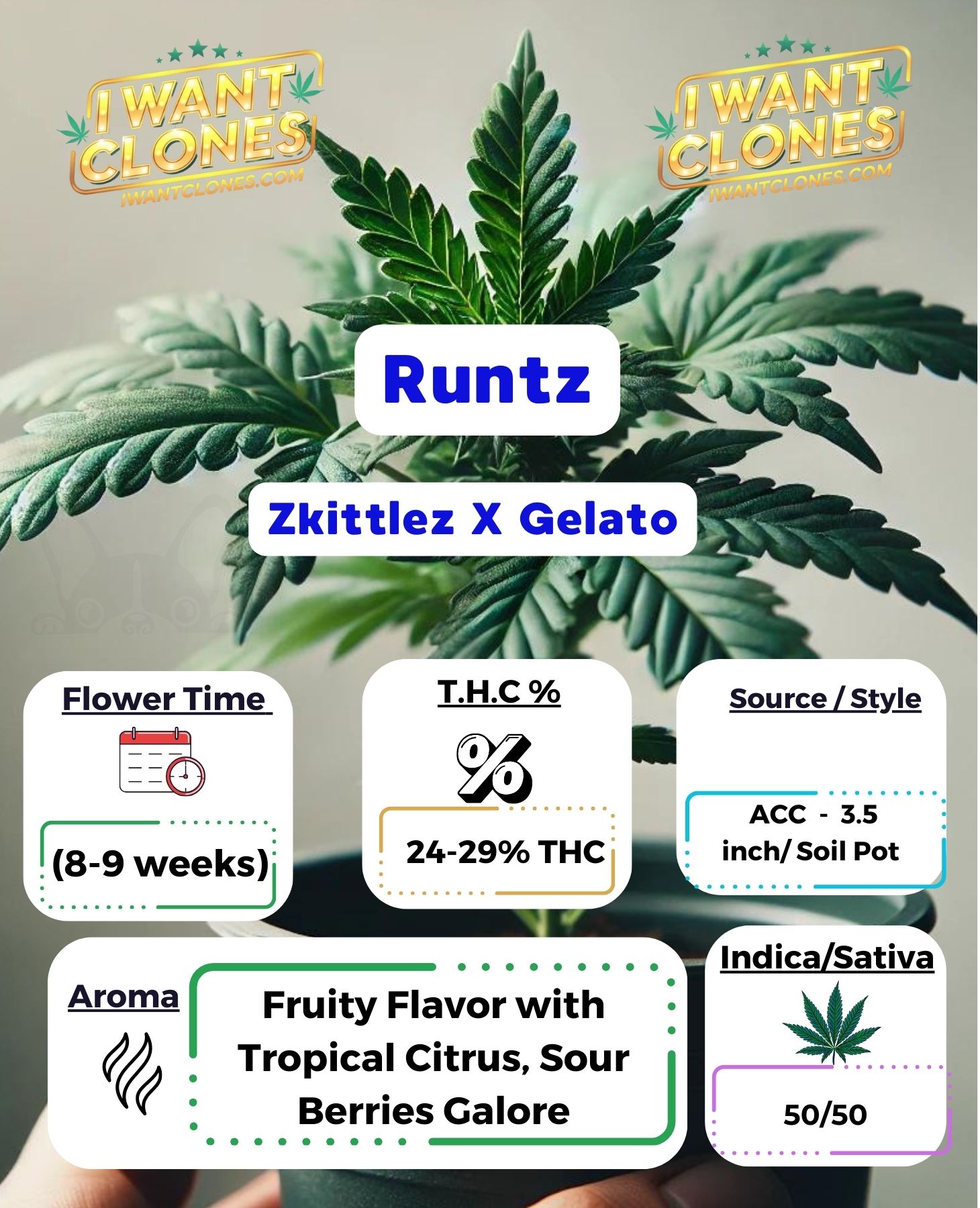
The Runtz family is a group of high-THC, candy-forward cannabis strains descended from the legendary Gelato x Zkittlez cross—or closely related genetics within the Cookies breeding ecosystem. Original Runtz tests between 27% to 33% THC, delivers dense, resin-packed buds, and produces a distinctly sweet, tropical-candy terpene profile. White Runtz, Forbidden Runtz (also called Runtz of Eden), and RS-11 (Rainbow Sherbet #11) each branch off that same flavor DNA while bringing their own unique character to the garden.
If you’re shopping rare cannabis clone strains and keep landing on Runtz variants, this guide explains exactly what you’re looking at—the lineage, the differences, the grow traits, and how to pick the right one for your setup.
- Runtz = Gelato x Zkittlez, bred by the Cookies team; one of the most influential cannabis strains of the 2020s.
- White Runtz is a backcross/cut selection of Runtz with a lighter green appearance, higher average THC, and a creamier terpene note layered on top of the candy profile.
- Forbidden Runtz (sold as Runtz of Eden) combines the Runtz line with Cherry Pie heritage, adding a dark-fruit dimension.
- RS-11 (Rainbow Sherbet #11) by Deep East is a distinct strain—Pink Guava x OZK—that shares the candy-sherbet flavor world of the Runtz family without being a direct Runtz descendant.
- All four produce extremely dense, trichome-heavy buds that need good airflow and a watchful eye for mold in the final weeks of flower.
- Buying high-THC cannabis clone strains as rooted clones saves 4 to 6 weeks versus starting from seed and guarantees you’re growing the exact genetics you ordered.
Key Takeaways
- Runtz is a Cookies-family hybrid of Gelato x Zkittlez, prized for candy-sweet terpenes and roughly 24% to 29% THC.
- White Runtz, Forbidden Runtz (Runtz of Eden), and RS-11 (Rainbow Sherbet #11) are distinct cuts within or alongside the Runtz lineage.
- All produce dense, resin-coated buds that demand strong airflow and mold prevention in late flower.
- Flowering runs roughly 8 to 9 weeks for most Runtz-family cuts.
- Buying a verified clone guarantees the true cut and its sex—no pheno-hunting required.
- IWantClones carries Runtz, White Runtz, Forbidden Runtz, and RS-11 as tested clones.
Where Runtz Strains Come From: The Gelato × Zkittlez Origin Story
To understand the Runtz family, you need to know its parents. Gelato is a Cookies Fam creation—a cross of Sunset Sherbet and Thin Mint GSC (Girl Scout Cookies). It’s known for thick, compact buds, intense sweet-citrus-dessert terps, and THC levels that regularly push past 25%. Zkittlez, developed by Terp Hogz and 3rd Gen Family, is a cross of Grape Ape and Grapefruit that brought a whole new level of fruity sweetness to the market when it won multiple Cannabis Cups in 2015 and 2016.
Cross those two, and you get Runtz: a strain that inherited Gelato’s resin production and potency alongside Zkittlez’s explosive fruit-candy aroma. The result hit the Los Angeles market around 2017 to 2018 and became a cultural touchstone almost overnight. By 2020 Runtz was named Leafly’s Strain of the Year—a reflection of how broadly the genetics had spread through both licensed dispensaries and the underground market.
The Cookies family connection matters for growers. These genetics trend toward:
- Short-to-medium height with strong lateral branching
- Very high calyx-to-leaf ratio (easy trim jobs)
- Dense, hard buds that hold moisture—watch your humidity in weeks 6 to 8 of flower
- Long, slow finishes—9 to 10 weeks is common for full trichome maturity
- Elevated nutrient sensitivity; they’re not heavy feeders like some sativas
Understanding the family tree helps you anticipate what you’ll see in your grow room before the first root emerges. All four strains in this guide trace back to this same flavor and structure profile, with variations we’ll break down below.
Runtz: The Original
Original Runtz—sometimes called “Pink Runtz” to distinguish it from the white phenotype—is the strain that started everything. The Gelato x Zkittlez genetic combination produces buds that look as good as they smell: dense, purple-tinged nugs absolutely coated in white trichomes, with orange pistils winding through the sugar leaves. The aroma is unmistakable—think a bag of mixed tropical candy, sweet and slightly sour, with a creamy undertone from the Gelato side.
Runtz: Key Stats
- Genetics: Gelato x Zkittlez (Cookies Fam)
- THC: 27% to 33%
- CBD: <1%
- Dominant terpenes: Caryophyllene, Limonene, Linalool
- Flower time: 8 to 9 weeks indoors
- Yield: Moderate (dense buds, not volumetric yielders)
- Effects: Euphoric, uplifting, relaxing body buzz; well-balanced hybrid
The effects are classic balanced hybrid. Users report a cerebral rush that settles into a warm, relaxing body high—not couch-lock territory, but definitely not a strain to start before a productive workday. The candy-sherbet flavor translates directly to the exhale, making it one of the more genuinely enjoyable strains to smoke from a pure sensory standpoint.
Growing Runtz Indoors
Runtz performs best in a controlled indoor environment where you can dial in VPD (vapor pressure deficit) and keep relative humidity at 45% to 50% during flower. The buds get remarkably dense—which is great for yield weight but creates a risk of bud rot if airflow is poor. Run oscillating fans, top and bottom, and defoliate aggressively through weeks 3 to 4 of flower to open the canopy.
Training technique matters. Runtz responds exceptionally well to LST (low-stress training) and topping. A simple manifold or mainline structure gives you 6 to 8 primary colas of uniform size. SOG (sea of green) with clones is another popular approach—you can pack density because the plants stay compact, and uniform genetics from clones means your canopy is even.
Feeding: start conservative. Runtz plants show phosphorus and calcium sensitivity if you push nutrients too hard in early veg. Build up to full-strength bloom nutrients around week 3 of flower, then taper off in the final two weeks for a clean flush. Coco and perlite is a popular medium because it gives you precise control over EC (electrical conductivity).
You can order Runtz clones directly from IWantClones.com—rooted, healthy, and ready to transplant within a few days of arrival.
White Runtz: The Creamier, Heavier-Hitting Cut
White Runtz is widely considered a phenotype selection or backcross cut from the original Runtz line, though the exact genetics have been debated since the strain exploded in popularity. What’s consistent across reputable sources: White Runtz presents with a notably lighter, more white-green appearance (from the extreme trichome density that almost obscures the green of the buds), pushes THC numbers slightly higher than pink/original Runtz, and adds a distinct creamier vanilla note to the candy-fruit base.
White Runtz: Key Stats
- Genetics: Runtz phenotype / backcross (Gelato x Zkittlez lineage)
- THC: 29% to 35%
- CBD: <1%
- Dominant terpenes: Caryophyllene, Limonene, Myrcene
- Flower time: 8 to 9 weeks indoors
- Yield: Moderate to moderate-high
- Effects: Potent cerebral euphoria, heavy relaxation; leans slightly indica in the body
The visual difference is real and noticeable at harvest. A well-grown White Runtz plant looks like it’s been dusted with powdered sugar—the trichome coverage is exceptional, making it one of the most photogenic strains to grow. This also means extraordinary bag appeal if you’re running a legal small commercial operation.
Growing White Runtz
White Runtz shares most of the same grow characteristics as original Runtz—same 8- to 9-week flower window, same preference for controlled humidity, same structure. A few differences to note:
White Runtz tends to stretch slightly more in the first two weeks of flower than the original. If you’re tight on vertical space, flip it a week or two earlier than you think you need to. The extra resin production also means slightly longer dry and cure times—plan for 10 to 14 days dry at 60°F/60% RH, then a 4- to 8-week cure in sealed glass jars. The terpene development during cure on White Runtz is genuinely impressive; growers who rush the cure consistently report disappointment.
Get started with White Runtz clones from IWantClones.com and skip the phenotype lottery entirely.
Forbidden Runtz (Runtz of Eden): The Dark-Fruit Twist
Forbidden Runtz—sold at IWantClones.com as Runtz of Eden—takes the Runtz candy base and layers in the deep, jammy stone-fruit notes of Cherry Pie heritage. Cherry Pie itself is a Granddaddy Purple x F1 Durb cross, and it contributes a distinctive cherry-berry aroma alongside its deeply relaxing indica-leaning effects. The result is a Runtz variant that smells more like a dark-fruit cobbler than tropical candy—same sweetness, different flavor register.
Forbidden Runtz: Key Stats
- Genetics: Runtz x Cherry Pie (Granddaddy Purple x F1 Durb lineage)
- THC: 26% to 31%
- CBD: <1%
- Dominant terpenes: Myrcene, Caryophyllene, Linalool
- Flower time: 8 to 10 weeks indoors
- Yield: Moderate
- Effects: Deep physical relaxation, euphoric and mood-elevating, excellent for evening use
The Cherry Pie genetics shift the effects profile toward the relaxing end of the hybrid spectrum. Forbidden Runtz hits heavier in the body than original or White Runtz—it’s not the strain to reach for if you need to stay sharp. The added Myrcene from the Cherry Pie side amplifies the sedative component, making this a top pick for evening use or for growers who want to serve customers who prioritize relaxation.
Growing Forbidden Runtz
The Cherry Pie influence adds some height and slightly longer flowering time compared to original Runtz—expect 9 to 10 weeks to full maturity. The structure is more open than original Runtz, which actually helps with airflow and reduces the mold risk that sometimes plagues dense Runtz cuts. You’ll still see that signature purple color expression, especially if you drop nighttime temperatures 10 to 15°F below daytime temps in the final two weeks.
Nutrient feeding: Forbidden Runtz is a slightly heavier feeder than original Runtz, likely due to the GDP influence through Cherry Pie. You can push your bloom nutrients to 80% to 90% of manufacturer recommendations in the peak flowering window without stress. EC in coco should stay under 2.0 to avoid salt buildup.
Order Forbidden Runtz (Runtz of Eden) clones at IWantClones.com to lock in this specific cut.
RS-11 (Rainbow Sherbet #11): The Cousin, Not the Sibling
RS-11 deserves its own clear explanation because it gets lumped in with the Runtz family despite having distinct genetics. RS-11, short for Rainbow Sherbet #11, was developed by Deep East—a California breeding collective with roots in the East Bay—and is a cross of Pink Guava x OZK. It is not a direct Runtz descendant.
So why is RS-11 grouped with the Runtz family? Two reasons: First, it inhabits the same candy-fruit-dessert terpene world that Runtz made famous. Pink Guava contributes a tropical sweetness that reads very close to Zkittlez’s flavor profile, while OZK (a cut of the famous OGKB—OG Kush Breath) adds the creamy, cookie-like undertone. The result smells and tastes like it belongs in the Runtz family even though it’s built differently. Second, RS-11 became closely associated with Runtz culture through the same dispensary and social media ecosystem that promoted the Runtz brand.
RS-11: Key Stats
- Genetics: Pink Guava x OZK (Deep East)
- THC: 28% to 33%
- CBD: <1%
- Dominant terpenes: Limonene, Caryophyllene, Ocimene
- Flower time: 9 to 10 weeks indoors
- Yield: Moderate to moderate-high
- Effects: Uplifting, creative, euphoric; lighter body effect than the Runtz cuts
RS-11 is notably more uplifting and cerebral than the rest of this family. The OZK side brings a fuel-and-earth undertone that cuts through the sweetness—it’s more complex on the palate than original Runtz. For growers targeting a daytime or social effect profile, RS-11 is the pick from this group.
Growing RS-11
RS-11 grows taller and more open than the compact Runtz cuts. The Pink Guava genetics push sativa-leaning structure: you’ll see more stretch in flower (plan for 1.5 to 2x flip height), longer internodal spacing, and lighter, airier bud structure than Runtz proper. This actually makes RS-11 easier to manage from a mold-prevention standpoint—the buds don’t pack in as tightly.
The tradeoff is lower calyx density at harvest compared to Runtz. You’ll trim more, and the visual impact of the buds is slightly less dramatic than a White Runtz nug. But the terpene complexity is exceptional—many experienced growers consider RS-11’s flavor the best in this whole category. The Ocimene terpene (floral, sweet, slightly herbal) is relatively rare in Cookies-adjacent genetics and gives RS-11 its distinctive nose that sets it apart in a blind smell test.
Feed RS-11 on the heavier side relative to other entries in this family—the sativa-leaning structure means larger root mass and higher nutrient uptake. Keep CalMag supplementation consistent throughout flower. Review the comprehensive clone feeding guide to get your nutrient schedule dialed in.
Order RS-11 clones from IWantClones.com to grow this sought-after cut.
Side-by-Side Comparison: Runtz, White Runtz, Forbidden Runtz and RS-11
| Trait | Runtz (Original) | White Runtz | Forbidden Runtz | RS-11 |
|---|---|---|---|---|
| Genetics | Gelato × Zkittlez | Runtz phenotype/backcross | Runtz × Cherry Pie | Pink Guava × OZK (Deep East) |
| THC Range | 27% to 33% | 29% to 35% | 26% to 31% | 28% to 33% |
| Dominant Terps | Caryophyllene, Limonene, Linalool | Caryophyllene, Limonene, Myrcene | Myrcene, Caryophyllene, Linalool | Limonene, Caryophyllene, Ocimene |
| Flavor Profile | Tropical candy, sweet-sour, creamy | Creamy vanilla candy, extra sweet | Dark fruit, cherry-berry cobbler | Tropical sherbet, floral, fuel |
| Flower Time | 8 to 9 weeks | 8 to 9 weeks | 9 to 10 weeks | 9 to 10 weeks |
| Plant Height | Short-medium, compact | Short-medium, slight stretch | Medium, more open structure | Medium-tall, sativa-leaning |
| Bud Density | Very dense | Extremely dense | Dense to moderately dense | Moderate, airier |
| Mold Risk | Moderate-high (dense buds) | High (extremely dense + high resin) | Moderate | Lower (open structure) |
| Effect Character | Balanced hybrid, euphoric + relaxing | Potent, leans indica body | Deep relaxation, evening use | Uplifting, cerebral, daytime |
| Best For | All-day, versatile, crowd-pleaser | Potency seekers, bag appeal | Evening/sleep, berry lovers | Creative work, social use, flavor connoisseurs |
| Grower Difficulty | Intermediate | Intermediate | Intermediate | Intermediate-advanced |
| Clone Available | Yes—order here | Yes—order here | Yes—order here | Yes—order here |
Runtz Family Terpene Profiles: Why They Smell and Taste the Way They Do
The candy-fruit aroma that defines the Runtz family isn’t magic—it’s chemistry. Caryophyllene (pronounced carry-OFF-uh-leen) is a sesquiterpene found in black pepper and cloves; it contributes a spicy, woody depth that keeps the sweetness from becoming cloying. Limonene is the citrus and uplift terpene—it’s directly responsible for that “candy bag just opened” top note. Linalool brings the floral, slightly lavender quality that rounds out the overall profile.
RS-11’s inclusion of Ocimene is particularly interesting. Ocimene is a monoterpene with a sweet, herbal, tropical character—it’s found in orchids, mint, and kumquats—and is less common in Cookies-adjacent genetics. It’s one of the reasons RS-11 smells distinctive even in a room full of Runtz plants.
Forbidden Runtz’s elevated Myrcene (from the Cherry Pie x GDP ancestry) is why that strain hits the body harder. Myrcene is the most prevalent terpene in cannabis overall and is closely associated with the sedative, couch-lock end of the effect spectrum. When you’re choosing between variants for a customer or for your own use, Myrcene content is one of the most reliable predictors of whether a strain leans relaxing or active.
Grow Notes: What Every Runtz Family Strain Needs
Environment
All four of these strains prefer a controlled indoor environment. Target 78 to 82°F daytime with lights on, 65 to 70°F with lights off during flower. Relative humidity should sit at 55% to 65% in veg and drop to 40% to 50% in flower—lower still (35% to 45%) in the final two weeks to encourage trichome production and reduce the late-stage mold risk that dense Runtz buds invite. Use your climate and environment guide to get your room dialed before your clones arrive.
Lighting
These strains reward high PPFD (photosynthetic photon flux density). In flower, push toward 800 to 1,000 µmol/m²/s at canopy level once the plants are established. LED full-spectrum fixtures with UV supplementation in the last two weeks of flower can push trichome density even further. Runtz genetics tend to stack their resin production later in the flower cycle, so patience with your harvest timing pays off.
Training
Topping at the 4th or 5th node and running a simple SCROG (screen of green) is effective for all four strains. The compact Runtz cuts pack into a SCROG beautifully—you can fill a 4×4 tent with 4 clones trained into the screen. RS-11 benefits from a slightly wider spacing due to its more vigorous lateral growth.
Mold Prevention
This is the most important grow note in this entire family. Dense Runtz buds hold moisture. If you’re running these genetics, you need:
- Oscillating fans moving air through the canopy (not just above it)
- Aggressive defoliation of interior leaves in weeks 3 to 4 of flower
- Humidity below 50% from week 5 onward
- Daily inspection of your largest colas in weeks 6 to 8
If you’re in a naturally humid region, review the humid climate growing guide for region-specific strategies. Catching early botrytis (gray mold) means the difference between a salvageable harvest and a total loss on a bud site.
Feeding Schedule
Start clones on 25% strength nutrients for the first week after transplant. Move to a standard veg formula at 50% for weeks 2 to 3, then ramp up to full-strength bloom nutrients as you flip. All four strains are sensitive to nutrient burn; watch leaf tips and back off the EC if you see early curl or tip browning. CalMag supplementation (150 to 200ppm above base nutrient solution) is recommended throughout, especially in RO (reverse osmosis) water. The IWantClones.com feeding guide has full week-by-week recommendations.
How To Choose the Right Runtz Strain for Your Grow
Here’s the practical decision framework we use when helping growers pick:
Choose Original Runtz if you want the benchmark genetics, proven performance, and a balanced hybrid effect that works for a wide customer base or personal use at any time of day. It’s the baseline everything else is measured against.
Choose White Runtz if potency and bag appeal are your top priorities. The trichome coverage is extraordinary, THC averages run slightly higher, and if you’re in a legal market where visual presentation matters at point of sale, nothing in this family competes with it.
Choose Forbidden Runtz (Runtz of Eden) if your customers or personal preference runs toward dark-fruit, berry, and cherry flavors over tropical candy, or if evening/relaxation use is the primary goal. The Cherry Pie genetics meaningfully shift the effect profile toward the indica end.
Choose RS-11 if you want something distinct from the Runtz line that still lives in the same terpene universe—or if you want a more uplifting, cerebral effect from your high-THC strain. RS-11 is the connoisseur pick in this group. Its flavor complexity is hard to match, and it performs differently enough from the Runtz cuts to serve a distinct position in any garden lineup.
Need more guidance on matching genetics to your setup? The clone strain selection guide walks through the full decision process, and the troubleshooting resource covers the most common issues growers hit with dense, resinous strains like these.
Why Clones Beat Seeds for the Runtz Family
The Runtz family has suffered from more seed counterfeiting and mislabeling than almost any strain category in cannabis history. When these genetics became famous, every seed bank started slapping “Runtz” on crosses of questionable provenance. Buying seeds—even feminized seeds from reputable breeders—means phenotype hunting: you may run 10 plants and only find 1 or 2 that express the terpene profile you’re after.
With clones from IWantClones.com, you get a rooted cutting of the actual verified cut—the same genetics, the same terpene profile, the same growth characteristics as what was tested and confirmed. You skip the germination phase (saving 1 to 2 weeks), skip the seedling stage (saving another 2 to 3 weeks), and go straight to established vegetative growth. From rooted clone to harvest is typically 10 to 14 weeks depending on how long you run veg.
Our clones ship overnight with a 3-day guarantee. If your plants don’t arrive healthy and viable, we make it right—no bullshit. All four Runtz family strains are in stock:
- Runtz clones—$98.88
- White Runtz clones—$98.88
- Forbidden Runtz (Runtz of Eden) clones—$98.88
- RS-11 clones—$98.88
Cannabis cultivation is legal for adults in many U.S. states. Always verify your state and local laws before purchasing or growing cannabis clones. IWantClones.com ships to legal states only.
Frequently Asked Questions
What is the difference between Runtz and White Runtz?
White Runtz is a phenotype selection or backcross of the original Runtz (Gelato x Zkittlez) that expresses lighter, more white-green coloring from extreme trichome density, slightly higher average THC (29% to 35% vs. 27–33%), and a creamier vanilla note added to the candy-fruit base. Both share the same core genetics and grow profile.
Is RS-11 a Runtz strain?
No. RS-11 (Rainbow Sherbet #11) was bred by Deep East from Pink Guava x OZK and is not a direct Runtz descendant. It belongs to the same candy-fruit-dessert terpene family and is often sold alongside Runtz genetics, but it has distinct lineage, a more uplifting effect profile, and a more open bud structure than the Runtz cuts.
What is Forbidden Runtz made from?
Forbidden Runtz (sold as Runtz of Eden at IWantClones.com) is a cross of Runtz and Cherry Pie. Cherry Pie is a Granddaddy Purple x F1 Durb cross, which adds dark-fruit cherry-berry aroma and deeper Myrcene-driven body relaxation to the Runtz candy base. It flowers in 9 to 10 weeks.
How long does Runtz take to flower?
Original Runtz and White Runtz finish in approximately 8 to 9 weeks of indoor flowering. Forbidden Runtz and RS-11 run slightly longer at 9–10 weeks. All four strains benefit from patience at the end of the flower cycle—pushing past 8 weeks allows full trichome maturity and maximum terpene development.
Are Runtz strains hard to grow?
Runtz family strains are rated intermediate difficulty. The main challenge is managing the dense bud structure—tight buds hold moisture and are prone to botrytis (bud rot) if humidity exceeds 50% in the back half of flower. Strong airflow, aggressive defoliation, and humidity control are the three keys. The genetics themselves are resilient and not particularly pest-susceptible.
Why buy Runtz as clones instead of seeds?
Runtz seeds are heavily counterfeited and phenotype expression varies widely even in authentic crosses. Buying rooted clones from a verified source guarantees you receive the specific, tested cut with the terpene profile and growth traits described. Clones also save 4 to 6 weeks compared to starting from seed, with no germination failure risk.