Blueberry Strain & Clone Grow Guide (DJ Short Blueberry)

The Blueberry strain is an award-winning indica-dominant cannabis variety bred by DJ Short in the late 1970s and early 1980s, combining Thai, Highland Oaxacan Gold, and Afghani landrace genetics. It is best known for its intensely sweet berry aroma, deeply relaxing effects, and the stunning purple and blue phenotypes it expresses during late flower. If you want a true-to-type Blueberry with no guesswork, starting from a verified clone is the surest path to the classic DJ Short expression everyone is chasing.

  • Genetics: Indica-dominant hybrid — Thai x Highland Oaxacan Gold x Afghani landrace
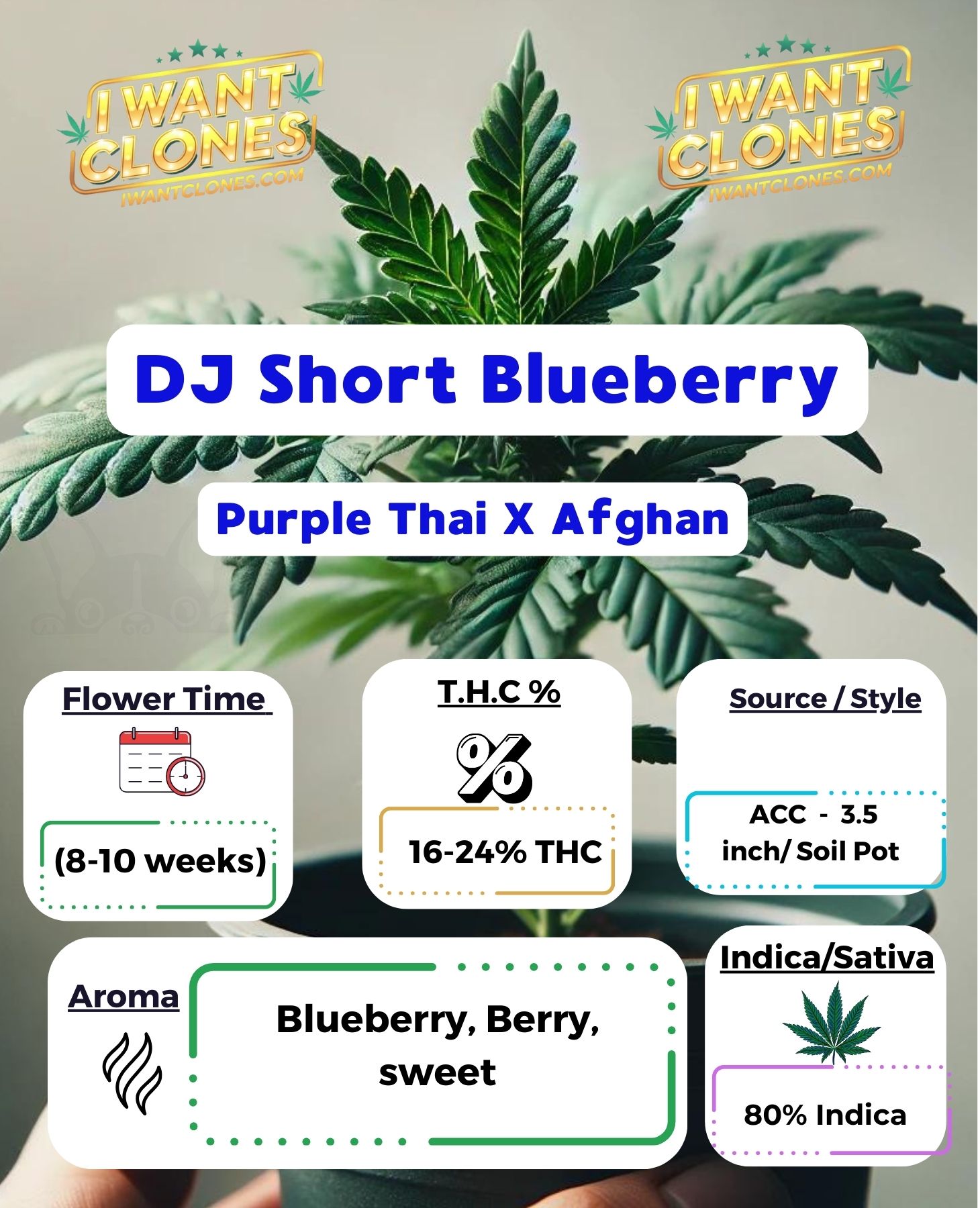
  • Flower time: 56–63 days (8–9 weeks) indoors
  • THC range: 17–20% (verified cuts, phenotype-dependent)
  • Dominant terpenes: Myrcene, caryophyllene, linalool, alpha-pinene
  • Purple/blue color: Triggered by nighttime temps below 60°F (15°C) in weeks 6–8 of flower
  • Difficulty: Intermediate — rewarding for growers who dial in their environment and flush well
  • Best training method: LST and SCROG; responds poorly to heavy defoliation late in flower

Heritage & Genetics: The Story Behind DJ Short Blueberry

DJ Short — widely regarded as one of cannabis breeding’s true legends — spent years in the Pacific Northwest developing what would become one of the most recognized strain families in history. His work in the late 1970s and early 1980s involved careful selection from rare Southeast Asian and Central Asian landrace seeds, many of which are essentially impossible to source today.

The Blueberry lineage draws from three primary sources. The first is a Thai sativa — a tall, long-flowering variety with powerful cerebral energy and unusual tropical fruit aromatics. The second is Highland Oaxacan Gold, a Mexican sativa prized for its uplifting, clear-headed effect profile. DJ Short used these two sativas partly to introduce the unique aromatic complexity that sets Blueberry apart from most indicas. The third pillar is an Afghani indica, which brings the compact structure, shorter flower time, resin production, and body-weight effect that grounds the whole experience.

DJ Short crossed and backcrossed these lines over multiple generations, selecting aggressively for the blue and purple pigmentation, the specific berry sweetness, and the balanced effect profile. The result was a strain that won the High Times Cannabis Cup in 2000 — a win that cemented its place in cannabis history. Wikipedia’s entry on Blueberry cannabis provides a good high-level overview of the strain’s cultural impact.

Today, dozens of breeders have used Blueberry as a parent to create crosses like Blue Dream, Blue Cheese, and Berry White. But the original DJ Short Blueberry — grown from a verified, authenticated cut — is a different experience from those offspring. The pure expression is what we carry at IWantClones.com.

Indica-Dominant, But Not a Pure Indica

It’s worth clarifying: Blueberry is indica-dominant, not a pure indica. The sativa input from the Thai and Oaxacan lines is part of what gives the effect profile its euphoric lift before the body relaxation sets in. Structurally, however, the plants grow much more like an indica — compact, bushy, with tight node spacing (typically 1–2 inches between nodes during vegetative growth) and broad, dark green fan leaves.

Phenotypic variation exists within the Blueberry family. Some phenos run more sativa in structure, stretching moderately in early flower. Others stay squat and produce enormous, dense lateral buds. A verified clone eliminates that uncertainty — you know the pheno you’re getting before you ever flip the lights.

Key Takeaways

  • Blueberry is a legendary indica-dominant strain from breeder DJ Short, built from Thai, Highland Oaxacan, and Afghani landrace genetics.
  • It is prized for a sweet, true-to-name blueberry aroma driven largely by myrcene and supporting terpenes.
  • Cool nighttime temperatures in late flower bring out Blueberry’s signature deep blue and purple bud colors.
  • Effects are relaxing and mellow, making Blueberry a popular evening and stress-relief choice.
  • Indoor flowering runs about 8-9 weeks with moderate, dense yields.
  • Buying Blueberry as a verified clone guarantees the true DJ Short phenotype, color, and flavor.

Blueberry Strain Quick-Reference Stats

Attribute Detail
Genetics Thai x Highland Oaxacan Gold x Afghani
Breeder DJ Short
Classification Indica-dominant hybrid (~80% indica / 20% sativa)
THC 17–20%
CBD <1%
Flower Time (Indoor) 56–63 days (8–9 weeks)
Outdoor Harvest Late September to mid-October
Indoor Height 24–40 inches (trained); up to 48 inches untrained
Indoor Yield 1.2–1.8 oz/ft² (well-dialed SCROG)
Dominant Terpenes Myrcene, caryophyllene, linalool, alpha-pinene
Aroma Profile Fresh blueberry, mixed berry jam, vanilla undertone, light earth
Grow Difficulty Intermediate
Best Training LST, SCROG, light topping in veg
Feeding Sensitivity Moderate feeder; nitrogen-sensitive in late flower

Terpene Profile & Aroma: What Makes Blueberry Smell Like Blueberry

Few strains have an aroma as immediately recognizable as DJ Short Blueberry. The moment you walk into a room where a healthy Blueberry plant is in mid-to-late flower, you know exactly what you’re smelling. That signature comes from a specific terpene combination that is worth understanding in detail — both because it helps you appreciate the genetics and because it guides how you treat the plant to protect those terps through harvest.

For a deeper background on how terpenes work in cannabis, our cannabis terpenes explained guide is a good starting point.

Myrcene

Myrcene is the most abundant terpene in most cannabis strains, and Blueberry is no exception. In Blueberry, myrcene contributes the ripe, musky fruit quality — the part that reads as actual blueberry rather than something more synthetic. High myrcene content is also associated with the heavy, sedative body quality this strain is known for. Myrcene is sensitive to heat; dry and cure at temperatures below 70°F to preserve it.

Caryophyllene

Beta-caryophyllene adds a subtle spice and wood note underneath the sweetness. It is the only terpene known to interact directly with CB2 receptors, and its presence is thought to round out Blueberry’s effect profile. Caryophyllene is more heat-stable than myrcene, making it a reliable terpene to detect in lab testing even after curing.

Linalool

Linalool is a floral terpene found in lavender and many herbs. In Blueberry, linalool contributes a soft, almost sweet perfume quality that smooths out what could otherwise be an overpoweringly fruity nose. Linalool is also commonly associated with calming, relaxing effects — which aligns with the overall experience this strain delivers.

Alpha-Pinene

Pinene adds a clean, fresh note that keeps Blueberry’s aroma from becoming cloying. In the plant during late veg and early flower, the pinene is quite prominent. As flower develops and myrcene production ramps up, the berry sweetness takes over and the pine note moves to the background. It remains detectable on the exhale.

To maximize terpene production, keep your grow room temperatures between 68–78°F during lights-on, with a 10–15°F temperature drop during lights-off in late flower. Low-stress environments — stable humidity (45–55% RH in flower), consistent light schedules, and avoiding major pH swings — let Blueberry express its full aromatic potential.

Effects & Experience: What Growers and Enthusiasts Report

Blueberry is widely popular among growers and enthusiasts for its balanced but body-forward effect profile. It is often chosen for its deeply calming and euphoric reputation — the kind of relaxation that settles in from head to toe without leaving the user feeling disconnected or foggy early in the experience.

Users frequently report an initial wave of gentle euphoria and mood lift — a quality that likely traces back to the Thai and Oaxacan sativa input in its lineage. This is not the racy, anxious head-buzz that some sativa-heavy strains produce. It is warm, comfortable, and social in the right setting. As time passes, the Afghani indica influence becomes more dominant, bringing a heavy body sensation that many users describe as ideal for winding down in the evening.

Blueberry is often cited in cannabis communities as one of the more approachable indica-dominant strains for users who are sensitive to high-THC cultivars. The terpene combination — particularly the high myrcene and linalool content — is thought to contribute to its smooth, non-overwhelming character. That said, at 17–20% THC, this is not a beginner-level strain for new users. Respect the dose.

“Blueberry is one of those strains where the terpenes do as much work as the cannabinoids. You smell it, and half the relaxation happens before you even light it.” — Heard from growers at cannabis events more times than we can count.

Important note: Nothing on this page is medical advice. Cannabis affects everyone differently. Always check your state’s legal status before purchasing, growing, or using cannabis products.

Growing Blueberry Clones: A Complete Cultivation Guide

Blueberry is an intermediate-level grow. It is not finicky in the way that some high-maintenance cultivars are, but it does reward attention to detail — especially around feeding in late flower and environmental control for color expression. Starting from a verified DJ Short Blueberry clone means you skip the seed-to-seedling phase and the phenotype lottery entirely. Your plant is rooted, sexed, and ready to grow from day one.

Vegetative Stage

Blueberry clones root quickly and establish well under 18/6 light schedules. Once your clone is rooted and showing active new growth, target a veg period of 3–5 weeks to develop a solid root system and canopy structure. The plant will develop a bushy, lateral growth habit naturally — you will not need to fight it into shape.

During veg, node spacing should be tight: 1–2 inches between nodes is ideal. If you’re seeing stretch (nodes more than 3 inches apart), your light intensity may be too low or your plant is too far from the source. Refer to our light requirements guide for cannabis clones for specific DLI and PPFD targets by growth stage.

Veg feeding for Blueberry: target a nutrient solution of 600–900 PPM (EC 1.2–1.8) with balanced N-P-K. The plant handles nitrogen well during this phase. Keep pH between 6.0–6.5 in soil or 5.8–6.2 in hydro/coco. After rooting your clone, read our comprehensive nutrient guide for new clones to dial in your feed schedule from week one.

When your plant has filled out to a size you are happy with — typically 12–18 inches for an indoor SCROG setup — it is time to transplant up and flip to flower. See our complete up-potting guide if you need help timing the transition to a larger container before the flip.

Training Blueberry: LST and SCROG

Blueberry’s naturally bushy, compact structure makes it an ideal candidate for low-stress training (LST) and screen of green (SCROG) techniques. Its lateral branching is strong, and bending main stems outward in early veg creates an even canopy that maximizes light penetration across all bud sites.

For LST: start bending the main stem outward when the plant has 4–6 nodes. Use soft ties or plant wire — never anything that will cut into the stem. Tie down each main branch so the canopy is as flat and even as possible. As new vertical growth appears, tie it down again. The goal is a flat, wide plant with all bud sites at roughly the same height going into flower.

For SCROG: install a screen at 8–12 inches above the pot. Weave branches through the screen as they grow, filling each square of the net before flipping. Aim for 80–90% canopy fill before switching to 12/12. Blueberry’s dense lateral branching fills a SCROG efficiently — a single well-trained plant can cover a 3×3 ft space. Our SCROG vs SOG guide breaks down when each method makes the most sense for your setup.

Topping is also effective on Blueberry — top once or twice during veg to create multiple main colas. Avoid heavy topping or fimming late in veg (within 2 weeks of flip), as recovery time eats into productive flower development. For step-by-step technique, see our topping and LST guide for cannabis clones.

Flowering Stage

Flip to 12/12 once your canopy is trained and your plants have the size you want. Blueberry flowers in 56–63 days — call it 8 to 9 weeks. During the first 10–14 days of flower (the “stretch phase”), plants can increase in height by 30–50%. Account for this in your training by leaving room above your SCROG screen.

Early flower (weeks 1–3): maintain feeds at 900–1,100 PPM (EC 1.8–2.2). Keep nitrogen in the mix but begin transitioning toward a phosphorus and potassium-dominant formula. Blueberry responds well to bloom boosters but does not need extreme levels — this is not a high-demand cultivar.

Mid-flower (weeks 4–6): bud sites swell rapidly. Drop nitrogen further; target a P-K-heavy formula at 1,000–1,200 PPM. Watch for signs of nitrogen excess: dark, clawing leaves or unusually deep green coloration in the upper canopy. If you see it, dial back your N and increase your flush intervals. At this stage, humidity should be at 45% RH or below to protect the dense bud structure from mold.

Late flower (weeks 7–9): reduce feeding to 600–800 PPM as the plant enters its final swell and senescence. Begin your flush 10–14 days before harvest. Blueberry benefits significantly from a proper flush — flushing clears residual mineral salts and lets the plant’s natural terpene expression come through fully at harvest. For timing your harvest precisely, our harvest timing guide covers trichome assessment in detail.

Feeding Notes and Sensitivity

Blueberry is a moderate feeder — not a heavy-feeding strain. The most common mistake growers make with this cultivar is pushing nitrogen too hard in late flower. Excess nitrogen in weeks 5–9 masks the terpene profile and produces a harsher end product. It also suppresses the purple and blue coloration that Blueberry is famous for — excess N keeps the plant greener longer and fights anthocyanin expression.

Watch your leaf tips. Slight tip burn at medium PPM levels (above 1,100 EC 2.2) is a sign to back off. This strain prefers to run slightly lean rather than heavy. A clean flush in the final two weeks is non-negotiable for premium results.

pH stability matters more with Blueberry than with some more forgiving strains. Swings outside the 6.0–6.5 range (soil) lock out the micronutrients that support terpene synthesis. If your terp profile is disappointing at harvest, pH instability during flower is often the culprit — not the genetics.

Phenotype Expression & Color: Getting That Purple and Blue

The purple and blue coloration in Blueberry comes from anthocyanins — the same pigment compounds responsible for color in blueberries, red cabbage, and purple flowers. Anthocyanin production in cannabis is triggered by temperature differentials, specifically by cool nighttime temperatures during the late flowering period.

To bring out maximum color in your Blueberry plants, target nighttime temperatures of 55–60°F (13–15°C) during weeks 6–9 of flower. This is the critical window. Temperatures below 55°F slow metabolic activity too much and can stress the plant; temperatures above 65°F during lights-off will suppress anthocyanin expression significantly.

The daytime (lights-on) temperature can remain at your standard 72–78°F. It’s the delta — the difference between day and night temps — that matters. A 15–20°F swing is ideal. Many indoor growers achieve this by lowering room temperature during the dark period using their HVAC system, or by running lights-on during nighttime hours when ambient temps are naturally cooler.

Genetics play the biggest role. Not every cannabis strain has the genetic potential to purple; Blueberry absolutely does, and expressing that color is largely an environmental unlock rather than a genetic question. A verified DJ Short Blueberry clone will color up under the right conditions. A seed-grown plant with unknown parentage may or may not, regardless of what you do environmentally.

Colors typically appear first in the calyxes and sugar leaves, then spread to the larger fan leaves as the plant approaches harvest. By day 55–60, a well-run Blueberry can display deep blue, violet, and indigo hues across the entire canopy. It is genuinely one of the most visually striking harvest rooms you can produce.

Indoor vs. Outdoor Growing for Blueberry

Indoor

Indoor is where Blueberry truly shines. The ability to control temperature precisely — especially to hit those 55–60°F nighttime temps during late flower — lets you unlock the full phenotype. You also have complete control over humidity (critical for a dense-budding indica), light spectrum, and harvest timing.

Under 600W HPS or equivalent LED in a 3×3 ft space with a SCROG, a single well-trained Blueberry clone can yield 2–3 oz of finished product. In a 4×4 space with 4 plants, yields of 8–12 oz are achievable with a dialed-in grow. Blueberry’s compact height makes it suitable for grow tents and rooms with ceiling heights as low as 5 feet when trained flat.

Outdoor

Outdoor Blueberry thrives in climates with warm summers and cool falls. The Pacific Northwest — DJ Short’s home territory — is ideal, as cool September and October nights naturally trigger color and the dry fall weather reduces mold risk. Mediterranean and similar climates work well too.

In outdoor settings, Blueberry finishes in late September to mid-October at most US latitudes. The compact indica structure handles wind reasonably well, but the dense bud formation is susceptible to bud rot in wet or humid fall climates. If you are in a high-humidity outdoor environment, choose a spot with excellent airflow and consider a light canopy defoliation in the final 3 weeks to improve air circulation.

Outdoor plants can reach 4–5 feet with full veg time. Yield potential is high — 3–6 oz per plant under good sun exposure, with exceptional specimens yielding more. Color expression outdoors is natural and often dramatic, especially at higher elevations or in areas with significant day-to-night temperature swings in early fall.

Why Choose a Clone Over Seeds for Blueberry

This is not a rhetorical question — there are real, practical reasons why experienced growers choose clones over seeds for a strain like Blueberry specifically.

Phenotypic consistency. Blueberry seeds — even from reputable breeders — produce a range of phenotypes. Some will be more sativa-leaning, some more indica. Some will express purple; others will stay green. Some will have the classic berry aroma; others will smell more like generic cannabis. Selecting “the” Blueberry pheno from seeds can take multiple generations of grow cycles and seed runs. A verified clone is already the selected pheno.

Genetic authenticity. The Blueberry name is one of the most widely misused in cannabis. Dispensaries, seed banks, and clone nurseries use it loosely. A clone that traces back to a verified DJ Short lineage cut is not the same thing as “Blueberry” seeds from a random online breeder. When you purchase from a source with traceable genetics — like our lineup at IWantClones.com — you know what you’re getting.

Time savings. Germinating seeds, nursing seedlings through early development, sexing plants (if not feminized), and then selecting the best phenotype can add 8–12 weeks to your grow timeline before you even get to the genetic selection work. Clones skip all of that. You start from a rooted, established, already-sexed female plant.

Known grow profile. With a verified clone, the grow characteristics — height, flower time, feeding needs, training response — are known quantities. You can plan your grow room, training schedule, and nutrient program with confidence before the plant ever arrives.

If you are still in the process of selecting which strain to grow, our clone strain selection guide walks through how to match a cultivar to your setup and goals. We also carry a curated selection of rare cannabis clone strains if Blueberry is not the only option you are considering.

Where to Get DJ Short Blueberry Clones

We carry verified DJ Short Blueberry clones at IWantClones.com, backed by the genetics expertise of SeedsHereNow.com — over 15 years in cannabis genetics. Every clone we ship is rooted, healthy, and inspected before it leaves our facility.

Here is what you get when you order from us:

  • $98.88 per clone — a premium price for a premium, verified cut
  • Overnight shipping — clones are living plants; we don’t mess around with transit time
  • 3-day guarantee — if your clone does not arrive alive and healthy, we make it right
  • US shipping only — we comply fully with US shipping regulations
  • Checkout handled securely through SeedsHereNow.com

Availability is limited — we don’t maintain an unlimited supply of any single cut. If you’re serious about growing DJ Short Blueberry this season, check current availability at the product page and order ahead. Browse the full lineup at our clone shop if you want to compare other available strains.

Legal note: Cannabis is a controlled substance under federal law in the United States. State and local laws regarding cannabis cultivation vary significantly. It is your responsibility to verify that cannabis cultivation is legal in your state and locality before purchasing clones or beginning a grow. IWantClones.com ships only to states where it is permitted to do so.

Frequently Asked Questions

How long does Blueberry strain take to flower?

DJ Short Blueberry finishes in 56–63 days (8–9 weeks) indoors under a 12/12 light schedule. Outdoor plants typically finish in late September to mid-October depending on latitude and local conditions. Pulling early at day 50 sacrifices yield and color; waiting until trichomes are mostly cloudy with some amber gives the best result. Use a jeweler’s loupe or digital microscope to assess trichome color before harvesting.

How do I get Blueberry plants to turn purple and blue?

Lower your nighttime (lights-off) temperature to 55–60°F during weeks 6–9 of flower. This triggers anthocyanin production, which creates the signature purple, blue, and violet pigmentation. The daytime temperature can stay at 72–78°F. A 15–20°F day-to-night swing is ideal. Genetics matter too — a verified DJ Short Blueberry clone has the built-in potential that many “Blueberry” seeds lack.

Is Blueberry strain good for beginner growers?

Blueberry is rated intermediate difficulty. It is not the most forgiving strain for first-time growers because of its sensitivity to nitrogen excess in late flower and its preference for stable pH and clean flushes. That said, it is far from the most difficult. Growers who have completed one or two successful grows and understand the basics of nutrients and environment will find Blueberry very manageable — and the results are highly rewarding.

What are the main terpenes in DJ Short Blueberry?

The dominant terpenes in Blueberry are myrcene (ripe fruit, musky berry), beta-caryophyllene (spice, wood), linalool (floral, lavender), and alpha-pinene (fresh pine). Myrcene is typically the most abundant and is responsible for the signature sweet blueberry scent. Linalool adds a smooth, floral quality. Together, these four terpenes create the iconic berry-jam-meets-earth aroma that makes Blueberry one of the most recognizable strains on the market.

Why buy a Blueberry clone instead of seeds?

Seeds — even from reputable breeders — produce phenotypic variation. You may grow ten Blueberry seeds and get ten slightly different plants in structure, aroma, and color expression. A verified clone is already phenotype-selected: you get the specific genetic expression that was chosen for its berry aroma, purple coloring, and classic DJ Short characteristics. You also skip the seedling phase and germination risk, saving 3–4 weeks of grow time from the start.

Share

Comments are closed.

Also recommended

Blueberry Strain & Clone Grow Guide (DJ Short Blueberry)

July 27, 2026

The Blueberry strain is an award-winning indica-dominant cannabis variety bred by DJ Short in the late 1970s and early 1980s, combining Thai, Highland Oaxacan Gold, and Afghani landrace genetics. It is best known for its intensely sweet berry aroma, deeply relaxing effects, and the stunning purple and blue phenotypes it expresses during late flower. If you want a true-to-type Blueberry with no guesswork, starting from a verified clone is the surest path to the classic DJ Short expression everyone is chasing.

  • Genetics: Indica-dominant hybrid — Thai x Highland Oaxacan Gold x Afghani landrace
  • Flower time: 56–63 days (8–9 weeks) indoors
  • THC range: 17–20% (verified cuts, phenotype-dependent)
  • Dominant terpenes: Myrcene, caryophyllene, linalool, alpha-pinene
  • Purple/blue color: Triggered by nighttime temps below 60°F (15°C) in weeks 6–8 of flower
  • Difficulty: Intermediate — rewarding for growers who dial in their environment and flush well
  • Best training method: LST and SCROG; responds poorly to heavy defoliation late in flower

Heritage & Genetics: The Story Behind DJ Short Blueberry

DJ Short — widely regarded as one of cannabis breeding’s true legends — spent years in the Pacific Northwest developing what would become one of the most recognized strain families in history. His work in the late 1970s and early 1980s involved careful selection from rare Southeast Asian and Central Asian landrace seeds, many of which are essentially impossible to source today.

The Blueberry lineage draws from three primary sources. The first is a Thai sativa — a tall, long-flowering variety with powerful cerebral energy and unusual tropical fruit aromatics. The second is Highland Oaxacan Gold, a Mexican sativa prized for its uplifting, clear-headed effect profile. DJ Short used these two sativas partly to introduce the unique aromatic complexity that sets Blueberry apart from most indicas. The third pillar is an Afghani indica, which brings the compact structure, shorter flower time, resin production, and body-weight effect that grounds the whole experience.

DJ Short crossed and backcrossed these lines over multiple generations, selecting aggressively for the blue and purple pigmentation, the specific berry sweetness, and the balanced effect profile. The result was a strain that won the High Times Cannabis Cup in 2000 — a win that cemented its place in cannabis history. Wikipedia’s entry on Blueberry cannabis provides a good high-level overview of the strain’s cultural impact.

Today, dozens of breeders have used Blueberry as a parent to create crosses like Blue Dream, Blue Cheese, and Berry White. But the original DJ Short Blueberry — grown from a verified, authenticated cut — is a different experience from those offspring. The pure expression is what we carry at IWantClones.com.

Indica-Dominant, But Not a Pure Indica

It’s worth clarifying: Blueberry is indica-dominant, not a pure indica. The sativa input from the Thai and Oaxacan lines is part of what gives the effect profile its euphoric lift before the body relaxation sets in. Structurally, however, the plants grow much more like an indica — compact, bushy, with tight node spacing (typically 1–2 inches between nodes during vegetative growth) and broad, dark green fan leaves.

Phenotypic variation exists within the Blueberry family. Some phenos run more sativa in structure, stretching moderately in early flower. Others stay squat and produce enormous, dense lateral buds. A verified clone eliminates that uncertainty — you know the pheno you’re getting before you ever flip the lights.

Key Takeaways

  • Blueberry is a legendary indica-dominant strain from breeder DJ Short, built from Thai, Highland Oaxacan, and Afghani landrace genetics.
  • It is prized for a sweet, true-to-name blueberry aroma driven largely by myrcene and supporting terpenes.
  • Cool nighttime temperatures in late flower bring out Blueberry’s signature deep blue and purple bud colors.
  • Effects are relaxing and mellow, making Blueberry a popular evening and stress-relief choice.
  • Indoor flowering runs about 8-9 weeks with moderate, dense yields.
  • Buying Blueberry as a verified clone guarantees the true DJ Short phenotype, color, and flavor.

Blueberry Strain Quick-Reference Stats

Attribute Detail
Genetics Thai x Highland Oaxacan Gold x Afghani
Breeder DJ Short
Classification Indica-dominant hybrid (~80% indica / 20% sativa)
THC 17–20%
CBD <1%
Flower Time (Indoor) 56–63 days (8–9 weeks)
Outdoor Harvest Late September to mid-October
Indoor Height 24–40 inches (trained); up to 48 inches untrained
Indoor Yield 1.2–1.8 oz/ft² (well-dialed SCROG)
Dominant Terpenes Myrcene, caryophyllene, linalool, alpha-pinene
Aroma Profile Fresh blueberry, mixed berry jam, vanilla undertone, light earth
Grow Difficulty Intermediate
Best Training LST, SCROG, light topping in veg
Feeding Sensitivity Moderate feeder; nitrogen-sensitive in late flower

Terpene Profile & Aroma: What Makes Blueberry Smell Like Blueberry

Few strains have an aroma as immediately recognizable as DJ Short Blueberry. The moment you walk into a room where a healthy Blueberry plant is in mid-to-late flower, you know exactly what you’re smelling. That signature comes from a specific terpene combination that is worth understanding in detail — both because it helps you appreciate the genetics and because it guides how you treat the plant to protect those terps through harvest.

For a deeper background on how terpenes work in cannabis, our cannabis terpenes explained guide is a good starting point.

Myrcene

Myrcene is the most abundant terpene in most cannabis strains, and Blueberry is no exception. In Blueberry, myrcene contributes the ripe, musky fruit quality — the part that reads as actual blueberry rather than something more synthetic. High myrcene content is also associated with the heavy, sedative body quality this strain is known for. Myrcene is sensitive to heat; dry and cure at temperatures below 70°F to preserve it.

Caryophyllene

Beta-caryophyllene adds a subtle spice and wood note underneath the sweetness. It is the only terpene known to interact directly with CB2 receptors, and its presence is thought to round out Blueberry’s effect profile. Caryophyllene is more heat-stable than myrcene, making it a reliable terpene to detect in lab testing even after curing.

Linalool

Linalool is a floral terpene found in lavender and many herbs. In Blueberry, linalool contributes a soft, almost sweet perfume quality that smooths out what could otherwise be an overpoweringly fruity nose. Linalool is also commonly associated with calming, relaxing effects — which aligns with the overall experience this strain delivers.

Alpha-Pinene

Pinene adds a clean, fresh note that keeps Blueberry’s aroma from becoming cloying. In the plant during late veg and early flower, the pinene is quite prominent. As flower develops and myrcene production ramps up, the berry sweetness takes over and the pine note moves to the background. It remains detectable on the exhale.

To maximize terpene production, keep your grow room temperatures between 68–78°F during lights-on, with a 10–15°F temperature drop during lights-off in late flower. Low-stress environments — stable humidity (45–55% RH in flower), consistent light schedules, and avoiding major pH swings — let Blueberry express its full aromatic potential.

Effects & Experience: What Growers and Enthusiasts Report

Blueberry is widely popular among growers and enthusiasts for its balanced but body-forward effect profile. It is often chosen for its deeply calming and euphoric reputation — the kind of relaxation that settles in from head to toe without leaving the user feeling disconnected or foggy early in the experience.

Users frequently report an initial wave of gentle euphoria and mood lift — a quality that likely traces back to the Thai and Oaxacan sativa input in its lineage. This is not the racy, anxious head-buzz that some sativa-heavy strains produce. It is warm, comfortable, and social in the right setting. As time passes, the Afghani indica influence becomes more dominant, bringing a heavy body sensation that many users describe as ideal for winding down in the evening.

Blueberry is often cited in cannabis communities as one of the more approachable indica-dominant strains for users who are sensitive to high-THC cultivars. The terpene combination — particularly the high myrcene and linalool content — is thought to contribute to its smooth, non-overwhelming character. That said, at 17–20% THC, this is not a beginner-level strain for new users. Respect the dose.

“Blueberry is one of those strains where the terpenes do as much work as the cannabinoids. You smell it, and half the relaxation happens before you even light it.” — Heard from growers at cannabis events more times than we can count.

Important note: Nothing on this page is medical advice. Cannabis affects everyone differently. Always check your state’s legal status before purchasing, growing, or using cannabis products.

Growing Blueberry Clones: A Complete Cultivation Guide

Blueberry is an intermediate-level grow. It is not finicky in the way that some high-maintenance cultivars are, but it does reward attention to detail — especially around feeding in late flower and environmental control for color expression. Starting from a verified DJ Short Blueberry clone means you skip the seed-to-seedling phase and the phenotype lottery entirely. Your plant is rooted, sexed, and ready to grow from day one.

Vegetative Stage

Blueberry clones root quickly and establish well under 18/6 light schedules. Once your clone is rooted and showing active new growth, target a veg period of 3–5 weeks to develop a solid root system and canopy structure. The plant will develop a bushy, lateral growth habit naturally — you will not need to fight it into shape.

During veg, node spacing should be tight: 1–2 inches between nodes is ideal. If you’re seeing stretch (nodes more than 3 inches apart), your light intensity may be too low or your plant is too far from the source. Refer to our light requirements guide for cannabis clones for specific DLI and PPFD targets by growth stage.

Veg feeding for Blueberry: target a nutrient solution of 600–900 PPM (EC 1.2–1.8) with balanced N-P-K. The plant handles nitrogen well during this phase. Keep pH between 6.0–6.5 in soil or 5.8–6.2 in hydro/coco. After rooting your clone, read our comprehensive nutrient guide for new clones to dial in your feed schedule from week one.

When your plant has filled out to a size you are happy with — typically 12–18 inches for an indoor SCROG setup — it is time to transplant up and flip to flower. See our complete up-potting guide if you need help timing the transition to a larger container before the flip.

Training Blueberry: LST and SCROG

Blueberry’s naturally bushy, compact structure makes it an ideal candidate for low-stress training (LST) and screen of green (SCROG) techniques. Its lateral branching is strong, and bending main stems outward in early veg creates an even canopy that maximizes light penetration across all bud sites.

For LST: start bending the main stem outward when the plant has 4–6 nodes. Use soft ties or plant wire — never anything that will cut into the stem. Tie down each main branch so the canopy is as flat and even as possible. As new vertical growth appears, tie it down again. The goal is a flat, wide plant with all bud sites at roughly the same height going into flower.

For SCROG: install a screen at 8–12 inches above the pot. Weave branches through the screen as they grow, filling each square of the net before flipping. Aim for 80–90% canopy fill before switching to 12/12. Blueberry’s dense lateral branching fills a SCROG efficiently — a single well-trained plant can cover a 3×3 ft space. Our SCROG vs SOG guide breaks down when each method makes the most sense for your setup.

Topping is also effective on Blueberry — top once or twice during veg to create multiple main colas. Avoid heavy topping or fimming late in veg (within 2 weeks of flip), as recovery time eats into productive flower development. For step-by-step technique, see our topping and LST guide for cannabis clones.

Flowering Stage

Flip to 12/12 once your canopy is trained and your plants have the size you want. Blueberry flowers in 56–63 days — call it 8 to 9 weeks. During the first 10–14 days of flower (the “stretch phase”), plants can increase in height by 30–50%. Account for this in your training by leaving room above your SCROG screen.

Early flower (weeks 1–3): maintain feeds at 900–1,100 PPM (EC 1.8–2.2). Keep nitrogen in the mix but begin transitioning toward a phosphorus and potassium-dominant formula. Blueberry responds well to bloom boosters but does not need extreme levels — this is not a high-demand cultivar.

Mid-flower (weeks 4–6): bud sites swell rapidly. Drop nitrogen further; target a P-K-heavy formula at 1,000–1,200 PPM. Watch for signs of nitrogen excess: dark, clawing leaves or unusually deep green coloration in the upper canopy. If you see it, dial back your N and increase your flush intervals. At this stage, humidity should be at 45% RH or below to protect the dense bud structure from mold.

Late flower (weeks 7–9): reduce feeding to 600–800 PPM as the plant enters its final swell and senescence. Begin your flush 10–14 days before harvest. Blueberry benefits significantly from a proper flush — flushing clears residual mineral salts and lets the plant’s natural terpene expression come through fully at harvest. For timing your harvest precisely, our harvest timing guide covers trichome assessment in detail.

Feeding Notes and Sensitivity

Blueberry is a moderate feeder — not a heavy-feeding strain. The most common mistake growers make with this cultivar is pushing nitrogen too hard in late flower. Excess nitrogen in weeks 5–9 masks the terpene profile and produces a harsher end product. It also suppresses the purple and blue coloration that Blueberry is famous for — excess N keeps the plant greener longer and fights anthocyanin expression.

Watch your leaf tips. Slight tip burn at medium PPM levels (above 1,100 EC 2.2) is a sign to back off. This strain prefers to run slightly lean rather than heavy. A clean flush in the final two weeks is non-negotiable for premium results.

pH stability matters more with Blueberry than with some more forgiving strains. Swings outside the 6.0–6.5 range (soil) lock out the micronutrients that support terpene synthesis. If your terp profile is disappointing at harvest, pH instability during flower is often the culprit — not the genetics.

Phenotype Expression & Color: Getting That Purple and Blue

The purple and blue coloration in Blueberry comes from anthocyanins — the same pigment compounds responsible for color in blueberries, red cabbage, and purple flowers. Anthocyanin production in cannabis is triggered by temperature differentials, specifically by cool nighttime temperatures during the late flowering period.

To bring out maximum color in your Blueberry plants, target nighttime temperatures of 55–60°F (13–15°C) during weeks 6–9 of flower. This is the critical window. Temperatures below 55°F slow metabolic activity too much and can stress the plant; temperatures above 65°F during lights-off will suppress anthocyanin expression significantly.

The daytime (lights-on) temperature can remain at your standard 72–78°F. It’s the delta — the difference between day and night temps — that matters. A 15–20°F swing is ideal. Many indoor growers achieve this by lowering room temperature during the dark period using their HVAC system, or by running lights-on during nighttime hours when ambient temps are naturally cooler.

Genetics play the biggest role. Not every cannabis strain has the genetic potential to purple; Blueberry absolutely does, and expressing that color is largely an environmental unlock rather than a genetic question. A verified DJ Short Blueberry clone will color up under the right conditions. A seed-grown plant with unknown parentage may or may not, regardless of what you do environmentally.

Colors typically appear first in the calyxes and sugar leaves, then spread to the larger fan leaves as the plant approaches harvest. By day 55–60, a well-run Blueberry can display deep blue, violet, and indigo hues across the entire canopy. It is genuinely one of the most visually striking harvest rooms you can produce.

Indoor vs. Outdoor Growing for Blueberry

Indoor

Indoor is where Blueberry truly shines. The ability to control temperature precisely — especially to hit those 55–60°F nighttime temps during late flower — lets you unlock the full phenotype. You also have complete control over humidity (critical for a dense-budding indica), light spectrum, and harvest timing.

Under 600W HPS or equivalent LED in a 3×3 ft space with a SCROG, a single well-trained Blueberry clone can yield 2–3 oz of finished product. In a 4×4 space with 4 plants, yields of 8–12 oz are achievable with a dialed-in grow. Blueberry’s compact height makes it suitable for grow tents and rooms with ceiling heights as low as 5 feet when trained flat.

Outdoor

Outdoor Blueberry thrives in climates with warm summers and cool falls. The Pacific Northwest — DJ Short’s home territory — is ideal, as cool September and October nights naturally trigger color and the dry fall weather reduces mold risk. Mediterranean and similar climates work well too.

In outdoor settings, Blueberry finishes in late September to mid-October at most US latitudes. The compact indica structure handles wind reasonably well, but the dense bud formation is susceptible to bud rot in wet or humid fall climates. If you are in a high-humidity outdoor environment, choose a spot with excellent airflow and consider a light canopy defoliation in the final 3 weeks to improve air circulation.

Outdoor plants can reach 4–5 feet with full veg time. Yield potential is high — 3–6 oz per plant under good sun exposure, with exceptional specimens yielding more. Color expression outdoors is natural and often dramatic, especially at higher elevations or in areas with significant day-to-night temperature swings in early fall.

Why Choose a Clone Over Seeds for Blueberry

This is not a rhetorical question — there are real, practical reasons why experienced growers choose clones over seeds for a strain like Blueberry specifically.

Phenotypic consistency. Blueberry seeds — even from reputable breeders — produce a range of phenotypes. Some will be more sativa-leaning, some more indica. Some will express purple; others will stay green. Some will have the classic berry aroma; others will smell more like generic cannabis. Selecting “the” Blueberry pheno from seeds can take multiple generations of grow cycles and seed runs. A verified clone is already the selected pheno.

Genetic authenticity. The Blueberry name is one of the most widely misused in cannabis. Dispensaries, seed banks, and clone nurseries use it loosely. A clone that traces back to a verified DJ Short lineage cut is not the same thing as “Blueberry” seeds from a random online breeder. When you purchase from a source with traceable genetics — like our lineup at IWantClones.com — you know what you’re getting.

Time savings. Germinating seeds, nursing seedlings through early development, sexing plants (if not feminized), and then selecting the best phenotype can add 8–12 weeks to your grow timeline before you even get to the genetic selection work. Clones skip all of that. You start from a rooted, established, already-sexed female plant.

Known grow profile. With a verified clone, the grow characteristics — height, flower time, feeding needs, training response — are known quantities. You can plan your grow room, training schedule, and nutrient program with confidence before the plant ever arrives.

If you are still in the process of selecting which strain to grow, our clone strain selection guide walks through how to match a cultivar to your setup and goals. We also carry a curated selection of rare cannabis clone strains if Blueberry is not the only option you are considering.

Where to Get DJ Short Blueberry Clones

We carry verified DJ Short Blueberry clones at IWantClones.com, backed by the genetics expertise of SeedsHereNow.com — over 15 years in cannabis genetics. Every clone we ship is rooted, healthy, and inspected before it leaves our facility.

Here is what you get when you order from us:

  • $98.88 per clone — a premium price for a premium, verified cut
  • Overnight shipping — clones are living plants; we don’t mess around with transit time
  • 3-day guarantee — if your clone does not arrive alive and healthy, we make it right
  • US shipping only — we comply fully with US shipping regulations
  • Checkout handled securely through SeedsHereNow.com

Availability is limited — we don’t maintain an unlimited supply of any single cut. If you’re serious about growing DJ Short Blueberry this season, check current availability at the product page and order ahead. Browse the full lineup at our clone shop if you want to compare other available strains.

Legal note: Cannabis is a controlled substance under federal law in the United States. State and local laws regarding cannabis cultivation vary significantly. It is your responsibility to verify that cannabis cultivation is legal in your state and locality before purchasing clones or beginning a grow. IWantClones.com ships only to states where it is permitted to do so.

Frequently Asked Questions

How long does Blueberry strain take to flower?

DJ Short Blueberry finishes in 56–63 days (8–9 weeks) indoors under a 12/12 light schedule. Outdoor plants typically finish in late September to mid-October depending on latitude and local conditions. Pulling early at day 50 sacrifices yield and color; waiting until trichomes are mostly cloudy with some amber gives the best result. Use a jeweler’s loupe or digital microscope to assess trichome color before harvesting.

How do I get Blueberry plants to turn purple and blue?

Lower your nighttime (lights-off) temperature to 55–60°F during weeks 6–9 of flower. This triggers anthocyanin production, which creates the signature purple, blue, and violet pigmentation. The daytime temperature can stay at 72–78°F. A 15–20°F day-to-night swing is ideal. Genetics matter too — a verified DJ Short Blueberry clone has the built-in potential that many “Blueberry” seeds lack.

Is Blueberry strain good for beginner growers?

Blueberry is rated intermediate difficulty. It is not the most forgiving strain for first-time growers because of its sensitivity to nitrogen excess in late flower and its preference for stable pH and clean flushes. That said, it is far from the most difficult. Growers who have completed one or two successful grows and understand the basics of nutrients and environment will find Blueberry very manageable — and the results are highly rewarding.

What are the main terpenes in DJ Short Blueberry?

The dominant terpenes in Blueberry are myrcene (ripe fruit, musky berry), beta-caryophyllene (spice, wood), linalool (floral, lavender), and alpha-pinene (fresh pine). Myrcene is typically the most abundant and is responsible for the signature sweet blueberry scent. Linalool adds a smooth, floral quality. Together, these four terpenes create the iconic berry-jam-meets-earth aroma that makes Blueberry one of the most recognizable strains on the market.

Why buy a Blueberry clone instead of seeds?

Seeds — even from reputable breeders — produce phenotypic variation. You may grow ten Blueberry seeds and get ten slightly different plants in structure, aroma, and color expression. A verified clone is already phenotype-selected: you get the specific genetic expression that was chosen for its berry aroma, purple coloring, and classic DJ Short characteristics. You also skip the seedling phase and germination risk, saving 3–4 weeks of grow time from the start.

Written by James Bean

Recent Posts

Nutrient Lockout & How to Flush Cannabis Plants

Nutrient lockout stops plants from absorbing food even when it’s present. Learn the causes, symptoms, how to diagnose with runoff EC/pH, and how to flush cannabis correctly.

Read More
Best Dessert & Sweet Cannabis Strains (Top Clones)

Shop the best dessert cannabis strains — Gelato, Runtz, Sundae Driver, Cookies and Cream & more. Verified clones shipped overnight from IWantClones.com.

Read More
Best Energizing Cannabis Strains for Daytime & Focus

Discover the best strains for energy — sativa-dominant clones with limonene, terpinolene & pinene. Shop Sour Diesel, Jack Herer & more. US shipping, 3-day guarantee.

Read More

Subscribe Today!

Get 10% off when you sign up for our weekly updates!

About Us

At IWantClones.com, we are dedicated to providing top-quality cannabis clones to growers of all levels.

Subscribe Today!

Subscribe our newsletter to get our latest update & news
We currently accept credit/debit card payments, cash, check, money order, bitcoin (BTC), litecoin (LTE), bitcoin cash (BCH), and dogecoin (DOGE).
© 2026 seedsherenow.com All Rights Reserved
magnifiercross linkedin facebook pinterest youtube rss twitter instagram facebook-blank rss-blank linkedin-blank pinterest youtube twitter instagram