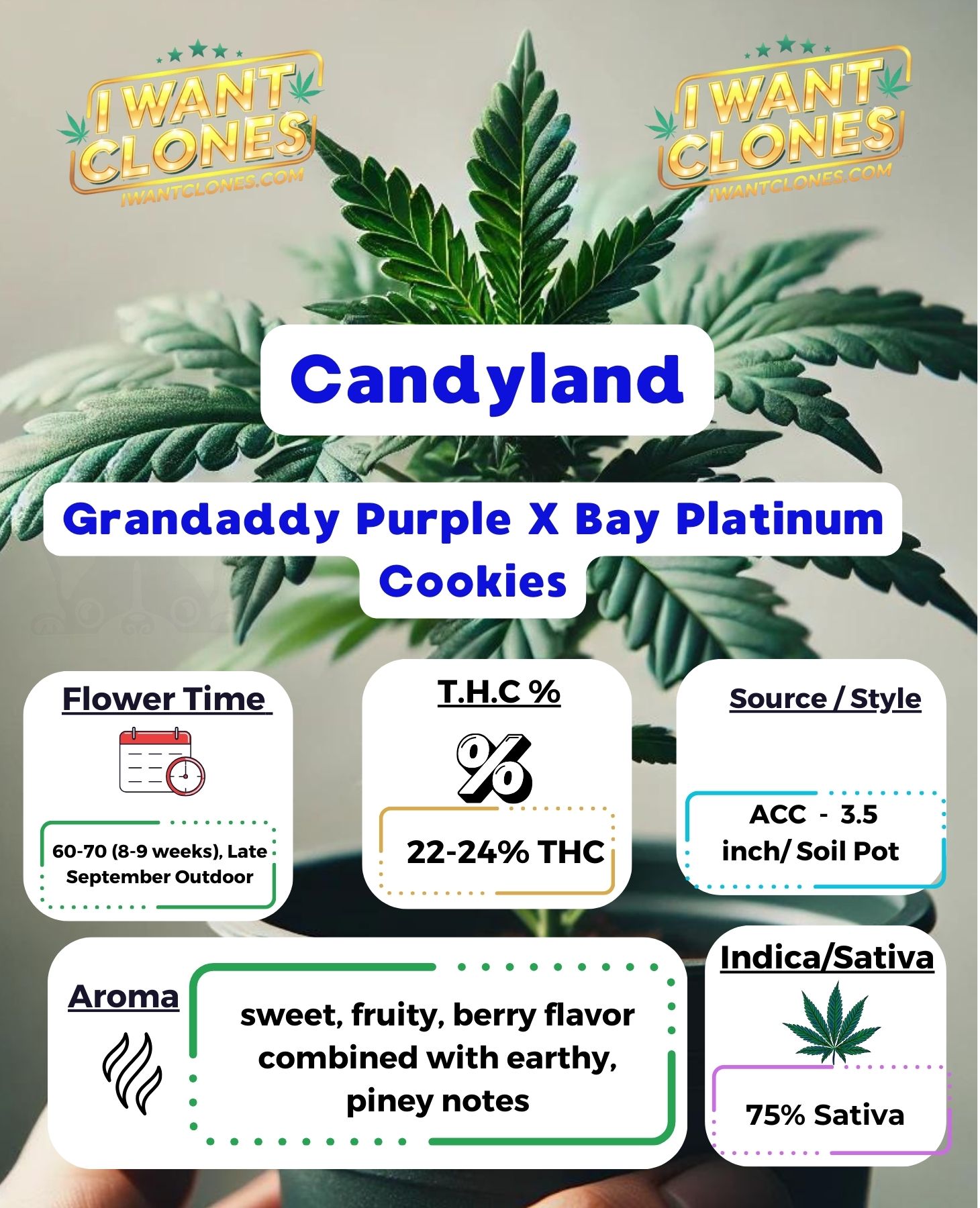
The Candyland strain is a sativa-dominant hybrid bred by Ken Estes in California, born from a cross of Granddaddy Purple and Platinum Girl Scout Cookies. It won the 2012 San Francisco Cannabis Cup in the sativa category and has earned a devoted following ever since. If you want a daytime strain that delivers euphoria, creativity, and a sweet candy aroma without knocking you flat, Candyland belongs on your grow list.
Key Takeaways
- Candyland is a cross of Granddaddy Purple x Platinum GSC, bred by Ken Estes in California.
- It won the 2012 San Francisco Cannabis Cup in the sativa category.
- THC levels run 19–25%, making it potent but accessible for most experienced users.
- Dominant terpenes are beta-caryophyllene, myrcene, and limonene — delivering a spicy-sweet-citrus nose.
- Flower time is 8–9 weeks with indoor yields of 400–500g/m² and up to 600g per plant outdoors.
- Clones from a verified source lock in the award-winning phenotype that seeds simply cannot guarantee.
What Is the Candyland Strain?
Candyland is the result of Ken Estes crossing Granddaddy Purple — his own legendary California creation — with Platinum Girl Scout Cookies, a premium cut of the Bay Area’s most celebrated cookie line. The goal was to combine GDP’s colorful bag appeal and relaxing body notes with Platinum GSC’s crushing resin production and cerebral punch. The result exceeded the goal by a wide margin.
The strain debuted to serious competition buzz and took home the sativa title at the 2012 San Francisco Cannabis Cup. That win wasn’t just hype — judges responded to a profile that was genuinely different: uplifting and social rather than sedating, with complexity in the nose that you don’t usually find in a first-place sativa. From that moment, Candyland became a California staple.
What makes the lineage especially interesting is the contrast at play. GDP leans indica and brings the purple pigmentation, the earthy depth, and the body softness. Platinum GSC brings the gas, the cookies dough sweetness, and the heady sativa energy. Ken Estes didn’t average those two traits — he layered them. The result is a plant that grows tall and sativa-ish above the canopy but produces dense, frost-covered buds with the visual appeal of a top-shelf indica.
You can read more about related genetics in our Gelato strain family guide, which traces the broader cookie lineage that overlaps with Candyland’s Platinum GSC parent. Understanding where these genetics come from helps you predict how a plant will behave in your space.
Candyland Strain Terpene Profile
Terpenes are what you smell, taste, and ultimately feel. With Candyland, the three heavy hitters are beta-caryophyllene, myrcene, and limonene, and each one is doing real work in the jar.
Beta-caryophyllene is the spicy, peppery backbone. It’s the terpene that makes you think of black pepper and cloves, and it’s one of the few terpenes that also binds directly to CB2 receptors in the body. In Candyland, it gives the finish a dry, slightly sharp edge that balances all the sweetness coming in from the front end.
Myrcene provides the earthy, herbal foundation — a slightly musky quality that grounds the nose and keeps Candyland from smelling purely like a candy store. Myrcene is the most common terpene in cannabis and is responsible for much of the classic “weed” aroma. Here it plays a supporting role, adding depth without dominating.
Limonene brings the citrus lift on the inhale. It’s bright and clean, almost like lemon candy, and it’s the reason Candyland smells as cheerful as it tastes. Limonene is associated with mood elevation, which fits neatly with Candyland’s reputation as a pick-me-up strain.
Put it all together and you get an aroma that opens with sweet candy and fresh citrus, settles into an earthy, herbal mid, and finishes with a spicy, almost sandalwood warmth on the exhale. The flavor closely mirrors the nose. Properly cured Candyland — especially a clone-grown specimen from a proven cut — is one of the more complex-tasting sativa hybrids on the market. Check out Leafly’s Candyland strain profile for community tasting notes that reinforce just how consistent this terpene expression runs across well-grown cuts.
Candyland Strain Effects and Experience
Candyland is a daytime strain. We say that plainly because it matters — if you’re looking for something to ease you into sleep or park you on the couch, this isn’t your plant. But if you want a clear-headed, social, and creatively energetic experience, Candyland delivers consistently.
The onset is fast and noticeable. Users typically report a cerebral rush within the first few minutes — a lift in mood, a sharpening of focus, and a social ease that makes conversation feel natural and fun. This is GDP’s counterintuitive contribution: the indica genetics don’t sedate here; instead, they seem to soften the edges of the GSC’s racier sativa tendencies, keeping the headspace euphoric rather than anxious.
Body effects are present but light. There’s a gentle warmth that moves through the muscles without becoming heavy. Most people describe it as a physical comfort that lets you stay active rather than a relaxation that asks you to sit down. That combination — heady euphoria plus light body ease — is exactly what made Candyland a Cannabis Cup winner. It’s the kind of strain that works in a creative session, a social gathering, an outdoor activity, or just getting things done.
THC runs 19–25%, which means newer consumers should start slow. At those levels, the sativa-leaning effects can intensify quickly, and some users report a slight increase in racing thoughts at high doses. The key is dosing with intention. For most experienced consumers, though, Candyland is the rare high-THC strain that feels manageable and functional.
Candyland doesn’t hit you over the head — it opens a door. The creativity, the conversation, the energy: it all feels like it was already there. Candyland just gave it room to move.
Candyland Strain at a Glance
| Detail | Candyland |
|---|---|
| Genetics | Granddaddy Purple x Platinum GSC |
| Breeder | Ken Estes |
| Type | Sativa-dominant hybrid |
| THC | 19–25% |
| Terpenes | Beta-caryophyllene, Myrcene, Limonene |
| Flower Time | 8–9 weeks (56–63 days) |
| Yield Indoor | 400–500g/m² |
| Yield Outdoor | Up to 600g/plant |
| Awards | 1st Place Sativa, 2012 SF Cannabis Cup |
Growing the Candyland Strain: What to Expect
Candyland is a grower’s strain in the best sense. It’s not a beginner’s trap that punishes every small mistake, but it does reward growers who pay attention to structure, airflow, and nutrition. The genetics ask for some management, and when you give them that, the plant returns something special.
The first thing you’ll notice is the structure. Candyland grows tall with a strong central stalk and elongated colas that can get heavy as they fatten in late flower. Outdoor plants can push past six feet without any height management. Indoors, you’ll want to plan for that vertical stretch and train accordingly.
Vegetative Stage
During veg, Candyland moves at a steady, confident pace. It’s not the fastest-growing strain, but it doesn’t drag either. Node spacing is moderate, and the plant builds a solid structure before it starts to stretch. Expect branches that are strong enough to support heavy colas later — this is one plant that actually benefits from that robust veg period.
We recommend a 4–6 week veg period indoors depending on your space. Shorter if you’re working in a 4×4 tent and want to keep height in check; longer if you have vertical room and want to maximize site count before flipping. Outdoors, let the natural photoperiod drive it. Transplant rooted clones after the last frost and let her go.
During veg, top early and often if you’re planning a multi-cola setup. Candyland responds well to topping and quickly rebounds to push two vigorous shoots where one was cut. You’re setting the structure now that will hold those colas in flower, so put in the work during this phase.
Flowering Stage and Timeline
Flip the lights to 12/12 and Candyland will stretch — sometimes significantly. Expect a 50–75% height increase in the first two to three weeks of flower. If you haven’t done any height management during veg, that stretch can push into your lights fast. Plan for it.
After the stretch settles, the plant starts stacking. Buds build along the full length of each cola, creating long, dense flower clusters that don’t always look impressive at week four but absolutely do by week seven. The purple and gold coloring that Candyland is known for tends to show up in the final two weeks when night temperatures drop into the low 60s Fahrenheit. It’s not required — you’ll still get great bud without it — but the cold-triggered coloring is part of what makes a well-grown Candyland genuinely beautiful.
Full flower time runs 56–63 days (8–9 weeks). Most growers hit the sweet spot around day 58–60. Don’t rush this. Pulling early costs you terpene development, potency, and that candy-sweet finish that defines the strain.
Training Techniques for Candyland
Candyland’s tall, branchy structure makes it an ideal candidate for training. We especially like it in a SCROG (Screen of Green) setup because the long colas fill horizontal space beautifully once they’re woven through a net. Read our full SCROG vs SOG comparison if you’re deciding between methods — for Candyland specifically, SCROG almost always outperforms SOG because you’re working with one vigorous plant that wants to spread rather than a canopy of smaller plants.
Low-stress training (LST) works equally well for growers who want a less hands-intensive approach. Bend the main stalk and outer branches horizontally early in veg to open up the canopy and let lower bud sites catch more light. Our full breakdown of topping and LST techniques walks through exactly how to approach this with clone-started plants, which begin training with an advantage because their root system is more established at transplant than a seedling’s.
Whatever method you choose, the goal is the same: get as much of the plant’s canopy into the same light footprint at roughly the same height. Candyland will reward that work with even, heavy production across all trained sites.
Feeding and Nutrients
Candyland is a moderate-to-heavy feeder. It wants a solid nutrient base and won’t shy away from higher EC levels as it moves through mid-flower. That said, it’s not a strain you run at maximum dose from day one — build up gradually, watch your leaves, and adjust.
The one micronutrient to watch closely is magnesium. Candyland has a documented tendency toward magnesium deficiency, which shows up as yellowing between the leaf veins (interveinal chlorosis) while the veins themselves stay green. If you see that pattern, it’s almost certainly Mg. Add CalMag at 2–5ml per gallon with your regular watering and the issue typically clears within a week. Running RO water makes this even more important since you’re starting with a blank mineral slate.
In general terms: standard vegetative nitrogen-heavy feeding during veg, a gradual transition to phosphorus and potassium-forward feeding as you flip to flower, and a clean flush in the final 7–10 days before harvest to clear any residual salts. Our detailed cannabis clone nutrient guide covers this progression in full, with specific timing and dosing recommendations for clone-started plants that apply directly to Candyland.
Environment and Climate
Keep temperatures between 70–80°F (21–27°C) during the day and no lower than 60°F (15°C) at night in the vegetative stage. In flower, you can let night temps dip to the low 60s deliberately to trigger that purple and gold pigmentation — it won’t harm the plant and it will make your buds look extraordinary.
Humidity is a critical control point with Candyland. During veg, 50–70% RH is fine. Once you’re in flower, bring humidity down to 40–50%. Candyland’s dense bud structure and the tight stacking of late flower create conditions where moisture can get trapped if airflow and RH aren’t managed carefully. Keep your oscillating fans moving air through the canopy at all times.
CO2 supplementation is optional but beneficial if you’re running high-intensity lights. Candyland can use elevated CO2 levels effectively, especially in mid-flower when the plant is at peak metabolic activity. Not a requirement for a great grow, but it’s a tool that delivers a measurable return with this strain.
Common Issues When Growing Candyland
Powdery mildew (PM) is the most significant risk. If relative humidity climbs above 55% in flower — even briefly — you create a window for PM to establish. The dense bud structure makes it hard to treat once it’s in there, so prevention through airflow and humidity control is always the better play. If you see the first chalky white spots, act immediately: diluted hydrogen peroxide or potassium bicarbonate-based sprays can knock it back in early stages.
Spider mites are a warm-environment pest that Candyland can attract, especially if you’re running temps above 80°F consistently. Check the undersides of leaves weekly during veg. Mites reproduce fast and can establish a damaging population in a matter of days if left unchecked. Preventive neem oil or insecticidal soap during veg — stopped well before flower — is the cleanest approach.
Magnesium deficiency is so common with this strain that we’re mentioning it twice. Pre-emptively adding CalMag to your feeding regimen from week two of veg is more effective than chasing the deficiency after it appears. Consider it a baseline part of your Candyland protocol rather than a reactive fix.
Height management catches some growers off guard, especially on a first run. Candyland can double in height during the flowering stretch. If your tent or grow room has low ceilings, start training early, flip to flower sooner rather than later, and consider super-cropping any branches that approach light proximity limits. A bent branch heals and continues producing; a light-burned branch doesn’t recover well.
Harvesting, Drying, and Curing Candyland
Knowing when to harvest is where a lot of otherwise excellent grows fall apart. With Candyland, the target is trichomes that are mostly cloudy white with 10–20% amber. At that ratio, you’re catching the strain at peak THC and terpene expression — full potency, full aromatic complexity, and that clean candy finish intact.
Use a jeweler’s loupe or digital microscope to check trichomes on the bud itself, not the sugar leaves — sugar leaf trichomes mature faster and will give you a false early reading. Take a sample from the middle of a main cola, not the tip. Look at the head of the trichome: clear means not ready, cloudy means peak potency, amber means THC is converting to CBN. Your target window is narrow, usually a 5–7 day window around days 58–62 for most phenotypes.
For more detail on timing and what to look for, our harvest timing guide goes deep on trichome reading, pistil color assessment, and the signs that tell you a week before harvest that your plant is in the home stretch.
After the cut, dry slowly in a dark room at 60–65°F and 55–60% RH. A slow dry over 10–14 days preserves far more terpene content than a fast rack dry. The candy and citrus notes that make Candyland special are volatile — they evaporate with heat and speed. Give the drying process the time it needs.
Cure in glass mason jars for a minimum of two weeks, burping daily for the first week and every two to three days after that. Two weeks is the floor; four weeks is where Candyland starts to really shine. The sweet, sandalwood-and-candy complexity in a properly cured jar of Candyland is something you have to smell to fully appreciate. Rushing the cure is the single most common way growers undercut an otherwise excellent harvest.
Why Buy Candyland Clones Instead of Seeds
This is a question we get asked often, and for Candyland specifically, the answer is clearer than it is for most strains.
Ken Estes developed the Candyland cut that won the 2012 Cannabis Cup as a specific phenotype. That exact expression — the aroma, the terpene balance, the visual appeal, the effect profile — lives in a clone, not in a seed. When you grow Candyland from seed, you’re growing from genetics that were stabilized to produce offspring with Candyland-like traits, but no two seeds produce the same plant. Some will be outstanding. Many will be average. A few might lean too indica or too sativa. You won’t know until late flower, which is a 90-day commitment to a roll of the dice.
When you order Candyland clones from us, you’re starting with a rooted cut taken from a verified, tested mother plant. That plant has already proven its genetics. You know what it produces before it goes in your medium. The purple and gold coloring, the candy-spice terpene expression, the 19–25% THC ceiling — all of that is already locked in. You’re not hunting a phenotype. You’re growing a proven winner from day one.
There’s also a time advantage. A rooted clone skips the 2–4 week germination and early seedling phase entirely. You go straight into vegetative growth with a plant that already has an established root system. For growers on a schedule — whether that’s a personal harvest timeline or a commercial production cycle — that head start is genuinely valuable.
At IWantClones.com, every clone we ship is grown in a clean, pest-free facility, inspected before it leaves, and packaged to arrive in the best condition possible. We test our mothers regularly so you know exactly what you’re growing. Our Candyland clones come from stock we’re proud of — and that we grow ourselves.
Frequently Asked Questions
Is Candyland a sativa or indica?
Candyland is a sativa-dominant hybrid. Its parents — Granddaddy Purple and Platinum GSC — both have indica heritage, but the expression that won the 2012 San Francisco Cannabis Cup is decidedly sativa-leaning: tall growth, energetic and uplifting effects, and a long flowering period. You’ll feel the body relaxation from the GDP side, but the overall experience skews heady and active.
How long does Candyland take to flower?
Candyland finishes in 8–9 weeks from the flip to 12/12 lighting, or roughly 56–63 days. Most phenotypes hit their peak trichome window around day 58–60. Watch your trichomes starting at week seven — look for mostly cloudy with a small percentage of amber heads to confirm readiness before cutting.
What makes Candyland difficult to grow?
Candyland isn’t difficult, but it does have a few specific needs. The main challenges are height management during the flowering stretch, a tendency toward magnesium deficiency that requires proactive CalMag supplementation, and humidity sensitivity in flower that demands airflow and RH control to prevent powdery mildew. Growers who plan for these factors have straightforward, high-yield runs.
What does Candyland taste like?
Properly grown and cured Candyland has a sweet candy opening with citrus brightness, an earthy herbal mid, and a spicy, sandalwood-laced finish. The three dominant terpenes — limonene, myrcene, and beta-caryophyllene — are directly responsible for that flavor progression. A rushed dry or cure collapses the top notes and leaves you with mostly the earthy base, which is why taking your time at harvest makes such a big difference.
Can I grow Candyland outdoors?
Yes, and it can be spectacular outdoors. Candyland can yield up to 600g per plant in a full outdoor season with adequate sun, nutrition, and space to stretch. It thrives in warm, dry climates similar to its California origins — think Mediterranean conditions. In humid climates, stay on top of airflow and watch for mold in the dense late-flower bud clusters. Harvest timing will follow your local light cycle, typically late September to mid-October in the Northern Hemisphere.
Ready to Grow Candyland?
Candyland earned its Cannabis Cup for a reason. The genetics are exceptional, the terpene profile is unlike almost anything else in the sativa category, and when it’s grown and cured right, it’s the kind of flower that makes people ask what strain that is the moment a jar gets opened.
You don’t need to gamble on seeds to experience the real thing. At IWantClones.com, we maintain verified Candyland mother stock so you can start with a rooted, tested clone and go straight to growing the award-winning phenotype — not chasing it. Our clones arrive healthy, rooted, and ready to vegetate.
Order Candyland clones from IWantClones.com and get growing with genetics you can trust from day one.
Legal note: Cannabis laws vary by state, county, and municipality. As of April 23, 2026, the DEA/DOJ moved FDA-approved marijuana-derived products and state-licensed medical marijuana into Schedule III. Recreational and adult-use cannabis remains Schedule I at the federal level. A broader federal rescheduling hearing is scheduled for June 29 – July 15, 2026. Always verify the current laws in your specific jurisdiction before purchasing, possessing, cultivating, or using cannabis or cannabis clones. Nothing on this page constitutes legal or medical advice.
Candyland’s uplifting lean puts it in sativa territory — see what’s available in our sativa clone lineup, and for the sour end of the energetic spectrum, read our East Coast Sour Diesel strain and clone guide.