MAC — short for Miracle Alien Cookies — is a cross of Alien Cookies F2 × (Colombian × Starfighter), bred by the legendary Capulator. It delivers a creamy, citrusy, floral terpene profile, THC levels typically ranging from 20–28%, and a balanced euphoric high that sits right in the sweet spot between cerebral energy and physical relaxation. MAC is a moderately advanced strain: it rewards careful growers with jaw-dropping, frost-covered buds, but it punishes overfeeding and neglect with lower yields and stressed plants.
- Lineage: Alien Cookies F2 × (Colombian × Starfighter), bred by Capulator
- THC Range: 20–28%; CBD typically below 1%
- Dominant Terpenes: Limonene, caryophyllene, myrcene — creamy citrus + floral notes
- Flowering Time: 9–10 weeks (photoperiod, indoor); harvest late October outdoors
- Yield: Moderate — 1.2–1.6 oz/ft² indoors; MAC rewards quality over quantity
- Skill Level: Intermediate to advanced — sensitive to overfeeding; needs training for canopy structure
- Best Use: Starting from a verified clone guarantees the authentic cut — skip the seed lottery entirely
Key Takeaways
- MAC (Miracle Alien Cookies) is a cross of Alien Cookies F2 and a Colombian × Starfighter hybrid, stabilized by breeder Capulator in the mid-2010s.
- THC levels range from 20–28%, and the strain delivers a balanced euphoric effect — cerebral energy paired with physical relaxation — driven by limonene, caryophyllene, and myrcene.
- MAC produces exceptional trichome coverage; buds frost so heavily at peak ripeness that they appear grey-white under grow lighting, making them among the most visually striking in the market.
- The strain is sensitive to overfeeding and requires careful nutrient management — less-is-more is the governing principle, especially with nitrogen in late veg and early flower.
- Flowering time runs 9–10 weeks indoors, with yields averaging 1.2–1.6 oz/ft² — moderate quantity, but the quality and bag appeal command premium pricing.
- Growing MAC from a verified clone guarantees the authentic Capulator-lineage cut; seeds produce inconsistent phenotypes that rarely match the original expression.
What Is the MAC Strain?
MAC — Miracle Alien Cookies — earned its name from both its genetics and its near-mythical status in the craft cannabis scene. Capulator, a well-regarded underground breeder, stabilized this cross in the mid-2010s by combining the resin-drenched Alien Cookies F2 with a hybrid of Colombian and Starfighter. The result is a plant that looks almost unreal at peak ripeness: large, chunky calyxes frosted so heavily in trichomes the buds appear grey-white under good light.
The terpene profile is one of the most distinctive in modern cannabis. Expect dominant limonene that pushes bright citrus up front, followed by caryophyllene’s spicy pepper undertone, and myrcene softening everything into a creamy, almost vanilla-like finish. Some phenotypes lean harder into floral notes — closer to the Alien Cookies side — while others push citrus forward (that’s the Colombian/Starfighter influence).
Effects run balanced and versatile. Users report an uplifting, clear-headed euphoria that doesn’t tip into anxiety, paired with a progressive body relaxation that arrives without sedation at moderate doses. MAC is popular for creative work, social situations, and evening wind-down equally. Because of its relatively high THC ceiling and balanced cannabinoid profile, MAC is also frequently recommended by enthusiasts for stress and mood management — though we make no medical claims here.
MAC Strain Genetics: Breaking Down the Lineage
Understanding the genetics helps you grow the plant better. Here’s what each parent contributes.
Alien Cookies F2
Alien Cookies is itself a cross of Alien Dawg × Girl Scout Cookies. It contributes MAC’s signature resin production, the dense structure of its calyxes, and those floral/creamy terpene notes. The “F2” designation means Capulator selected from second-generation Alien Cookies seeds, giving him greater phenotype variety to work with. This is where MAC gets its density and trichome output.
Colombian × Starfighter
This hybrid brings the Colombian landrace sativa influence — adding a cerebral, uplifting component to the high and contributing to the citrus terpene leaning. Starfighter (Alien Tahoe OG × Lemon Alien Dawg) reinforces structure and adds a fuel-citrus dimension. Together this hybrid parent stretches MAC’s growth pattern slightly more than a pure Cookies strain and pushes the limonene expression forward.
Why Clone vs. Seed?
MAC from seed is a genetic lottery. Capulator’s original work was with specific selected phenotypes — when you plant MAC seeds, you get a wide range of expressions, many of which won’t produce that signature grey-white frost or the full terpene profile. Growing from a verified MAC clone guarantees you’re running the exact cut with known characteristics, not rolling the dice. At IWantClones.com, every clone is sourced from a verified mother so you get what you paid for — first time, every time.
MAC Terpene Profile & Effects in Detail
Terpenes
MAC’s terpene profile is dominated by three compounds that work together in what’s often called an “entourage effect” with the cannabinoids present.
- Limonene: The lead terpene in most MAC phenotypes. Limonene is responsible for the sharp citrus — lemon, orange, sometimes lime — that hits you first when you crack the jar. It’s also associated with mood elevation.
- Beta-Caryophyllene: A spicy, peppery sesquiterpene that adds depth and body to the flavor. Caryophyllene is unique among terpenes in that it can bind to CB2 receptors.
- Myrcene: The earthiest of MAC’s major terpenes. Myrcene rounds out the sharp citrus and pepper with a musky, slightly herbal quality that ties everything together into that creamy, dessert-like finish MAC is known for.
Effects
MAC’s effects come on relatively quickly — typically within 5–10 minutes of consumption. The initial phase is cerebral and uplifting: clear-headed focus and mood elevation without the racing thoughts that some sativas can produce. Over the following 30–45 minutes, a progressive physical relaxation spreads without becoming sedating at moderate doses. Heavy consumption tips into deeper body effects and can bring on the munchies. MAC is genuinely versatile — it works as a daytime strain for creative focus as effectively as an evening strain for relaxation. This balance is one of the main reasons it built such a strong following in legal markets.
High MAC vs. Super Lemon MAC: What’s the Difference?
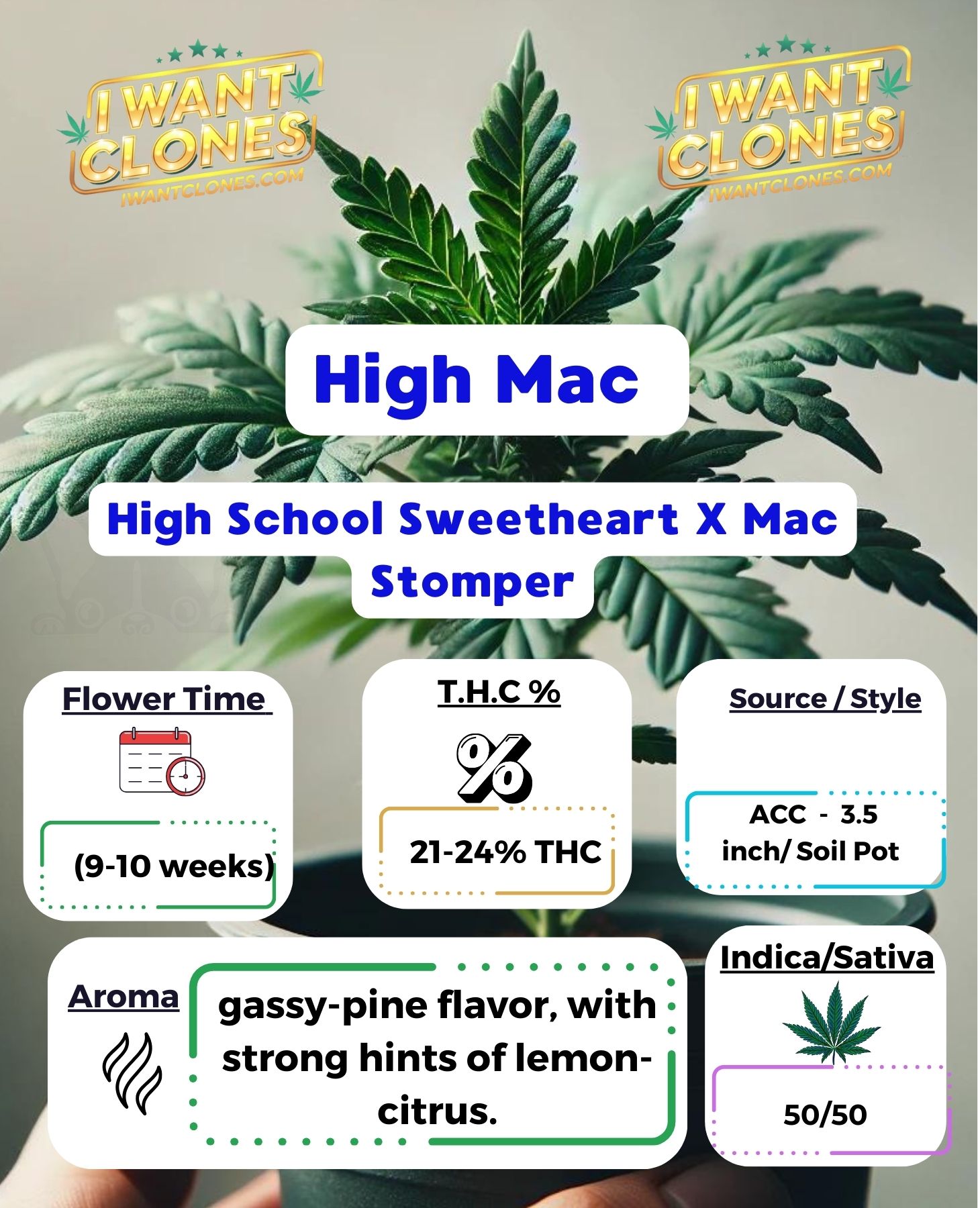
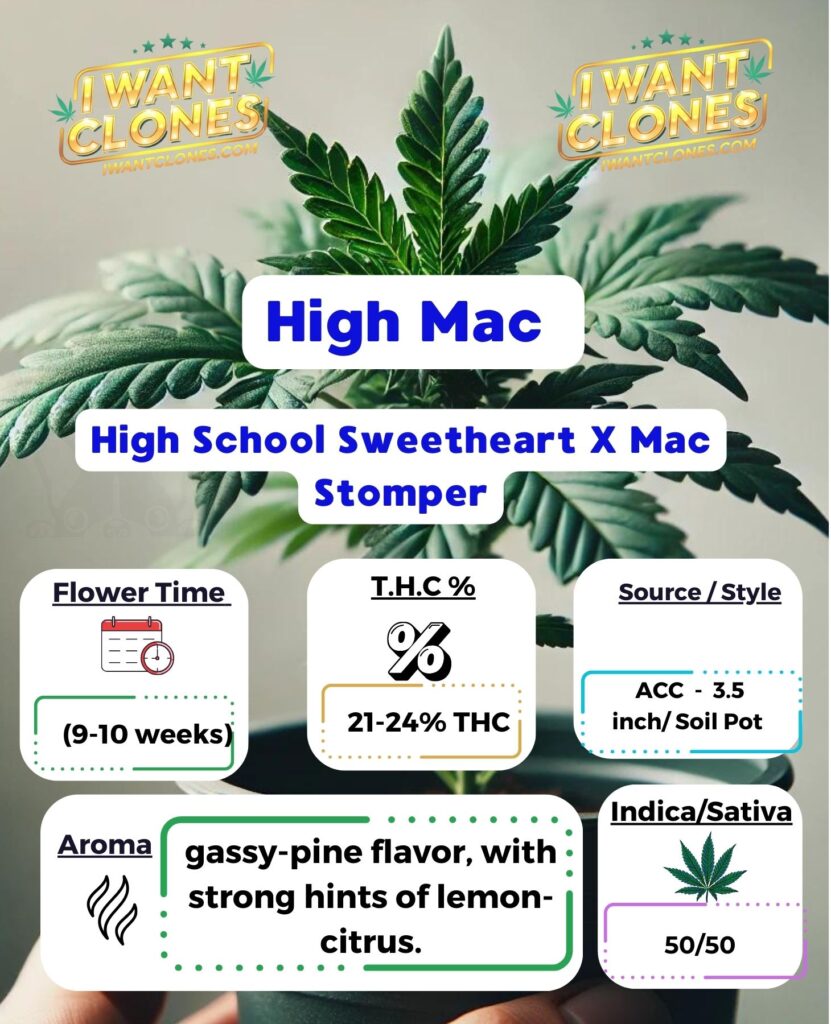
Two of the most popular MAC-derived cuts available at IWantClones.com are High MAC and Super Lemon MAC. Both preserve the MAC base but push different qualities forward. Here’s a direct comparison.
| Characteristic | High MAC | Super Lemon MAC |
|---|---|---|
| Base Lineage | MAC (Alien Cookies × Colombian/Starfighter) | MAC × Lemon-forward selection |
| THC Range | 24–28% | 22–26% |
| Dominant Terpenes | Caryophyllene, myrcene, limonene (balanced) | Limonene, limonene, limonene (lemon-dominant) |
| Flavor Profile | Creamy, gassy, floral with citrus | Bright lemon sherbet, tart citrus, light cream |
| Bud Structure | Dense, chunky, extremely frosty | Dense, slightly lighter structure, heavy trich coverage |
| Plant Height | Medium (3–4 ft indoors trained) | Medium-tall (4–5 ft indoors trained) |
| Flowering Time | 9–10 weeks | 9–10 weeks |
| Yield | Moderate (1.2–1.5 oz/ft²) | Moderate (1.3–1.6 oz/ft²) |
| Skill Level | Intermediate-Advanced | Intermediate-Advanced |
| Best For | Growers who want the classic MAC profile maximized | Growers who love lemon-forward terps in a MAC frame |
| Product Link | Shop High MAC Clones | Shop Super Lemon MAC Clones |
The short answer: if you love the classic creamy-gassy MAC experience at its highest THC expression, go High MAC. If you want that same elite genetics package with a brighter, more tart lemon sherbet terpene profile, Super Lemon MAC is your pick. Both require the same grow approach.
Setting Up for MAC: Environment Requirements
MAC is not the most forgiving strain on the market, but it’s absolutely manageable if you set your environment up correctly before the clone even goes in the ground. Cutting corners here costs you yield and quality.
Temperature & Humidity
Keep canopy temperature between 72–80°F (22–27°C) during lights-on in veg. Drop 5–8°F during dark periods to encourage healthy metabolic cycling. In flower, bring temps down to 68–76°F — cooler nights (62–68°F) in the final two weeks will coax out purple hues in some MAC phenotypes and swell trichome production.
Humidity is critical with MAC’s dense buds. Run 55–65% RH in veg, then drop to 40–50% RH in early flower, and push it down to 35–45% RH in late flower (weeks 7–10). MAC’s chunky bud structure creates a mold risk if humidity stays high through ripening. Monitor your VPD — check out our guide on VPD for cannabis clones for exact target charts by stage.
Lighting
MAC is a photoperiod strain — it won’t flower until you switch to 12/12 light cycle. During veg, run 18/6 (18 hours light, 6 hours dark). MAC responds well to higher PPFD levels in flower — target 800–1,000 µmol/m²/s at canopy height once plants are established. LED fixtures work exceptionally well because you can dial in light intensity and spectrum precisely without the heat load of HPS. Review our light requirements guide for clone-specific setup details and our optimal light schedules guide for timing recommendations.
Growing Medium
MAC performs well in both soil and coco/perlite. In soil, choose a well-aerated mix with good drainage — dense, waterlogged soil is a fast way to stress this strain. A 70/30 coco-to-perlite blend gives you excellent root oxygen and tight feeding control, which MAC appreciates. In soil, a quality amended organic mix can simplify feeding considerably. See our best soil types guide for specific product recommendations.
Vegetative Growth: Training MAC for Maximum Yield
MAC’s natural growth pattern is a somewhat bushy, medium-height plant with decent lateral branching. Without training, the plant tends to form a Christmas tree shape with a dominant central cola and undersized lower branches that won’t contribute much to your final weight. Training restructures this into a flat, even canopy where every branch site sees the same light intensity.
Low-Stress Training (LST)
LST is the most grower-friendly technique for MAC and produces excellent results. Start bending the main stem laterally as soon as the plant has 4–5 nodes in veg. Use soft wire or garden ties — never cut into the stem. As the plant continues to grow, continue bending and tying new growth outward to maintain a flat canopy. This creates multiple main colas at the same height rather than one dominant one. LST works in any container size and doesn’t require the plant recovery time that topping does.
Topping and FIM
Topping MAC above the 4th or 5th node is effective but requires the plant to recover before resuming vigorous growth — budget 5–7 days for recovery before switching to flower. Top once in early veg and allow the two new main branches to develop before bending them outward with LST. Avoid multiple topping sessions on MAC — it stresses the plant more than some hardier strains handle, and you risk stunting yield if you top too aggressively or too late. Read more in our guide on topping and LST for cannabis clones.
Screen of Green (SCROG)
SCROG is arguably the ideal method for MAC in a controlled indoor environment. Install a screen at 12–16 inches above the pot tops and weave branches through as they grow. When the screen is 70–80% filled, flip to 12/12. SCROG maximizes light penetration to every bud site and tames MAC’s moderate stretch during early flower. This technique requires more setup time but consistently delivers the best yield results with MAC’s canopy structure.
Flowering MAC: What to Expect Week by Week
MAC’s flowering period runs 9–10 weeks. Here’s a realistic week-by-week overview of what you’ll see.
Weeks 1–3: Stretch Phase
Once you flip to 12/12, MAC will stretch — typically 40–70% height increase from flip to when stretch stops around week 3. If you’re running a 3-foot plant at flip, expect it to finish around 4.5–5 feet unless you’ve trained it flat with SCROG or LST. Pistils emerge white and sparse. Maintain higher nitrogen levels during this transition — the plant is still building structure. Support taller branches with bamboo stakes if needed.
Weeks 4–6: Bud Swelling
This is when MAC starts showing its true character. Buds swell noticeably and trichome production ramps up — you’ll see the early signs of that silver-frost coating beginning to develop. Switch feeding to a bloom-focused formula with lower nitrogen and elevated phosphorus and potassium. Start watching your humidity carefully — as buds thicken, airflow becomes critical to prevent moisture pockets inside the canopy. Our complete nutrient guide covers the exact feed schedule transition for this stage.
Weeks 7–9: Ripening
Trichome coverage accelerates dramatically in weeks 7–8. The buds take on that signature frost-white appearance that makes MAC photos look almost fake. Pistils shift from white to amber. Reduce humidity to 35–45% — this is when mold risk is highest in dense MAC colas. Begin flushing in the final 10–14 days if growing in a non-organic medium. Lower canopy temps by 5–10°F to encourage terpene retention and, in some phenotypes, color development. Use a jeweler’s loupe or digital microscope to monitor trichomes — harvest when you see a mix of cloudy and amber trichomes at your preferred ratio. Our harvest timing guide covers this in full detail.
Week 10: Final Push
Some MAC phenotypes run a full 10 weeks. If you’re still seeing mostly cloudy trichomes at day 63–65, give it another 5–7 days. Patience here pays off — MAC’s resin production continues right up to the end. Harvesting even a week early can cost you a meaningful amount of trichome density and cannabinoid potency.
Feeding MAC: Less Is More
This is where many growers go wrong with MAC. MAC is a moderate feeder — it does not want the aggressive nutrient loading you might run with a heavy-feeding strain like Gorilla Glue. Overfeeding MAC, especially with nitrogen in flower, causes rapid tip-burn, nutrient lockout, and a muted terpene profile at harvest.
Veg Feeding
Start at 50–60% of the recommended dose on any quality nutrient line. Increase gradually based on plant response — healthy dark green leaves without tip curl are the target. MAC in coco typically runs EC 1.4–1.8 in veg; in soil, less frequent feeding at higher EC with good drainage. Watch for nitrogen toxicity (clawing, very dark leaves) as an early warning sign you’re overfeeding.
Flower Feeding
Transition to a bloom formula at week 3 of flower. Reduce nitrogen, increase phosphorus (P) and potassium (K). A solid general target is EC 1.8–2.2 in the peak bloom period (weeks 4–7). Back off to EC 1.4–1.6 in the final weeks before flush. MAC rewards a clean finish — excess salts at harvest will mute the very terpene profile you’re trying to protect. See our full nutrient feeding guide for product-specific recommendations and weekly EC targets.
Cal-Mag
MAC in coco or RO water will require supplemental calcium and magnesium. Run 3–5 ml/gallon of a quality Cal-Mag supplement consistently through veg and into mid-flower. Calcium deficiency shows as brown spots on older leaves; magnesium deficiency shows as interveinal yellowing. Catch either early and correct immediately — deficiencies in MAC during flower affect terpene production.
Common MAC Growing Problems & How to Fix Them
Lower Yield Than Expected
MAC is honestly a moderate yielder even in the best conditions. Growers expecting Gorilla Glue-level quantity from MAC will be disappointed — the trade-off is extraordinary quality. If you’re consistently getting below 1 oz/ft², check your canopy training first (most likely issue), then your light intensity (PPFD), then feeding levels. MAC grown with proper SCROG and dialed-in environment consistently hits 1.5 oz/ft² or better.
Nutrient Burn
If you see tip burn appearing on multiple leaf sets, reduce your EC immediately by 20–25% and flush with plain water for one feeding. MAC will communicate overfeeding quickly. The good news: if caught early, it recovers well.
Mold on Dense Buds
Botrytis (bud rot) is a real risk with MAC’s chunky, tightly-packed colas, especially in the final two weeks when humidity creeps up. Prevention beats treatment: keep RH below 45% in late flower, ensure strong airflow through the canopy (oscillating fans pointed at canopy level, not directly at plants), and do a final defoliation at week 5–6 to open up bud sites. If you spot grey moldy material inside a cola, remove the affected section immediately, sterilize your scissors, and lower humidity aggressively. Check our guide to growing in humid climates if your environment tends to run high RH.
Slow Root Development From Clone
MAC clones occasionally root a day or two slower than faster-rooting strains. Keep the propagation environment steady at 72–78°F with 75–80% RH and be patient. Don’t overwater early. Once you see roots emerging from the rockwool or plugs, transplant promptly. Our transplanting guide covers the process step by step.
MAC Outdoor Growing
MAC can be grown outdoors in the right climate — it prefers warm, dry conditions with low humidity in the fall. In the US, the Pacific Northwest and upper Midwest can be challenging due to fall rains arriving before harvest (typically late October for MAC outdoors). Southern California, Arizona, and similar dry climates are better suited. Outdoor MAC plants can grow larger — 5–6 feet is common without aggressive training — and yields scale up accordingly. Watch humidity carefully as nights cool in September and October; that’s when mold becomes a genuine threat to outdoor dense-budding strains like MAC.
Is MAC Right for You?
MAC is the right choice if you’re an intermediate or experienced grower who wants to produce a top-shelf, market-leading product — either for personal enjoyment or to stand out in a legal market. It’s not the highest-yielding strain available, but the combination of terpene profile, visual appeal (that frost coverage genuinely stops people in their tracks), and effect quality makes MAC one of the most sought-after strains in craft cannabis circles.
If you’re a beginner looking for your first clone run, consider gaining some experience with a more forgiving strain first — something like Gorilla Glue #4 or Pineapple Express — then graduate to MAC once you’ve got your environment dialed in. If you’re ready to run MAC, we ship verified High MAC clones and Super Lemon MAC clones overnight to most US states. All clones come with our 3-day no-bullshit guarantee.
Also worth exploring: our guide on Cap Junky strain clone guide (another Capulator creation with similar craft-level demands) and our topping and LST training guide if you’re new to canopy management techniques.
Legal Note: Cannabis cultivation laws vary by state and locality. Always verify your local home grow regulations before ordering or planting. Visit our home grow laws by state 2026 guide for current state-by-state information. IWantClones.com ships to US states where cannabis clone sales are legal.
Frequently Asked Questions
What does MAC strain stand for?
MAC stands for Miracle Alien Cookies. It was named by its breeder, Capulator, and reflects the strain’s near-miraculous quality and its Alien Cookies parentage. The full lineage is Alien Cookies F2 crossed with a Colombian × Starfighter hybrid, created in the mid-2010s.
How long does MAC take to flower?
MAC takes 9–10 weeks to flower from the start of the 12/12 light cycle indoors. Some phenotypes finish closer to 9 weeks; pushing to 10 weeks often maximizes trichome density. Outdoors, MAC is typically ready for harvest in late October in most US climates.
Is MAC a good strain for beginners to grow?
MAC is rated intermediate to advanced difficulty. It’s sensitive to overfeeding, produces moderate yields, and its dense buds require low humidity in late flower to avoid mold. Beginners with at least one successful grow under their belt can handle it, but it rewards experience and attention to environmental details more than forgiving strains.
What is the difference between High MAC and Super Lemon MAC?
High MAC is a MAC cut pushing toward the high end of THC expression (24–28%) with a balanced creamy-gassy-citrus terpene profile. Super Lemon MAC crosses MAC genetics with a lemon-forward selection, producing a brighter lemon-sherbet terpene profile at 22–26% THC. Both flower in 9–10 weeks and are grown the same way.
Does MAC clone well?
Yes — MAC clones root reliably when taken from healthy mother plants, though it may root 1–2 days slower than faster-rooting strains. A stable propagation environment (72–78°F, 75–80% RH) and quality rooting medium produce strong clones consistently. Buying a verified rooted clone from IWantClones.com skips the propagation step entirely.
What yield should I expect from MAC?
Indoor MAC yields typically run 1.2–1.6 oz per square foot under proper conditions — 600–800W equivalent light per 4×4 tent, trained canopy, dialed-in feeding, and 9–10 week flower. MAC is not a heavy yielder; it competes on quality rather than quantity. Yield improves substantially with SCROG or LST training.