Gushers Strain & Clone Grow Guide (Fruit Gushers / White Gushers)

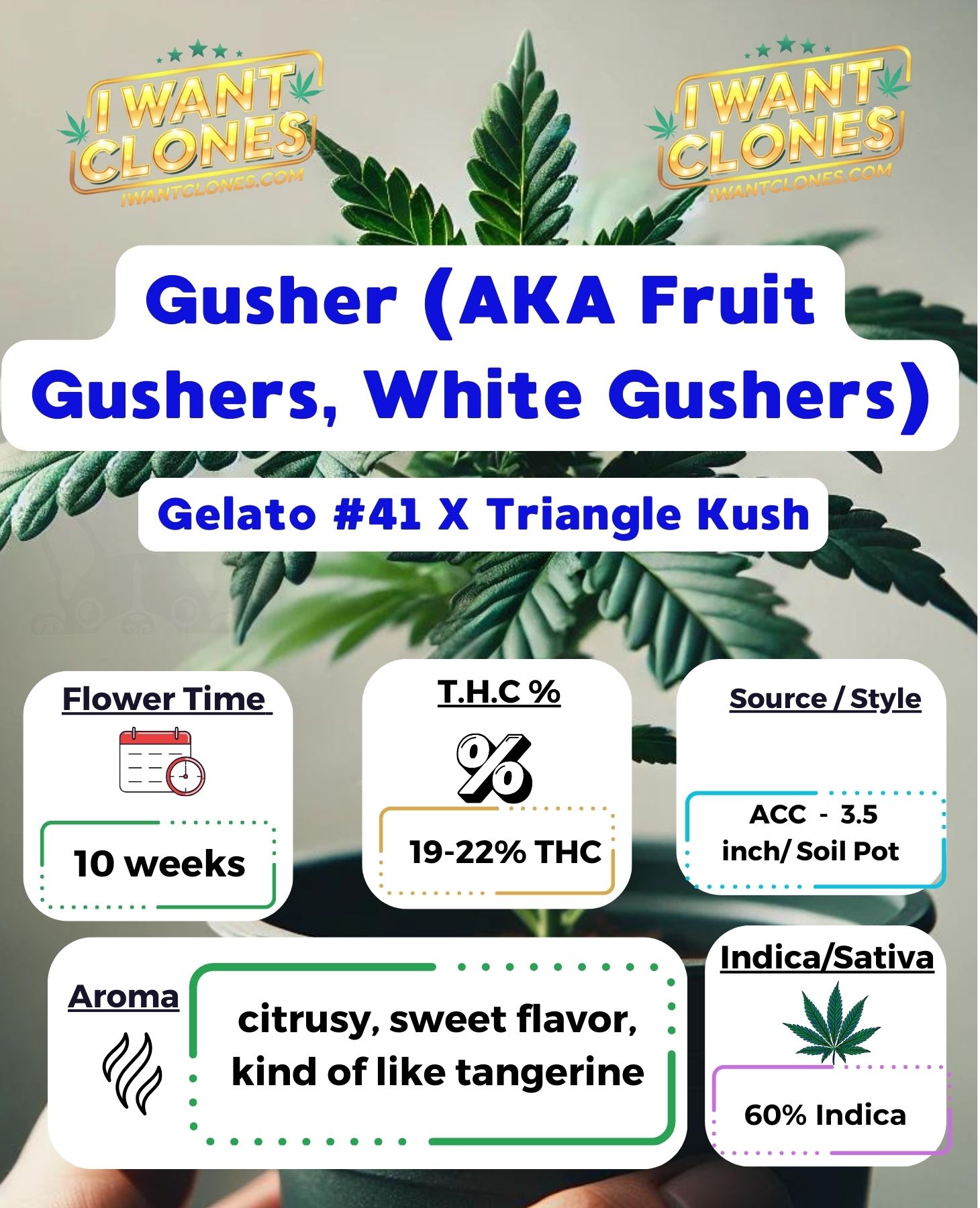
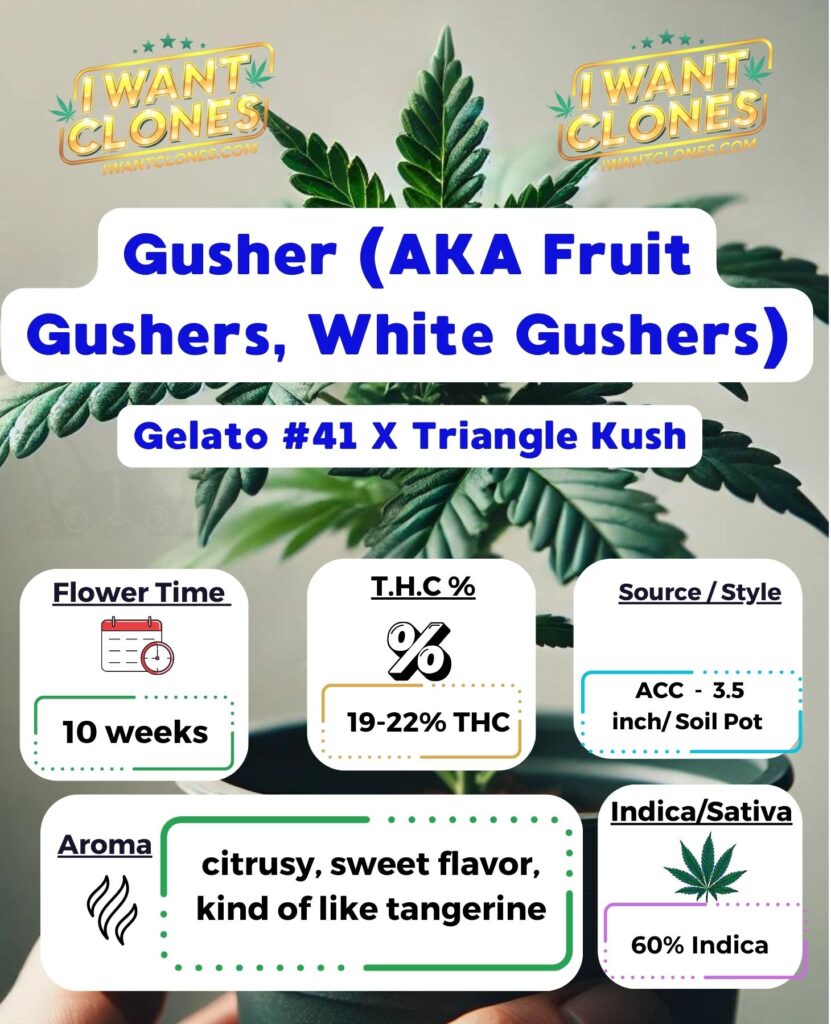
Gushers — also called Fruit Gushers or White Gushers — is a cross of Gelato #41 × Triangle Kush, bred within the Cookies family. It delivers an explosively sweet candy-tropical-fruit terpene profile, THC levels ranging from 22–25%, dense and colorful buds that shift purple and lavender in cooler conditions, and a deeply relaxing yet mentally present balanced effect. Gushers flowers in 8–9 weeks and is suitable for intermediate growers who want a visually stunning, market-ready product.

  • Lineage: Gelato #41 × Triangle Kush, Cookies family genetics
  • THC Range: 22–25%; CBD typically below 1%
  • Dominant Terpenes: Limonene, caryophyllene, myrcene — tropical fruit candy with earthy undertones
  • Flowering Time: 8–9 weeks indoors; late September to mid-October outdoors
  • Yield: Moderate-to-good — 1.5–2.0 oz/ft² with trained canopy indoors
  • Bud Appearance: Dense, chunky, green to purple with heavy trichome frost — highly marketable
  • Skill Level: Intermediate — watch humidity in late flower; rewards training

Key Takeaways

  • Gushers is a cross of Gelato #41 and Triangle Kush, bred within the Cookies family, delivering candy-tropical-fruit terpenes driven by limonene, caryophyllene, and myrcene.
  • THC levels range from 22–25%, producing a deeply relaxing yet mentally present balanced effect that is well-suited to evening use.
  • Buds are dense and chunky with a high calyx-to-leaf ratio, and they shift from green to purple and lavender when exposed to cooler nighttime temperatures during late flowering.
  • The dense bud structure that makes Gushers visually impressive also creates elevated mold risk — humidity must be kept below 50% RH and airflow must reach the interior of the canopy during the final weeks of flower.
  • Flowering time is 8–9 weeks indoors, which is shorter than most Cookies-family strains, making it an efficient option for growers running multiple cycles per year.
  • Indoor yields of 1.5–2.0 oz/ft² are achievable with a properly trained canopy, and the bag appeal and market demand for Gushers genetics remain consistently high.

What Is the Gushers Strain?

Gushers is one of the most instantly recognizable names to emerge from the California cannabis scene in the past decade. The strain takes its name from the candy — and for good reason. Break open a cured Gushers bud and the nose hit is pure tropical fruit confectionery: a rush of sweet grape, tropical citrus, and candy that’s immediately distinctive and immediately memorable.

Gushers was developed within the broader Cookies family of genetics — the same universe that produced Girl Scout Cookies, Gelato, and Runtz. The breeding crosses Gelato #41 (one of the most prized Gelato phenotypes, known for its fruit-forward terp profile and exceptional resin production) with Triangle Kush (a Florida OG Kush cut with deep indica characteristics and a complex earthy-fuel-citrus terpene profile). The result is a strain that inherits Gelato’s sweet candy terpenes and dense structure while Triangle Kush grounds everything with a weighted body effect and adds complexity to the flavor.

In legal markets, Gushers commands premium shelf prices. The combination of visually striking buds — dense, heavily frosted, frequently displaying purple and lavender colors — and a universally appealing flavor profile makes it a perennial bestseller wherever it’s available. Growing from a verified Gushers clone guarantees you’re running authenticated genetics rather than a phenotype hunt from seeds.

Gushers Lineage: Understanding the Parents

Gelato #41 (Thin Mint GSC × Sunset Sherbet)

Gelato #41 is arguably the most sought-after Gelato phenotype. Gelato itself is a cross of Thin Mint Girl Scout Cookies and Sunset Sherbet — and #41 (sometimes called “Bacio Gelato” in some circles) was selected for its exceptional resin production, balanced indica-sativa effect, and a dessert-sweet terpene profile dominated by limonene and caryophyllene. Gelato #41 contributes Gushers’ candy-sweet base aroma, its dense bud structure, heavy trichome production, and the creamy dessert quality that makes Gushers flavor so distinctive.

If you want to explore the Gelato family directly, we also offer verified Gelato #41 clones, Bacio Gelato clones, and Lemon Cherry Gelato clones.

Triangle Kush (OG Kush phenotype, Florida)

Triangle Kush is an OG Kush-derived cut that originated in Florida’s cannabis scene — the name references the “Triangle” formed by Miami, Tampa, and Jacksonville. It’s a heavy indica-leaning strain with a complex terpene profile that layers earthy pine, fuel, and subtle citrus. Triangle Kush brings body weight to Gushers’ effect profile, grounds the sweet terpenes with that earthy OG depth, and contributes to the strain’s exceptional bag appeal — including the tendency toward purple and lavender hues when temperatures drop during flowering.

Why “Fruit Gushers” vs. “White Gushers”?

You’ll see Gushers marketed under several names: Gushers, Fruit Gushers, and White Gushers are the most common. These typically refer to different phenotype selections from the same cross. White Gushers tends to be lighter green with extremely heavy trichome coverage (the “white” refers to the density of crystals, not albino genetics). Fruit Gushers often refers to phenotypes with more pronounced tropical fruit terpene expression. The product at IWantClones.com — Gushers (Fruit Gushers / White Gushers) — captures the best characteristics of this lineage in a verified, stabilized clone.

Gushers Terpenes, Flavor & Effects

Terpene Profile

Gushers’ terpene profile is centered on three primary compounds that create its signature candy-tropical experience:

  • Limonene: Delivers the bright citrus and tropical fruit character — think mango, pineapple, and a squeeze of lemon all at once. Limonene is the terpene most responsible for Gushers’ uplifting first impression.
  • Beta-Caryophyllene: Adds a spicy, woody depth underneath the sweetness. This terpene is unique in that it interacts directly with cannabinoid receptors, contributing to the body effect alongside THC.
  • Myrcene: Contributes the earthy, musky base that ties everything together and deepens the overall aroma toward something more complex than pure candy. Myrcene is also associated with the sedating quality in the body effect.

The overall flavor is frequently described as: tropical candy on the inhale, creamy earthy grape on the exhale. Some phenotypes push more toward sour tropical, others lean creamier. All are distinctly Gushers.

Effects

Gushers produces a high that’s balanced but leans toward the body side — fitting given Triangle Kush’s indica genetics. The onset is quick: a wave of euphoria and mental ease arrives within a few minutes, followed by a spreading physical warmth that relaxes muscles without putting most users to sleep at moderate doses. Gushers is an excellent evening and late-afternoon strain — relaxing enough to wind down after a day, but mentally present enough to enjoy a movie, music, or conversation. At higher doses, the body effect deepens toward genuine sedation. THC at 22–25% means Gushers has real horsepower — new users should approach it with respect.

Gushers Grow Stats at a Glance

Characteristic Gushers (Indoor) Gushers (Outdoor)
Lineage Gelato #41 × Triangle Kush (Cookies family)
THC Range 22–25%
CBD <1% typically
Flowering Time 8–9 weeks (12/12) Late September–mid-October
Plant Height 3–4.5 ft (trained) 4–6 ft
Yield 1.5–2.0 oz/ft² 3–5 oz per plant (well-trained)
Bud Structure Dense, chunky, heavily frosted
Color Green to deep purple/lavender (cool temps)
Mold Resistance Moderate — watch humidity in late flower
Skill Level Intermediate
Primary Terpenes Limonene, caryophyllene, myrcene

Setting Up to Grow Gushers: Environment

Gushers is a more forgiving grow than some premium strains, but it still has preferences that, when met, dramatically improve your final product quality — especially that purple coloring and terpene intensity the strain is known for.

Temperature

During veg, run canopy temperatures of 72–80°F (22–27°C) with 5–8°F cooler nights. In flower, this is where you can influence Gushers’ color expression: maintain daytime temps at 70–76°F and push nights down to 58–65°F in the final three weeks. The cool nights signal the plant to produce anthocyanins — the pigments that turn Gushers buds from green to purple and lavender. Strains with Kush genetics (like Triangle Kush on the Gushers side) are particularly responsive to this temperature manipulation. The result is not just visually striking — it’s genuinely impressive bag appeal that adds to market value.

Humidity

Gushers’ dense bud structure creates the same late-flower humidity challenge as other dense-budding Cookies-family strains. Target:

  • Veg: 55–65% RH
  • Early flower (weeks 1–5): 45–55% RH
  • Late flower (weeks 6–9): 35–45% RH

Keep air circulating continuously inside your canopy. An oscillating fan at mid-canopy height and exhaust running 24/7 through late flower are non-negotiable. Our guide on climate and environment for cannabis clones covers fan placement, VPD targets, and humidity management in detail.

Lighting

Gushers responds well to higher light intensity. Target 700–1,000 µmol/m²/s PPFD at canopy in the peak flower period. LED is ideal — modern quantum board LEDs run cooler and allow you to maintain those lower flower temps while delivering the intensity Gushers wants. Run 18/6 in veg, flip to 12/12 to trigger flower. Our light requirements guide covers specific fixture recommendations and DLI targets for each growth stage.

Vegetative Training for Gushers

Gushers has an indica-leaning growth structure — compact internode spacing, bushy lateral branching, and a tendency to stay shorter than sativa-leaning strains. This makes it an excellent candidate for training techniques that maximize the number of main colas at an even canopy height.

Low-Stress Training (LST)

LST is the simplest and most effective approach for most home growers running Gushers. Start bending the main stem laterally once you have 4–5 nodes established. As the plant grows upward and outward, continue guiding branches with soft ties to create an even, open canopy. Gushers responds well — its branching structure means LST creates many equal cola sites relatively quickly. This is our recommended starting point for most growers. See our detailed topping and LST guide for step-by-step instructions.

Topping

Topping Gushers above the 4th or 5th node is effective and the plant recovers quickly — Gushers is more resilient to topping than some more finicky strains. Top once in early veg, allow the two new mains to establish for a week, then continue bending outward with LST. A single top combined with LST creates 4–8 main colas that fill a 3×3 or 4×4 canopy efficiently. Avoid aggressive multi-topping — it’s not necessary and adds recovery time.

SCROG (Screen of Green)

SCROG is particularly effective with Gushers due to its natural bushy structure. Set a screen 14–18 inches above the pot tops and weave branches through as they grow during veg. Gushers fills a screen well and the technique maximizes light distribution across the dense canopy. When the screen is 70% filled, flip to 12/12. Do a thorough lollipop (remove lower growth below the canopy) at flip to direct all energy to the top-canopy bud sites. Review our cannabis clone growth stages guide to time your training correctly relative to where the plant is developmentally.

Flowering Gushers: What to Expect

Weeks 1–3: Transition and Stretch

Gushers will stretch 30–50% from its flip height — less than many sativa-leaning strains but still significant. Plan for this when deciding how tall your plants should be at flip. If growing in a 5-foot tent, flip when plants are 2.5–3 feet tall. Pistils emerge white and abundant. Maintain good air circulation as buds begin setting. Keep nitrogen slightly elevated through week 3 — the plant is still building structure.

Weeks 4–6: Heavy Bud Development

This is when Gushers shows its Cookies genetics most clearly. Buds swell noticeably, trichome production ramps up, and the sweet-candy aroma starts filling the room. Transition your nutrient program to bloom-focused at this stage: lower nitrogen, elevated phosphorus and potassium. Maintain humidity at 45–50% and ensure your canopy airflow is strong. Watch for any signs of early bud rot — if you’re in a humid climate or environment, dial your RH down further. Our humid climate growing guide covers specific prevention tactics.

Weeks 6–9: Color, Frost, and Ripening

The final weeks are when Gushers delivers its most dramatic visual transformation. Trichome coverage goes from good to exceptional — buds develop a thick, almost crystalline white frost. If you’ve been running cooler nights (58–65°F), purple and lavender coloring emerges in the buds and sometimes the fan leaves by week 7–8. The candy-tropical aroma intensifies noticeably. Reduce humidity to 35–45% and continue strong airflow. Begin flushing (if using salt-based nutrients in non-organic medium) 10–14 days before projected harvest. Use a jeweler’s loupe or digital microscope to monitor trichomes — harvest when trichomes show mostly cloudy with 10–20% amber for a balanced effect, or push to 30% amber for deeper body sedation. Our harvest timing guide walks through trichome reading in detail.

Feeding Gushers: A Practical Nutrient Guide

Gushers is a moderate-to-moderate-heavy feeder — more so than MAC but not at the level of very hungry strains like some OG Kush varieties. It rewards a balanced nutrient approach throughout veg and a clean bloom program in flower.

Vegetative Phase

Start at 60–70% of the manufacturer’s recommended dose for any quality three-part or grow/bloom/micro nutrient line. EC target: 1.4–2.0 in veg depending on medium (coco runs higher; soil runs lower with buffered organics). Increase gradually based on plant response. Healthy Gushers in veg should be medium-dark green with no tip burn, no curling, and actively growing 1–2 new nodes every 2–3 days under 18/6. If you see tip burn, drop EC by 15–20%.

Bloom Phase

Transition to a bloom-focused formula at week 2–3 of flower. Target EC 1.8–2.3 during peak bloom (weeks 4–7). Key ratios: nitrogen lower than veg (but not zero — don’t drop N to nothing), phosphorus doubled or tripled, potassium elevated. A PK booster added at weeks 4–6 is beneficial for Gushers and Cookies-family strains generally — it supports the cell expansion that creates those dense, chunky calyxes. Back down to EC 1.4–1.6 for the final two weeks before harvest to clean up salts and allow terp expression to come forward. Our complete nutrient feeding guide has week-by-week EC targets and product recommendations for multiple popular nutrient lines.

Cal-Mag and pH

Gushers in coco or with RO/filtered water benefits from consistent Cal-Mag supplementation (3–5 ml/gallon). Maintain pH at 5.8–6.2 for coco/hydro and 6.0–6.8 for soil. pH drift outside this range locks out the micronutrients Gushers relies on for its terpene expression and color development. Check pH every feeding and calibrate your meter monthly.

Mold Prevention with Dense Gushers Buds

Dense Cookies-family buds are beautiful and high-value — but their tight structure creates microenvironments inside the bud where moisture accumulates if airflow is insufficient. Gushers is not uniquely mold-prone, but like any dense-budding strain, it requires active management in late flower.

Prevention Checklist

  • Run continuous airflow through the canopy — oscillating fan at mid-canopy height, 24/7 in late flower
  • Keep RH below 45% from week 6 onward; below 40% in the final two weeks if possible
  • Defoliate strategically at flip and again at week 5 — remove fan leaves blocking airflow to lower bud sites
  • Maintain consistent overnight temperature — cold, stagnant air at night raises RH and creates condensation risk
  • After defoliation, dispose of plant material immediately — decaying leaves are a botrytis breeding ground

If you find bud rot — grey, dusty, crumbling tissue inside a cola — cut the affected section at least 2 inches below the visible rot, sterilize your scissors immediately, and increase airflow aggressively. Check adjacent colas daily. Early detection prevents catastrophic loss. See our troubleshooting guide for visual identification of common diseases and deficiencies.

Gushers vs. Related Strains: How It Compares

Gushers sits in a family of Cookies-descended strains that includes some of the most popular genetics in modern cannabis. Here’s how it compares to two closely related strains you may be considering.

Characteristic Gushers Gelato #41 Runtz
Lineage Gelato #41 × Triangle Kush Thin Mint GSC × Sunset Sherbet Gelato × Zkittlez
THC Range 22–25% 23–26% 19–25%
Flavor Tropical candy, grape, citrus Creamy dessert, sweet citrus Rainbow candy, sweet fruit
Effect Type Balanced, body-forward Balanced, slightly euphoric-forward Balanced, smooth, euphoric
Flowering Time 8–9 weeks 8–9 weeks 8–9 weeks
Yield Moderate-good Moderate Moderate-good
Bag Appeal Exceptional (purple, heavy frost) Excellent Exceptional (colorful, dense)
Skill Level Intermediate Intermediate Beginner-Intermediate

For deeper reading on these related genetics, see our Runtz family strains guide and our overview of the broader Gelato strain family.

Gushers Outdoors

Gushers grows well outdoors in warm, relatively dry climates with long summers. The indica-leaning structure keeps outdoor plants manageable in height — typically 4–6 feet with some natural branching — and the 8–9 week flowering time means harvest arrives in late September to mid-October across most of the continental US. The cool nights of early autumn naturally encourage the purple coloring. Dry climates (California, Southwest) are ideal; humid East Coast and Pacific Northwest growers need to be especially vigilant about mold during the dense budding phase as autumn moisture arrives. If you’re outdoors in a humid climate, consider a portable greenhouse for the final month to control humidity during the most vulnerable period.

Who Should Grow Gushers?

Gushers is an excellent choice for intermediate growers who want a visually impressive, market-competitive product without MAC-level difficulty. Its 8–9 week flower time is on the faster end for premium strains, its training response is good, and the purple color that comes naturally from cool nights makes it genuinely striking at harvest. Anyone who’s completed one or two successful cannabis grows and wants to level up to a premium Cookies-family strain should consider Gushers as their next run.

Commercial and semi-commercial growers will find Gushers a strong candidate for the shelf: the combination of bag appeal, aroma, effect, and THC potency checks every box consumers care about. At $98.88 per verified clone, with overnight shipping and a 3-day guarantee, running Gushers clones from IWantClones.com means starting with known genetics — not a phenotype hunt — every time. Explore our full clone shop to see all available cuts, including bulk order options.

Legal Note: Cannabis cultivation laws vary significantly by state and locality. Confirm your local home grow and clone purchase regulations before ordering. Visit our 2026 cannabis clone legality guide for current state-specific information. IWantClones.com ships only to US states where clone sales are permitted under applicable law.

Frequently Asked Questions

What is the Gushers strain made of?

Gushers is a cross of Gelato #41 and Triangle Kush, developed within the Cookies family of cannabis genetics. Gelato #41 contributes the sweet, candy-fruit terpene profile and dense resin production. Triangle Kush adds OG Kush’s body effect, depth of flavor, and the genetics that produce purple coloring in cool conditions.

Is Gushers indica or sativa?

Gushers is classified as a balanced hybrid that leans indica — both Gelato #41 and Triangle Kush have strong indica heritage. The effect is primarily relaxing and body-forward, with a euphoric mental component from the Gelato side. Expect calming, mood-elevating effects rather than energizing sativa-style stimulation.

How long does Gushers take to flower?

Gushers flowers in 8–9 weeks from the start of the 12/12 light cycle indoors. This is on the faster side for a premium Cookies-family strain. Outdoors, Gushers is typically harvest-ready in late September to mid-October depending on latitude and local climate conditions.

Why do some Gushers buds turn purple?

Purple coloring in Gushers is caused by anthocyanin pigments, which are produced when nighttime temperatures drop to 58–65°F during the final 3–4 weeks of flowering. The Triangle Kush genetics make Gushers particularly responsive to temperature-driven color changes. Warmer nights produce mostly green buds; cooler nights produce the purple-lavender coloring associated with premium Gushers bag appeal.

How much does Gushers yield indoors?

Indoor Gushers yields typically range from 1.5–2.0 oz per square foot under good conditions: adequate lighting (700–1,000 µmol/m²/s PPFD), trained canopy (LST or SCROG), dialed-in feeding, and a full 8–9 week flower. Untrained, single-cola plants yield significantly less. Training is the single biggest lever for improving Gushers yield.

Is Gushers a good beginner strain?

Gushers is rated intermediate difficulty — a step up from the most beginner-friendly strains but more forgiving than advanced cuts like MAC. It feeds at a moderate-to-moderate-heavy level, requires humidity management in late flower, and rewards training. Growers who’ve completed one successful run and understand environmental control can grow Gushers successfully.


Share

Comments are closed.

Also recommended

Gushers Strain & Clone Grow Guide (Fruit Gushers / White Gushers)

July 12, 2026

Gushers — also called Fruit Gushers or White Gushers — is a cross of Gelato #41 × Triangle Kush, bred within the Cookies family. It delivers an explosively sweet candy-tropical-fruit terpene profile, THC levels ranging from 22–25%, dense and colorful buds that shift purple and lavender in cooler conditions, and a deeply relaxing yet mentally present balanced effect. Gushers flowers in 8–9 weeks and is suitable for intermediate growers who want a visually stunning, market-ready product.

  • Lineage: Gelato #41 × Triangle Kush, Cookies family genetics
  • THC Range: 22–25%; CBD typically below 1%
  • Dominant Terpenes: Limonene, caryophyllene, myrcene — tropical fruit candy with earthy undertones
  • Flowering Time: 8–9 weeks indoors; late September to mid-October outdoors
  • Yield: Moderate-to-good — 1.5–2.0 oz/ft² with trained canopy indoors
  • Bud Appearance: Dense, chunky, green to purple with heavy trichome frost — highly marketable
  • Skill Level: Intermediate — watch humidity in late flower; rewards training

Key Takeaways

  • Gushers is a cross of Gelato #41 and Triangle Kush, bred within the Cookies family, delivering candy-tropical-fruit terpenes driven by limonene, caryophyllene, and myrcene.
  • THC levels range from 22–25%, producing a deeply relaxing yet mentally present balanced effect that is well-suited to evening use.
  • Buds are dense and chunky with a high calyx-to-leaf ratio, and they shift from green to purple and lavender when exposed to cooler nighttime temperatures during late flowering.
  • The dense bud structure that makes Gushers visually impressive also creates elevated mold risk — humidity must be kept below 50% RH and airflow must reach the interior of the canopy during the final weeks of flower.
  • Flowering time is 8–9 weeks indoors, which is shorter than most Cookies-family strains, making it an efficient option for growers running multiple cycles per year.
  • Indoor yields of 1.5–2.0 oz/ft² are achievable with a properly trained canopy, and the bag appeal and market demand for Gushers genetics remain consistently high.

What Is the Gushers Strain?

Gushers is one of the most instantly recognizable names to emerge from the California cannabis scene in the past decade. The strain takes its name from the candy — and for good reason. Break open a cured Gushers bud and the nose hit is pure tropical fruit confectionery: a rush of sweet grape, tropical citrus, and candy that’s immediately distinctive and immediately memorable.

Gushers was developed within the broader Cookies family of genetics — the same universe that produced Girl Scout Cookies, Gelato, and Runtz. The breeding crosses Gelato #41 (one of the most prized Gelato phenotypes, known for its fruit-forward terp profile and exceptional resin production) with Triangle Kush (a Florida OG Kush cut with deep indica characteristics and a complex earthy-fuel-citrus terpene profile). The result is a strain that inherits Gelato’s sweet candy terpenes and dense structure while Triangle Kush grounds everything with a weighted body effect and adds complexity to the flavor.

In legal markets, Gushers commands premium shelf prices. The combination of visually striking buds — dense, heavily frosted, frequently displaying purple and lavender colors — and a universally appealing flavor profile makes it a perennial bestseller wherever it’s available. Growing from a verified Gushers clone guarantees you’re running authenticated genetics rather than a phenotype hunt from seeds.

Gushers Lineage: Understanding the Parents

Gelato #41 (Thin Mint GSC × Sunset Sherbet)

Gelato #41 is arguably the most sought-after Gelato phenotype. Gelato itself is a cross of Thin Mint Girl Scout Cookies and Sunset Sherbet — and #41 (sometimes called “Bacio Gelato” in some circles) was selected for its exceptional resin production, balanced indica-sativa effect, and a dessert-sweet terpene profile dominated by limonene and caryophyllene. Gelato #41 contributes Gushers’ candy-sweet base aroma, its dense bud structure, heavy trichome production, and the creamy dessert quality that makes Gushers flavor so distinctive.

If you want to explore the Gelato family directly, we also offer verified Gelato #41 clones, Bacio Gelato clones, and Lemon Cherry Gelato clones.

Triangle Kush (OG Kush phenotype, Florida)

Triangle Kush is an OG Kush-derived cut that originated in Florida’s cannabis scene — the name references the “Triangle” formed by Miami, Tampa, and Jacksonville. It’s a heavy indica-leaning strain with a complex terpene profile that layers earthy pine, fuel, and subtle citrus. Triangle Kush brings body weight to Gushers’ effect profile, grounds the sweet terpenes with that earthy OG depth, and contributes to the strain’s exceptional bag appeal — including the tendency toward purple and lavender hues when temperatures drop during flowering.

Why “Fruit Gushers” vs. “White Gushers”?

You’ll see Gushers marketed under several names: Gushers, Fruit Gushers, and White Gushers are the most common. These typically refer to different phenotype selections from the same cross. White Gushers tends to be lighter green with extremely heavy trichome coverage (the “white” refers to the density of crystals, not albino genetics). Fruit Gushers often refers to phenotypes with more pronounced tropical fruit terpene expression. The product at IWantClones.com — Gushers (Fruit Gushers / White Gushers) — captures the best characteristics of this lineage in a verified, stabilized clone.

Gushers Terpenes, Flavor & Effects

Terpene Profile

Gushers’ terpene profile is centered on three primary compounds that create its signature candy-tropical experience:

  • Limonene: Delivers the bright citrus and tropical fruit character — think mango, pineapple, and a squeeze of lemon all at once. Limonene is the terpene most responsible for Gushers’ uplifting first impression.
  • Beta-Caryophyllene: Adds a spicy, woody depth underneath the sweetness. This terpene is unique in that it interacts directly with cannabinoid receptors, contributing to the body effect alongside THC.
  • Myrcene: Contributes the earthy, musky base that ties everything together and deepens the overall aroma toward something more complex than pure candy. Myrcene is also associated with the sedating quality in the body effect.

The overall flavor is frequently described as: tropical candy on the inhale, creamy earthy grape on the exhale. Some phenotypes push more toward sour tropical, others lean creamier. All are distinctly Gushers.

Effects

Gushers produces a high that’s balanced but leans toward the body side — fitting given Triangle Kush’s indica genetics. The onset is quick: a wave of euphoria and mental ease arrives within a few minutes, followed by a spreading physical warmth that relaxes muscles without putting most users to sleep at moderate doses. Gushers is an excellent evening and late-afternoon strain — relaxing enough to wind down after a day, but mentally present enough to enjoy a movie, music, or conversation. At higher doses, the body effect deepens toward genuine sedation. THC at 22–25% means Gushers has real horsepower — new users should approach it with respect.

Gushers Grow Stats at a Glance

Characteristic Gushers (Indoor) Gushers (Outdoor)
Lineage Gelato #41 × Triangle Kush (Cookies family)
THC Range 22–25%
CBD <1% typically
Flowering Time 8–9 weeks (12/12) Late September–mid-October
Plant Height 3–4.5 ft (trained) 4–6 ft
Yield 1.5–2.0 oz/ft² 3–5 oz per plant (well-trained)
Bud Structure Dense, chunky, heavily frosted
Color Green to deep purple/lavender (cool temps)
Mold Resistance Moderate — watch humidity in late flower
Skill Level Intermediate
Primary Terpenes Limonene, caryophyllene, myrcene

Setting Up to Grow Gushers: Environment

Gushers is a more forgiving grow than some premium strains, but it still has preferences that, when met, dramatically improve your final product quality — especially that purple coloring and terpene intensity the strain is known for.

Temperature

During veg, run canopy temperatures of 72–80°F (22–27°C) with 5–8°F cooler nights. In flower, this is where you can influence Gushers’ color expression: maintain daytime temps at 70–76°F and push nights down to 58–65°F in the final three weeks. The cool nights signal the plant to produce anthocyanins — the pigments that turn Gushers buds from green to purple and lavender. Strains with Kush genetics (like Triangle Kush on the Gushers side) are particularly responsive to this temperature manipulation. The result is not just visually striking — it’s genuinely impressive bag appeal that adds to market value.

Humidity

Gushers’ dense bud structure creates the same late-flower humidity challenge as other dense-budding Cookies-family strains. Target:

  • Veg: 55–65% RH
  • Early flower (weeks 1–5): 45–55% RH
  • Late flower (weeks 6–9): 35–45% RH

Keep air circulating continuously inside your canopy. An oscillating fan at mid-canopy height and exhaust running 24/7 through late flower are non-negotiable. Our guide on climate and environment for cannabis clones covers fan placement, VPD targets, and humidity management in detail.

Lighting

Gushers responds well to higher light intensity. Target 700–1,000 µmol/m²/s PPFD at canopy in the peak flower period. LED is ideal — modern quantum board LEDs run cooler and allow you to maintain those lower flower temps while delivering the intensity Gushers wants. Run 18/6 in veg, flip to 12/12 to trigger flower. Our light requirements guide covers specific fixture recommendations and DLI targets for each growth stage.

Vegetative Training for Gushers

Gushers has an indica-leaning growth structure — compact internode spacing, bushy lateral branching, and a tendency to stay shorter than sativa-leaning strains. This makes it an excellent candidate for training techniques that maximize the number of main colas at an even canopy height.

Low-Stress Training (LST)

LST is the simplest and most effective approach for most home growers running Gushers. Start bending the main stem laterally once you have 4–5 nodes established. As the plant grows upward and outward, continue guiding branches with soft ties to create an even, open canopy. Gushers responds well — its branching structure means LST creates many equal cola sites relatively quickly. This is our recommended starting point for most growers. See our detailed topping and LST guide for step-by-step instructions.

Topping

Topping Gushers above the 4th or 5th node is effective and the plant recovers quickly — Gushers is more resilient to topping than some more finicky strains. Top once in early veg, allow the two new mains to establish for a week, then continue bending outward with LST. A single top combined with LST creates 4–8 main colas that fill a 3×3 or 4×4 canopy efficiently. Avoid aggressive multi-topping — it’s not necessary and adds recovery time.

SCROG (Screen of Green)

SCROG is particularly effective with Gushers due to its natural bushy structure. Set a screen 14–18 inches above the pot tops and weave branches through as they grow during veg. Gushers fills a screen well and the technique maximizes light distribution across the dense canopy. When the screen is 70% filled, flip to 12/12. Do a thorough lollipop (remove lower growth below the canopy) at flip to direct all energy to the top-canopy bud sites. Review our cannabis clone growth stages guide to time your training correctly relative to where the plant is developmentally.

Flowering Gushers: What to Expect

Weeks 1–3: Transition and Stretch

Gushers will stretch 30–50% from its flip height — less than many sativa-leaning strains but still significant. Plan for this when deciding how tall your plants should be at flip. If growing in a 5-foot tent, flip when plants are 2.5–3 feet tall. Pistils emerge white and abundant. Maintain good air circulation as buds begin setting. Keep nitrogen slightly elevated through week 3 — the plant is still building structure.

Weeks 4–6: Heavy Bud Development

This is when Gushers shows its Cookies genetics most clearly. Buds swell noticeably, trichome production ramps up, and the sweet-candy aroma starts filling the room. Transition your nutrient program to bloom-focused at this stage: lower nitrogen, elevated phosphorus and potassium. Maintain humidity at 45–50% and ensure your canopy airflow is strong. Watch for any signs of early bud rot — if you’re in a humid climate or environment, dial your RH down further. Our humid climate growing guide covers specific prevention tactics.

Weeks 6–9: Color, Frost, and Ripening

The final weeks are when Gushers delivers its most dramatic visual transformation. Trichome coverage goes from good to exceptional — buds develop a thick, almost crystalline white frost. If you’ve been running cooler nights (58–65°F), purple and lavender coloring emerges in the buds and sometimes the fan leaves by week 7–8. The candy-tropical aroma intensifies noticeably. Reduce humidity to 35–45% and continue strong airflow. Begin flushing (if using salt-based nutrients in non-organic medium) 10–14 days before projected harvest. Use a jeweler’s loupe or digital microscope to monitor trichomes — harvest when trichomes show mostly cloudy with 10–20% amber for a balanced effect, or push to 30% amber for deeper body sedation. Our harvest timing guide walks through trichome reading in detail.

Feeding Gushers: A Practical Nutrient Guide

Gushers is a moderate-to-moderate-heavy feeder — more so than MAC but not at the level of very hungry strains like some OG Kush varieties. It rewards a balanced nutrient approach throughout veg and a clean bloom program in flower.

Vegetative Phase

Start at 60–70% of the manufacturer’s recommended dose for any quality three-part or grow/bloom/micro nutrient line. EC target: 1.4–2.0 in veg depending on medium (coco runs higher; soil runs lower with buffered organics). Increase gradually based on plant response. Healthy Gushers in veg should be medium-dark green with no tip burn, no curling, and actively growing 1–2 new nodes every 2–3 days under 18/6. If you see tip burn, drop EC by 15–20%.

Bloom Phase

Transition to a bloom-focused formula at week 2–3 of flower. Target EC 1.8–2.3 during peak bloom (weeks 4–7). Key ratios: nitrogen lower than veg (but not zero — don’t drop N to nothing), phosphorus doubled or tripled, potassium elevated. A PK booster added at weeks 4–6 is beneficial for Gushers and Cookies-family strains generally — it supports the cell expansion that creates those dense, chunky calyxes. Back down to EC 1.4–1.6 for the final two weeks before harvest to clean up salts and allow terp expression to come forward. Our complete nutrient feeding guide has week-by-week EC targets and product recommendations for multiple popular nutrient lines.

Cal-Mag and pH

Gushers in coco or with RO/filtered water benefits from consistent Cal-Mag supplementation (3–5 ml/gallon). Maintain pH at 5.8–6.2 for coco/hydro and 6.0–6.8 for soil. pH drift outside this range locks out the micronutrients Gushers relies on for its terpene expression and color development. Check pH every feeding and calibrate your meter monthly.

Mold Prevention with Dense Gushers Buds

Dense Cookies-family buds are beautiful and high-value — but their tight structure creates microenvironments inside the bud where moisture accumulates if airflow is insufficient. Gushers is not uniquely mold-prone, but like any dense-budding strain, it requires active management in late flower.

Prevention Checklist

  • Run continuous airflow through the canopy — oscillating fan at mid-canopy height, 24/7 in late flower
  • Keep RH below 45% from week 6 onward; below 40% in the final two weeks if possible
  • Defoliate strategically at flip and again at week 5 — remove fan leaves blocking airflow to lower bud sites
  • Maintain consistent overnight temperature — cold, stagnant air at night raises RH and creates condensation risk
  • After defoliation, dispose of plant material immediately — decaying leaves are a botrytis breeding ground

If you find bud rot — grey, dusty, crumbling tissue inside a cola — cut the affected section at least 2 inches below the visible rot, sterilize your scissors immediately, and increase airflow aggressively. Check adjacent colas daily. Early detection prevents catastrophic loss. See our troubleshooting guide for visual identification of common diseases and deficiencies.

Gushers vs. Related Strains: How It Compares

Gushers sits in a family of Cookies-descended strains that includes some of the most popular genetics in modern cannabis. Here’s how it compares to two closely related strains you may be considering.

Characteristic Gushers Gelato #41 Runtz
Lineage Gelato #41 × Triangle Kush Thin Mint GSC × Sunset Sherbet Gelato × Zkittlez
THC Range 22–25% 23–26% 19–25%
Flavor Tropical candy, grape, citrus Creamy dessert, sweet citrus Rainbow candy, sweet fruit
Effect Type Balanced, body-forward Balanced, slightly euphoric-forward Balanced, smooth, euphoric
Flowering Time 8–9 weeks 8–9 weeks 8–9 weeks
Yield Moderate-good Moderate Moderate-good
Bag Appeal Exceptional (purple, heavy frost) Excellent Exceptional (colorful, dense)
Skill Level Intermediate Intermediate Beginner-Intermediate

For deeper reading on these related genetics, see our Runtz family strains guide and our overview of the broader Gelato strain family.

Gushers Outdoors

Gushers grows well outdoors in warm, relatively dry climates with long summers. The indica-leaning structure keeps outdoor plants manageable in height — typically 4–6 feet with some natural branching — and the 8–9 week flowering time means harvest arrives in late September to mid-October across most of the continental US. The cool nights of early autumn naturally encourage the purple coloring. Dry climates (California, Southwest) are ideal; humid East Coast and Pacific Northwest growers need to be especially vigilant about mold during the dense budding phase as autumn moisture arrives. If you’re outdoors in a humid climate, consider a portable greenhouse for the final month to control humidity during the most vulnerable period.

Who Should Grow Gushers?

Gushers is an excellent choice for intermediate growers who want a visually impressive, market-competitive product without MAC-level difficulty. Its 8–9 week flower time is on the faster end for premium strains, its training response is good, and the purple color that comes naturally from cool nights makes it genuinely striking at harvest. Anyone who’s completed one or two successful cannabis grows and wants to level up to a premium Cookies-family strain should consider Gushers as their next run.

Commercial and semi-commercial growers will find Gushers a strong candidate for the shelf: the combination of bag appeal, aroma, effect, and THC potency checks every box consumers care about. At $98.88 per verified clone, with overnight shipping and a 3-day guarantee, running Gushers clones from IWantClones.com means starting with known genetics — not a phenotype hunt — every time. Explore our full clone shop to see all available cuts, including bulk order options.

Legal Note: Cannabis cultivation laws vary significantly by state and locality. Confirm your local home grow and clone purchase regulations before ordering. Visit our 2026 cannabis clone legality guide for current state-specific information. IWantClones.com ships only to US states where clone sales are permitted under applicable law.

Frequently Asked Questions

What is the Gushers strain made of?

Gushers is a cross of Gelato #41 and Triangle Kush, developed within the Cookies family of cannabis genetics. Gelato #41 contributes the sweet, candy-fruit terpene profile and dense resin production. Triangle Kush adds OG Kush’s body effect, depth of flavor, and the genetics that produce purple coloring in cool conditions.

Is Gushers indica or sativa?

Gushers is classified as a balanced hybrid that leans indica — both Gelato #41 and Triangle Kush have strong indica heritage. The effect is primarily relaxing and body-forward, with a euphoric mental component from the Gelato side. Expect calming, mood-elevating effects rather than energizing sativa-style stimulation.

How long does Gushers take to flower?

Gushers flowers in 8–9 weeks from the start of the 12/12 light cycle indoors. This is on the faster side for a premium Cookies-family strain. Outdoors, Gushers is typically harvest-ready in late September to mid-October depending on latitude and local climate conditions.

Why do some Gushers buds turn purple?

Purple coloring in Gushers is caused by anthocyanin pigments, which are produced when nighttime temperatures drop to 58–65°F during the final 3–4 weeks of flowering. The Triangle Kush genetics make Gushers particularly responsive to temperature-driven color changes. Warmer nights produce mostly green buds; cooler nights produce the purple-lavender coloring associated with premium Gushers bag appeal.

How much does Gushers yield indoors?

Indoor Gushers yields typically range from 1.5–2.0 oz per square foot under good conditions: adequate lighting (700–1,000 µmol/m²/s PPFD), trained canopy (LST or SCROG), dialed-in feeding, and a full 8–9 week flower. Untrained, single-cola plants yield significantly less. Training is the single biggest lever for improving Gushers yield.

Is Gushers a good beginner strain?

Gushers is rated intermediate difficulty — a step up from the most beginner-friendly strains but more forgiving than advanced cuts like MAC. It feeds at a moderate-to-moderate-heavy level, requires humidity management in late flower, and rewards training. Growers who’ve completed one successful run and understand environmental control can grow Gushers successfully.

Written by James Bean

Recent Posts

SCROG vs SOG: Which Training Method Is Right for Your Clones?

SCROG vs SOG explained — how each method works, plant counts, veg times, yields, and which one suits your space and clone count. Pick the right method here.

Read More
Gushers Strain & Clone Grow Guide (Fruit Gushers / White Gushers)

Grow Gushers (Fruit Gushers / White Gushers) from clone. Lineage, candy terps, dense colorful buds, feeding & training tips. Shop verified Gushers clones.

Read More
Beginner Grow Tent Setup for Cannabis Clones (Full Walkthrough)

Build the perfect grow tent setup for cannabis clones. Full gear list, tent size guide, setup steps, and environment targets. Get started right.

Read More

Subscribe Today!

Get 10% off when you sign up for our weekly updates!

About Us

At IWantClones.com, we are dedicated to providing top-quality cannabis clones to growers of all levels.

Subscribe Today!

Subscribe our newsletter to get our latest update & news
We currently accept credit/debit card payments, cash, check, money order, bitcoin (BTC), litecoin (LTE), bitcoin cash (BCH), and dogecoin (DOGE).
© 2026 seedsherenow.com All Rights Reserved
magnifiercross linkedin facebook pinterest youtube rss twitter instagram facebook-blank rss-blank linkedin-blank pinterest youtube twitter instagram