Papaya Punch Strain & Clone Grow Guide

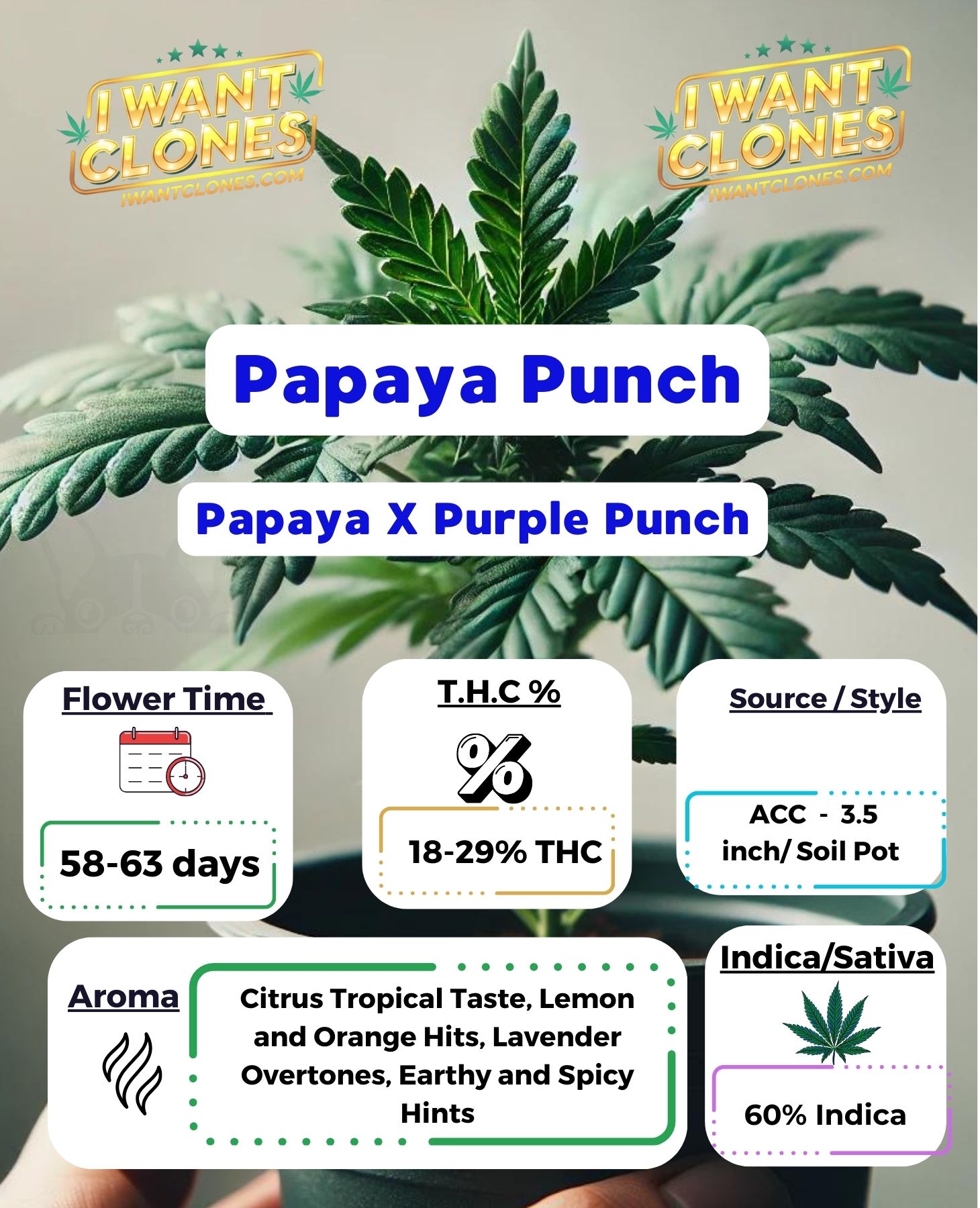
The papaya punch strain is an indica-dominant hybrid born from crossing Nirvana’s Papaya with the beloved Purple Punch, delivering a tropical fruit candy aroma, visually stunning purple-tinged buds, and deeply relaxing effects that typically clock in between 20–25% THC. It’s a grower-friendly plant that rewards basic training techniques with generous, colorful yields. At IWantClones.com, we carry Papaya Punch clones that are fully rooted and ready to run — no germination guesswork, no waiting.

Key Takeaways

  • Lineage: Papaya (Nirvana) × Purple Punch (Larry OG × Granddaddy Purple) — pure tropical-meets-purple power
  • Dominant terpenes: myrcene, ocimene, caryophyllene, and terpinolene; aroma runs from ripe papaya and mango to sweet grape and cream
  • THC typically 20–25%; effects are relaxing, euphoric, and mood-lifting with a strong body component
  • Flower time: 8–9 weeks; moderate-to-heavy yields with dense, colorful buds (purple, orange, green)
  • Dense buds mean humidity management is non-negotiable — keep late-flower RH under 45% and airflow dialed in
  • Brief cold nights (65–68°F) in the final two weeks unlock deep purple hues in the buds and leaves

Lineage & Genetics: Where Papaya Punch Comes From

Understanding a strain’s family tree tells you almost everything you need to know about how it grows. The papaya punch strain combines two heavy hitters that each bring a distinct set of traits to the table.

On the mother’s side, Nirvana’s Papaya is a tropical indica-leaning variety developed in the Netherlands. It earned its name from a strong, fruit-forward scent profile — think ripe papaya, mango, and citrus — and it’s known for producing compact, resin-coated buds with a fast flower time. Papaya plants tend to be stocky and manageable, which makes them practical for indoor growers with limited vertical space.

The father’s side brings in Purple Punch, the strain that came out of Supernova Gardens and quickly became one of the most recognizable purple varieties in California. Purple Punch itself is a cross of Larry OG and Granddaddy Purple. That lineage explains why Papaya Punch plants display those deep purple hues under the right conditions — it’s pure Purple Punch genetics expressing themselves. It also explains the sweet grape and berry notes that layer on top of the tropical fruit base.

The result of that cross is a strain that leans indica in structure and effect but surprises growers with its colorful expression and surprisingly approachable growth pattern. If you enjoy the Purple Punch side of the family tree, check out our Dosi Punch strain guide — another punch-lineage variety worth running alongside Papaya Punch.

Terpene Profile & Aroma

The papaya punch strain’s smell is one of its biggest selling points. The moment you open the jar, you get a rush of tropical fruit candy — papaya and mango lead the charge, with pineapple notes weaving in and out. That tropical base comes directly from the Papaya parent and is driven primarily by myrcene and terpinolene.

Then the Purple Punch genetics layer in sweet berry and grape, adding depth to what could otherwise be a one-dimensional tropical scent. Caryophyllene shows up in the background with a faint spice that keeps the sweetness from being cloying. Ocimene contributes the floral, almost herbal top note that growers often notice when they’re handling plants during late veg and early flower.

The finish on this strain is distinctly creamy — almost like a tropical sorbet. When properly dried and cured, the full terpene profile opens up in a way that makes the smoke or vapor feel rounded and smooth. On that note, don’t rush through post-harvest processing. A quality dry and cure is what lets these tropical terpenes truly shine. Our guide on drying and curing cannabis walks through the process in detail.

Expect the aroma to intensify significantly in weeks 6–8 of flower. Good airflow in your tent or room is important not just for mold prevention but for managing the strength of the smell.

Effects & Potency

The papaya punch strain sits comfortably in the indica-dominant hybrid category. The onset is euphoric and mood-lifting — a clean, pleasant head change that doesn’t feel heavy or sedating at first. Within 20–30 minutes, the body relaxation starts to build, working its way from the shoulders down. It’s the kind of effect profile that makes this strain popular for evening use without being a full knockout.

THC content typically runs between 20–25% depending on the phenotype and how the crop was grown. Clone genetics from proven cuts tend to express the higher end of that range consistently. The effect duration is moderate — most users report 2–3 hours of noticeable effect at typical doses.

This is not a strain that pushes into racy or anxious territory, largely because of the myrcene-heavy terpene profile. Myrcene is widely associated with that calming, body-forward quality. For newer consumers, starting low and going slow is always the right call regardless of what the label says. For cultivators, knowing your audience matters — this strain appeals to people who want relaxation without complete couch-lock.

Legal note: Cannabis laws vary significantly by state and locality. Always verify what’s permitted in your area. As of April 2026, the DEA placed FDA-approved marijuana products and state-licensed medical marijuana into Schedule III, but recreational/adult-use cannabis remains Schedule I federally. A broader rescheduling hearing runs June 29–July 15, 2026. Check your state and local laws before growing, purchasing, or consuming cannabis.

Strain Specs at a Glance

Characteristic Details
Lineage Papaya (Nirvana) × Purple Punch (Larry OG × GDP)
Type Indica-dominant hybrid
THC Range 20–25%
Dominant Terpenes Myrcene, Ocimene, Caryophyllene, Terpinolene
Flower Time 8–9 weeks
Yield Moderate to heavy
Plant Height Moderate (manageable indoors)
Grow Difficulty Beginner-friendly to Intermediate
Bud Appearance Dense; purple, orange, and green; visually striking
Best For Indoor, greenhouse; responds well to training

Growing Papaya Punch: Full Cultivation Overview

The papaya punch strain is a solid choice for cultivators at the beginner-to-intermediate level. It’s forgiving through most of the vegetative stage, responds well to training, and doesn’t require an aggressive or complicated feeding regimen. The one area where it demands attention is late-flower humidity — those dense buds are a real mold risk if you let your environment get sloppy.

Here’s how to set yourself up for a successful run from clone to harvest.

Starting with Clones vs. Seeds

If you’re growing the papaya punch strain for consistent results, clones are the clear choice over seeds. With seeds — even feminized ones — you’re rolling the dice on phenotype variation. One plant might express the tropical fruit profile perfectly; the next might lean heavier on grape and purple, or stretch more than expected. That inconsistency matters when you’re trying to dial in a repeatable crop.

A rooted clone from a verified cut gives you a genetic copy of a known performer. You know how it eats, how it stretches, what the finished product smells like. You can build a feeding and training schedule around its specific tendencies from day one. That’s a significant advantage — and it’s exactly why we offer Papaya Punch clones backed by SeedsHereNow.com’s sourcing standards.

Starting from a rooted clone also cuts weeks off your total grow time versus germinating from seed. Less time in the tent means lower overhead costs and faster turnaround between harvests.

Vegetative Stage: Building the Frame

Papaya Punch grows with moderate vigor in veg. It’s bushy by nature — the Papaya parent keeps it from stretching aggressively, and the compact node spacing means you have a lot of lateral growth potential to work with. Veg for 4–6 weeks from a rooted clone depending on how large you want your finished plant to be.

In veg, aim for:

  • Light: 18/6 photoperiod; 400–600 µmol PPFD at canopy
  • Temperature: 72–82°F (22–28°C)
  • Relative Humidity: 55–70% — no problem here in veg, the plant handles it well
  • VPD: 0.8–1.2 kPa; stay in range and you won’t have to babysit the plant

Managing your vapor pressure deficit properly through every growth stage makes a bigger difference than most new growers realize. Our VPD guide for cannabis clones has target charts for each stage. Keep that reference handy — you’ll use it from the day your clones arrive through the final week of flower.

For overall environment setup, including temperature stacking and airflow basics, the climate and environment guide is worth a full read before you start.

Feeding Schedule in Veg

Papaya Punch is a light-to-moderate feeder compared to some of the heavier OG crosses on the market. It doesn’t need to be pushed hard in veg to build a solid structure. Overfeeding — especially nitrogen — leads to dark, clawed leaves and can stunt root development in young clones.

A balanced NPK formula (around 3-1-2 or similar for veg) at about 70% of manufacturer-recommended strength is plenty for most of the vegetative stage. Bump to full strength only in the final week or two of veg as the plant’s demand increases heading into the pre-flower transition. Keep an eye on leaf color: a vibrant medium green is your target. Dark green means you’re pushing too much nitrogen.

Watch your calcium and magnesium levels, especially under LED lighting. Cal-Mag deficiency shows up as yellowing between the veins on young leaves — address it early. Our full nutrient guide for cannabis clones covers the specific products and timing that work for plants at every stage.

Training Techniques: Getting the Most from Your Canopy

The bushy, branchy structure of Papaya Punch makes it an excellent candidate for training. This strain responds particularly well to both topping and low-stress training (LST), and it genuinely thrives under a SCROG net.

Topping: Top the main stem at the 4th or 5th node during veg to split the plant into two main colas. From there, you can top each of those branches again (FIMing or full topping) to create a wide, even canopy with multiple top sites. Two or three rounds of topping in veg sets you up for a much more even light distribution at the canopy level.

LST (Low-Stress Training): After topping, use soft ties or garden wire to bend the main branches outward and downward, spreading the plant horizontally. This encourages all the secondary bud sites to receive direct light, which translates directly into more usable yield. Papaya Punch responds to LST quickly — you’ll see branches reorient toward the light within 24–48 hours of a tie-down.

SCROG: If you’re running multiple clones from the same cut in a controlled space, a SCROG net at 12–16 inches above the pot is a powerful tool. Train branches through the net during veg, then flip to 12/12 when the canopy is about 60–70% full. The plant will fill the remaining net space during the stretch in the first two to three weeks of flower. Papaya Punch’s lateral branching fills a net efficiently — expect an even, flat canopy that catches light uniformly across the board.

Flowering Stage: Weeks 1–9

The Transition and Stretch

When you flip to 12/12 light, Papaya Punch will stretch moderately — typically 30–50% height increase during the first three weeks of flower. This is manageable compared to sativa-heavy strains, but you need to account for it if you’re growing in a tent with limited height. If your canopy is at 24 inches when you flip, plan for it to reach 32–36 inches at peak stretch.

During weeks 1–3, the plant is still in a veg-like state nutritionally. Keep nitrogen in the mix but begin reducing it as white pistils start forming across the bud sites. This is the time to start shifting your NPK ratio toward higher phosphorus and potassium.

Mid-Flower: Weeks 4–6

This is where Papaya Punch starts to show you what it’s made of. Bud sites swell noticeably, the tropical terpene aroma picks up, and the first hints of purple can appear on the leaves and calyxes — especially if your night temperatures are running on the cooler side.

By week 5, drop nitrogen to near-zero and lean into a bloom-focused feed: higher phosphorus and potassium drive flower production and terpene development. A 0-5-4 or similar late-bloom ratio works well here. Keep calcium and magnesium supplementation consistent — flowering plants pull hard on these nutrients and deficiency can show up fast if you’re not paying attention.

Light intensity matters in mid-flower. If you’re running LEDs, push PPFD to 800–1,000 µmol at the canopy. Papaya Punch can handle higher light levels in flower without showing light stress, as long as your VPD is in range and the plant is well-fed.

Late Flower: Weeks 7–9 — Watch Your Humidity

Dense buds are beautiful, but they come with risk. The papaya punch strain produces tightly packed calyxes that can trap moisture inside the bud structure if your environment isn’t dialed in. Botrytis (bud rot) can destroy entire colas in 48–72 hours once it takes hold, and it’s almost invisible until the damage is severe.

In late flower, you need to:

  • Drop relative humidity to 40–45% RH — no higher
  • Maintain good airflow across and through the canopy, not just around it
  • Run an oscillating fan at low speed directly at the canopy during lights-on
  • Inspect buds every two to three days — look for any gray fuzzy growth or discolored calyxes
  • Remove any large fan leaves that are blocking airflow into dense bud clusters

If you’re growing in a region with naturally high ambient humidity, read our guide on growing cannabis clones in humid climates before you start. Managing the environment proactively in late flower is far easier than trying to save a crop that’s already showing mold.

For a deeper dive into how VPD interacts with late-flower environments, our VPD guide includes specific targets for weeks 7–9 that will keep you out of the danger zone.

Unlocking the Purple: Cold Treatment in Final Two Weeks

One of the most visually striking characteristics of the papaya punch strain is its potential for deep purple coloration. Those hues come directly from the Purple Punch parent — specifically from the anthocyanin pigments expressed in the buds and sugar leaves. But they don’t just appear automatically. You need to give the plant a temperature signal to trigger that expression.

In the last 10–14 days of flower, drop your nighttime temperature to 65–68°F (18–20°C). The temperature differential between lights-on (keep it in the high 70s) and lights-off (low-to-mid 60s) signals the plant to produce more anthocyanins, which show up as purple, blue, and magenta tones throughout the buds and leaf tissue.

This is purely aesthetic — the temperature treatment doesn’t meaningfully affect potency or terpene content — but the visual payoff is significant. Papaya Punch harvested with the cold treatment looks like something from a genetics display table. Purple calyxes, bright orange pistils, green sugar leaves dusted with white trichomes. It’s a striking combination that photographs well and commands attention.

Don’t drop temperatures below 60°F — you risk slowing trichome development and stressing the plant in its final stretch. The 65–68°F night window is the sweet spot.

Harvest Timing

Papaya Punch finishes in 8–9 weeks of flower under a 12/12 photoperiod. Don’t let the stated flower time be your only guide. Trichomes are the real indicator of when this strain is ready to come down.

In the final 1–2 weeks, check trichomes with a jeweler’s loupe (30–60x) or a digital microscope:

  • All clear: Too early — THC still building
  • Mostly cloudy/milky: Peak THC, more cerebral effect — harvest here for maximum potency
  • 30–50% amber: THC beginning to degrade to CBN; body effect becomes heavier and more sedating; personal preference zone

For the papaya punch strain specifically, most growers harvest when trichomes are 90% cloudy with just a few amber heads appearing. This preserves the strain’s euphoric onset while still allowing the body relaxation to fully develop. Pushing for more amber can tip the effect profile toward heavy sedation, which some users love and others find too much.

Our detailed harvest timing guide walks through the full trichome inspection process with visual references. Don’t skip this step — a two-day difference in harvest timing on a strain like this makes a real difference in the end product.

Feeding Through Late Flower

In the final 10–14 days, begin your flush. Whether you use plain water or a flushing agent depends on your medium and feeding approach — coco and hydro flush faster than soil. The goal is to clear residual salts from the root zone so the plant uses up its stored nutrients before harvest.

A properly flushed Papaya Punch will show natural yellowing of the large fan leaves in the final week — that’s the plant pulling nitrogen from leaf tissue back into the buds. Don’t panic and add nutrients when you see this. It’s exactly what you want to see at that stage.

Post-Harvest: Drying, Curing, and Preserving Terpenes

Papaya Punch’s tropical terpene profile is volatile — myrcene and terpinolene in particular can degrade quickly if you rush the dry or cure. A slow, controlled dry at 60–65°F with 55–60% RH for 10–14 days, followed by a cure in sealed glass jars for 4–8 weeks, preserves the full aromatic complexity that makes this strain worth growing.

Burp jars daily for the first two weeks of cure, then every few days as the moisture level stabilizes. When you open a properly cured jar of Papaya Punch, you should get that tropical fruit candy rush immediately. If you’re getting hay or grassy smell, the dry was too fast or too warm — the terpenes burned off before they could preserve.

For a complete walkthrough of the process, including troubleshooting common mistakes, our drying and curing cannabis guide covers everything you need.

Why Order Papaya Punch Clones Instead of Seeds

We covered the basics above, but it’s worth being direct about why most serious cultivators running the papaya punch strain do so from clones. Seeds introduce genetic lottery — even from reputable breeders, you can pull 20 seeds and get phenotype variation that ranges from “exactly what was advertised” to “close but not quite right.” That’s fine for a hobby run or for hunting a pheno. It’s inefficient for production growing.

When you order Papaya Punch clones from IWantClones.com, you’re getting a rooted, verified cut. The genetics are locked. The plant you receive will grow, smell, and produce in a predictable, documented way. You can optimize your environment and feeding schedule based on known characteristics rather than discovering them run by run.

At $98.88 per clone, you’re paying for genetic certainty, the weeks of propagation time we’ve already invested, and the assurance that comes from SeedsHereNow.com’s sourcing standards. Compare that to the seed cost, germination risk, sexing time, and phenotype hunting involved in a seed run — clones win on efficiency at every step.

Frequently Asked Questions

What does Papaya Punch taste and smell like?

The papaya punch strain delivers a tropical fruit candy experience — ripe papaya, mango, and pineapple lead the aroma, with sweet grape and berry notes layered in from the Purple Punch genetics. The finish is creamy and smooth. Dominant terpenes are myrcene, ocimene, caryophyllene, and terpinolene. Proper curing is what brings out the full range of this profile.

How long does Papaya Punch take to flower?

Papaya Punch finishes in 8–9 weeks under a 12/12 photoperiod. Use trichome color as your primary harvest indicator rather than the calendar alone. Harvest at mostly cloudy trichomes with minimal amber for peak potency. Pushing to 50% amber deepens the sedating body effect but begins degrading THC to CBN.

Is Papaya Punch a good strain for beginners?

Yes, with one important caveat. The papaya punch strain is beginner-friendly through veg and most of flower — it’s forgiving, not a heavy feeder, and responds well to training. The area that requires attention is late-flower humidity management. Dense buds are prone to mold if RH climbs above 45–50% in weeks 7–9. Keep airflow strong and humidity dialed, and you’ll be fine.

How do I get Papaya Punch buds to turn purple?

Drop your nighttime temperature to 65–68°F in the final 10–14 days of flower. The temperature differential between day and night triggers anthocyanin production, which expresses as deep purple coloration in the buds and sugar leaves. Don’t go below 60°F — that can stress the plant and slow trichome development right when you want it ramping up.

Where can I buy Papaya Punch clones?

We carry rooted Papaya Punch clones at IWantClones.com for $98.88. Clones are fully rooted from verified cuts, backed by SeedsHereNow.com’s sourcing. Starting from a proven clone means you skip germination, sexing, and phenotype hunting — and you know exactly what you’re growing from day one. Always confirm your state and local laws before purchasing or growing cannabis.

Final Thoughts

The papaya punch strain earns its reputation. It’s a visually striking, aromatically complex, beginner-accessible plant that produces dense, resinous buds with a THC content that satisfies experienced consumers. The lineage — Papaya crossed into Purple Punch — gives you a genetic foundation that you can trust to deliver tropical terpenes and colorful, photoworthy buds run after run.

The keys to a successful grow are straightforward: train early, manage late-flower humidity aggressively, and don’t skip the cold treatment if you want those purple hues. Get the dry and cure right, and the terpene profile that makes this strain special will come through clearly in the finished product.

If you’re ready to run it, order your Papaya Punch clones here — we’ll ship you rooted, ready-to-transplant genetics so you can skip straight to the growing part.

As always, verify your state and local laws before growing, purchasing, or consuming cannabis. Cannabis law continues to evolve at the federal and state level — what’s current today may change. IWantClones.com and SeedsHereNow.com do not provide legal advice.

Sources: Leafly — Papaya Punch strain profile

Share

Comments are closed.

Also recommended

Papaya Punch Strain & Clone Grow Guide

July 25, 2026

The papaya punch strain is an indica-dominant hybrid born from crossing Nirvana’s Papaya with the beloved Purple Punch, delivering a tropical fruit candy aroma, visually stunning purple-tinged buds, and deeply relaxing effects that typically clock in between 20–25% THC. It’s a grower-friendly plant that rewards basic training techniques with generous, colorful yields. At IWantClones.com, we carry Papaya Punch clones that are fully rooted and ready to run — no germination guesswork, no waiting.

Key Takeaways

  • Lineage: Papaya (Nirvana) × Purple Punch (Larry OG × Granddaddy Purple) — pure tropical-meets-purple power
  • Dominant terpenes: myrcene, ocimene, caryophyllene, and terpinolene; aroma runs from ripe papaya and mango to sweet grape and cream
  • THC typically 20–25%; effects are relaxing, euphoric, and mood-lifting with a strong body component
  • Flower time: 8–9 weeks; moderate-to-heavy yields with dense, colorful buds (purple, orange, green)
  • Dense buds mean humidity management is non-negotiable — keep late-flower RH under 45% and airflow dialed in
  • Brief cold nights (65–68°F) in the final two weeks unlock deep purple hues in the buds and leaves

Lineage & Genetics: Where Papaya Punch Comes From

Understanding a strain’s family tree tells you almost everything you need to know about how it grows. The papaya punch strain combines two heavy hitters that each bring a distinct set of traits to the table.

On the mother’s side, Nirvana’s Papaya is a tropical indica-leaning variety developed in the Netherlands. It earned its name from a strong, fruit-forward scent profile — think ripe papaya, mango, and citrus — and it’s known for producing compact, resin-coated buds with a fast flower time. Papaya plants tend to be stocky and manageable, which makes them practical for indoor growers with limited vertical space.

The father’s side brings in Purple Punch, the strain that came out of Supernova Gardens and quickly became one of the most recognizable purple varieties in California. Purple Punch itself is a cross of Larry OG and Granddaddy Purple. That lineage explains why Papaya Punch plants display those deep purple hues under the right conditions — it’s pure Purple Punch genetics expressing themselves. It also explains the sweet grape and berry notes that layer on top of the tropical fruit base.

The result of that cross is a strain that leans indica in structure and effect but surprises growers with its colorful expression and surprisingly approachable growth pattern. If you enjoy the Purple Punch side of the family tree, check out our Dosi Punch strain guide — another punch-lineage variety worth running alongside Papaya Punch.

Terpene Profile & Aroma

The papaya punch strain’s smell is one of its biggest selling points. The moment you open the jar, you get a rush of tropical fruit candy — papaya and mango lead the charge, with pineapple notes weaving in and out. That tropical base comes directly from the Papaya parent and is driven primarily by myrcene and terpinolene.

Then the Purple Punch genetics layer in sweet berry and grape, adding depth to what could otherwise be a one-dimensional tropical scent. Caryophyllene shows up in the background with a faint spice that keeps the sweetness from being cloying. Ocimene contributes the floral, almost herbal top note that growers often notice when they’re handling plants during late veg and early flower.

The finish on this strain is distinctly creamy — almost like a tropical sorbet. When properly dried and cured, the full terpene profile opens up in a way that makes the smoke or vapor feel rounded and smooth. On that note, don’t rush through post-harvest processing. A quality dry and cure is what lets these tropical terpenes truly shine. Our guide on drying and curing cannabis walks through the process in detail.

Expect the aroma to intensify significantly in weeks 6–8 of flower. Good airflow in your tent or room is important not just for mold prevention but for managing the strength of the smell.

Effects & Potency

The papaya punch strain sits comfortably in the indica-dominant hybrid category. The onset is euphoric and mood-lifting — a clean, pleasant head change that doesn’t feel heavy or sedating at first. Within 20–30 minutes, the body relaxation starts to build, working its way from the shoulders down. It’s the kind of effect profile that makes this strain popular for evening use without being a full knockout.

THC content typically runs between 20–25% depending on the phenotype and how the crop was grown. Clone genetics from proven cuts tend to express the higher end of that range consistently. The effect duration is moderate — most users report 2–3 hours of noticeable effect at typical doses.

This is not a strain that pushes into racy or anxious territory, largely because of the myrcene-heavy terpene profile. Myrcene is widely associated with that calming, body-forward quality. For newer consumers, starting low and going slow is always the right call regardless of what the label says. For cultivators, knowing your audience matters — this strain appeals to people who want relaxation without complete couch-lock.

Legal note: Cannabis laws vary significantly by state and locality. Always verify what’s permitted in your area. As of April 2026, the DEA placed FDA-approved marijuana products and state-licensed medical marijuana into Schedule III, but recreational/adult-use cannabis remains Schedule I federally. A broader rescheduling hearing runs June 29–July 15, 2026. Check your state and local laws before growing, purchasing, or consuming cannabis.

Strain Specs at a Glance

Characteristic Details
Lineage Papaya (Nirvana) × Purple Punch (Larry OG × GDP)
Type Indica-dominant hybrid
THC Range 20–25%
Dominant Terpenes Myrcene, Ocimene, Caryophyllene, Terpinolene
Flower Time 8–9 weeks
Yield Moderate to heavy
Plant Height Moderate (manageable indoors)
Grow Difficulty Beginner-friendly to Intermediate
Bud Appearance Dense; purple, orange, and green; visually striking
Best For Indoor, greenhouse; responds well to training

Growing Papaya Punch: Full Cultivation Overview

The papaya punch strain is a solid choice for cultivators at the beginner-to-intermediate level. It’s forgiving through most of the vegetative stage, responds well to training, and doesn’t require an aggressive or complicated feeding regimen. The one area where it demands attention is late-flower humidity — those dense buds are a real mold risk if you let your environment get sloppy.

Here’s how to set yourself up for a successful run from clone to harvest.

Starting with Clones vs. Seeds

If you’re growing the papaya punch strain for consistent results, clones are the clear choice over seeds. With seeds — even feminized ones — you’re rolling the dice on phenotype variation. One plant might express the tropical fruit profile perfectly; the next might lean heavier on grape and purple, or stretch more than expected. That inconsistency matters when you’re trying to dial in a repeatable crop.

A rooted clone from a verified cut gives you a genetic copy of a known performer. You know how it eats, how it stretches, what the finished product smells like. You can build a feeding and training schedule around its specific tendencies from day one. That’s a significant advantage — and it’s exactly why we offer Papaya Punch clones backed by SeedsHereNow.com’s sourcing standards.

Starting from a rooted clone also cuts weeks off your total grow time versus germinating from seed. Less time in the tent means lower overhead costs and faster turnaround between harvests.

Vegetative Stage: Building the Frame

Papaya Punch grows with moderate vigor in veg. It’s bushy by nature — the Papaya parent keeps it from stretching aggressively, and the compact node spacing means you have a lot of lateral growth potential to work with. Veg for 4–6 weeks from a rooted clone depending on how large you want your finished plant to be.

In veg, aim for:

  • Light: 18/6 photoperiod; 400–600 µmol PPFD at canopy
  • Temperature: 72–82°F (22–28°C)
  • Relative Humidity: 55–70% — no problem here in veg, the plant handles it well
  • VPD: 0.8–1.2 kPa; stay in range and you won’t have to babysit the plant

Managing your vapor pressure deficit properly through every growth stage makes a bigger difference than most new growers realize. Our VPD guide for cannabis clones has target charts for each stage. Keep that reference handy — you’ll use it from the day your clones arrive through the final week of flower.

For overall environment setup, including temperature stacking and airflow basics, the climate and environment guide is worth a full read before you start.

Feeding Schedule in Veg

Papaya Punch is a light-to-moderate feeder compared to some of the heavier OG crosses on the market. It doesn’t need to be pushed hard in veg to build a solid structure. Overfeeding — especially nitrogen — leads to dark, clawed leaves and can stunt root development in young clones.

A balanced NPK formula (around 3-1-2 or similar for veg) at about 70% of manufacturer-recommended strength is plenty for most of the vegetative stage. Bump to full strength only in the final week or two of veg as the plant’s demand increases heading into the pre-flower transition. Keep an eye on leaf color: a vibrant medium green is your target. Dark green means you’re pushing too much nitrogen.

Watch your calcium and magnesium levels, especially under LED lighting. Cal-Mag deficiency shows up as yellowing between the veins on young leaves — address it early. Our full nutrient guide for cannabis clones covers the specific products and timing that work for plants at every stage.

Training Techniques: Getting the Most from Your Canopy

The bushy, branchy structure of Papaya Punch makes it an excellent candidate for training. This strain responds particularly well to both topping and low-stress training (LST), and it genuinely thrives under a SCROG net.

Topping: Top the main stem at the 4th or 5th node during veg to split the plant into two main colas. From there, you can top each of those branches again (FIMing or full topping) to create a wide, even canopy with multiple top sites. Two or three rounds of topping in veg sets you up for a much more even light distribution at the canopy level.

LST (Low-Stress Training): After topping, use soft ties or garden wire to bend the main branches outward and downward, spreading the plant horizontally. This encourages all the secondary bud sites to receive direct light, which translates directly into more usable yield. Papaya Punch responds to LST quickly — you’ll see branches reorient toward the light within 24–48 hours of a tie-down.

SCROG: If you’re running multiple clones from the same cut in a controlled space, a SCROG net at 12–16 inches above the pot is a powerful tool. Train branches through the net during veg, then flip to 12/12 when the canopy is about 60–70% full. The plant will fill the remaining net space during the stretch in the first two to three weeks of flower. Papaya Punch’s lateral branching fills a net efficiently — expect an even, flat canopy that catches light uniformly across the board.

Flowering Stage: Weeks 1–9

The Transition and Stretch

When you flip to 12/12 light, Papaya Punch will stretch moderately — typically 30–50% height increase during the first three weeks of flower. This is manageable compared to sativa-heavy strains, but you need to account for it if you’re growing in a tent with limited height. If your canopy is at 24 inches when you flip, plan for it to reach 32–36 inches at peak stretch.

During weeks 1–3, the plant is still in a veg-like state nutritionally. Keep nitrogen in the mix but begin reducing it as white pistils start forming across the bud sites. This is the time to start shifting your NPK ratio toward higher phosphorus and potassium.

Mid-Flower: Weeks 4–6

This is where Papaya Punch starts to show you what it’s made of. Bud sites swell noticeably, the tropical terpene aroma picks up, and the first hints of purple can appear on the leaves and calyxes — especially if your night temperatures are running on the cooler side.

By week 5, drop nitrogen to near-zero and lean into a bloom-focused feed: higher phosphorus and potassium drive flower production and terpene development. A 0-5-4 or similar late-bloom ratio works well here. Keep calcium and magnesium supplementation consistent — flowering plants pull hard on these nutrients and deficiency can show up fast if you’re not paying attention.

Light intensity matters in mid-flower. If you’re running LEDs, push PPFD to 800–1,000 µmol at the canopy. Papaya Punch can handle higher light levels in flower without showing light stress, as long as your VPD is in range and the plant is well-fed.

Late Flower: Weeks 7–9 — Watch Your Humidity

Dense buds are beautiful, but they come with risk. The papaya punch strain produces tightly packed calyxes that can trap moisture inside the bud structure if your environment isn’t dialed in. Botrytis (bud rot) can destroy entire colas in 48–72 hours once it takes hold, and it’s almost invisible until the damage is severe.

In late flower, you need to:

  • Drop relative humidity to 40–45% RH — no higher
  • Maintain good airflow across and through the canopy, not just around it
  • Run an oscillating fan at low speed directly at the canopy during lights-on
  • Inspect buds every two to three days — look for any gray fuzzy growth or discolored calyxes
  • Remove any large fan leaves that are blocking airflow into dense bud clusters

If you’re growing in a region with naturally high ambient humidity, read our guide on growing cannabis clones in humid climates before you start. Managing the environment proactively in late flower is far easier than trying to save a crop that’s already showing mold.

For a deeper dive into how VPD interacts with late-flower environments, our VPD guide includes specific targets for weeks 7–9 that will keep you out of the danger zone.

Unlocking the Purple: Cold Treatment in Final Two Weeks

One of the most visually striking characteristics of the papaya punch strain is its potential for deep purple coloration. Those hues come directly from the Purple Punch parent — specifically from the anthocyanin pigments expressed in the buds and sugar leaves. But they don’t just appear automatically. You need to give the plant a temperature signal to trigger that expression.

In the last 10–14 days of flower, drop your nighttime temperature to 65–68°F (18–20°C). The temperature differential between lights-on (keep it in the high 70s) and lights-off (low-to-mid 60s) signals the plant to produce more anthocyanins, which show up as purple, blue, and magenta tones throughout the buds and leaf tissue.

This is purely aesthetic — the temperature treatment doesn’t meaningfully affect potency or terpene content — but the visual payoff is significant. Papaya Punch harvested with the cold treatment looks like something from a genetics display table. Purple calyxes, bright orange pistils, green sugar leaves dusted with white trichomes. It’s a striking combination that photographs well and commands attention.

Don’t drop temperatures below 60°F — you risk slowing trichome development and stressing the plant in its final stretch. The 65–68°F night window is the sweet spot.

Harvest Timing

Papaya Punch finishes in 8–9 weeks of flower under a 12/12 photoperiod. Don’t let the stated flower time be your only guide. Trichomes are the real indicator of when this strain is ready to come down.

In the final 1–2 weeks, check trichomes with a jeweler’s loupe (30–60x) or a digital microscope:

  • All clear: Too early — THC still building
  • Mostly cloudy/milky: Peak THC, more cerebral effect — harvest here for maximum potency
  • 30–50% amber: THC beginning to degrade to CBN; body effect becomes heavier and more sedating; personal preference zone

For the papaya punch strain specifically, most growers harvest when trichomes are 90% cloudy with just a few amber heads appearing. This preserves the strain’s euphoric onset while still allowing the body relaxation to fully develop. Pushing for more amber can tip the effect profile toward heavy sedation, which some users love and others find too much.

Our detailed harvest timing guide walks through the full trichome inspection process with visual references. Don’t skip this step — a two-day difference in harvest timing on a strain like this makes a real difference in the end product.

Feeding Through Late Flower

In the final 10–14 days, begin your flush. Whether you use plain water or a flushing agent depends on your medium and feeding approach — coco and hydro flush faster than soil. The goal is to clear residual salts from the root zone so the plant uses up its stored nutrients before harvest.

A properly flushed Papaya Punch will show natural yellowing of the large fan leaves in the final week — that’s the plant pulling nitrogen from leaf tissue back into the buds. Don’t panic and add nutrients when you see this. It’s exactly what you want to see at that stage.

Post-Harvest: Drying, Curing, and Preserving Terpenes

Papaya Punch’s tropical terpene profile is volatile — myrcene and terpinolene in particular can degrade quickly if you rush the dry or cure. A slow, controlled dry at 60–65°F with 55–60% RH for 10–14 days, followed by a cure in sealed glass jars for 4–8 weeks, preserves the full aromatic complexity that makes this strain worth growing.

Burp jars daily for the first two weeks of cure, then every few days as the moisture level stabilizes. When you open a properly cured jar of Papaya Punch, you should get that tropical fruit candy rush immediately. If you’re getting hay or grassy smell, the dry was too fast or too warm — the terpenes burned off before they could preserve.

For a complete walkthrough of the process, including troubleshooting common mistakes, our drying and curing cannabis guide covers everything you need.

Why Order Papaya Punch Clones Instead of Seeds

We covered the basics above, but it’s worth being direct about why most serious cultivators running the papaya punch strain do so from clones. Seeds introduce genetic lottery — even from reputable breeders, you can pull 20 seeds and get phenotype variation that ranges from “exactly what was advertised” to “close but not quite right.” That’s fine for a hobby run or for hunting a pheno. It’s inefficient for production growing.

When you order Papaya Punch clones from IWantClones.com, you’re getting a rooted, verified cut. The genetics are locked. The plant you receive will grow, smell, and produce in a predictable, documented way. You can optimize your environment and feeding schedule based on known characteristics rather than discovering them run by run.

At $98.88 per clone, you’re paying for genetic certainty, the weeks of propagation time we’ve already invested, and the assurance that comes from SeedsHereNow.com’s sourcing standards. Compare that to the seed cost, germination risk, sexing time, and phenotype hunting involved in a seed run — clones win on efficiency at every step.

Frequently Asked Questions

What does Papaya Punch taste and smell like?

The papaya punch strain delivers a tropical fruit candy experience — ripe papaya, mango, and pineapple lead the aroma, with sweet grape and berry notes layered in from the Purple Punch genetics. The finish is creamy and smooth. Dominant terpenes are myrcene, ocimene, caryophyllene, and terpinolene. Proper curing is what brings out the full range of this profile.

How long does Papaya Punch take to flower?

Papaya Punch finishes in 8–9 weeks under a 12/12 photoperiod. Use trichome color as your primary harvest indicator rather than the calendar alone. Harvest at mostly cloudy trichomes with minimal amber for peak potency. Pushing to 50% amber deepens the sedating body effect but begins degrading THC to CBN.

Is Papaya Punch a good strain for beginners?

Yes, with one important caveat. The papaya punch strain is beginner-friendly through veg and most of flower — it’s forgiving, not a heavy feeder, and responds well to training. The area that requires attention is late-flower humidity management. Dense buds are prone to mold if RH climbs above 45–50% in weeks 7–9. Keep airflow strong and humidity dialed, and you’ll be fine.

How do I get Papaya Punch buds to turn purple?

Drop your nighttime temperature to 65–68°F in the final 10–14 days of flower. The temperature differential between day and night triggers anthocyanin production, which expresses as deep purple coloration in the buds and sugar leaves. Don’t go below 60°F — that can stress the plant and slow trichome development right when you want it ramping up.

Where can I buy Papaya Punch clones?

We carry rooted Papaya Punch clones at IWantClones.com for $98.88. Clones are fully rooted from verified cuts, backed by SeedsHereNow.com’s sourcing. Starting from a proven clone means you skip germination, sexing, and phenotype hunting — and you know exactly what you’re growing from day one. Always confirm your state and local laws before purchasing or growing cannabis.

Final Thoughts

The papaya punch strain earns its reputation. It’s a visually striking, aromatically complex, beginner-accessible plant that produces dense, resinous buds with a THC content that satisfies experienced consumers. The lineage — Papaya crossed into Purple Punch — gives you a genetic foundation that you can trust to deliver tropical terpenes and colorful, photoworthy buds run after run.

The keys to a successful grow are straightforward: train early, manage late-flower humidity aggressively, and don’t skip the cold treatment if you want those purple hues. Get the dry and cure right, and the terpene profile that makes this strain special will come through clearly in the finished product.

If you’re ready to run it, order your Papaya Punch clones here — we’ll ship you rooted, ready-to-transplant genetics so you can skip straight to the growing part.

As always, verify your state and local laws before growing, purchasing, or consuming cannabis. Cannabis law continues to evolve at the federal and state level — what’s current today may change. IWantClones.com and SeedsHereNow.com do not provide legal advice.

Sources: Leafly — Papaya Punch strain profile

Written by James Bean

Recent Posts

Cannabis Grow Glossary: 50 Terms Every Grower Should Know

Master 50 essential cannabis growing terms — from phenotype and VPD to SCROG and HLVd. The definitive glossary for beginner and intermediate growers. Learn more at IWantClones.com.

Read More
Papaya Punch Strain & Clone Grow Guide

Grow the papaya punch strain like a pro. Lineage, terpenes, feeding, training & humidity tips — plus rooted Papaya Punch clones from $98.88.

Read More
Preventing Bud Rot & Powdery Mildew on Cannabis

Learn bud rot prevention strategies that actually work: humidity control, airflow, VPD, defoliation, and what to do if botrytis or PM hits your plants.

Read More

Subscribe Today!

Get 10% off when you sign up for our weekly updates!

About Us

At IWantClones.com, we are dedicated to providing top-quality cannabis clones to growers of all levels.

Subscribe Today!

Subscribe our newsletter to get our latest update & news
We currently accept credit/debit card payments, cash, check, money order, bitcoin (BTC), litecoin (LTE), bitcoin cash (BCH), and dogecoin (DOGE).
© 2026 seedsherenow.com All Rights Reserved
magnifiercross linkedin facebook pinterest youtube rss twitter instagram facebook-blank rss-blank linkedin-blank pinterest youtube twitter instagram