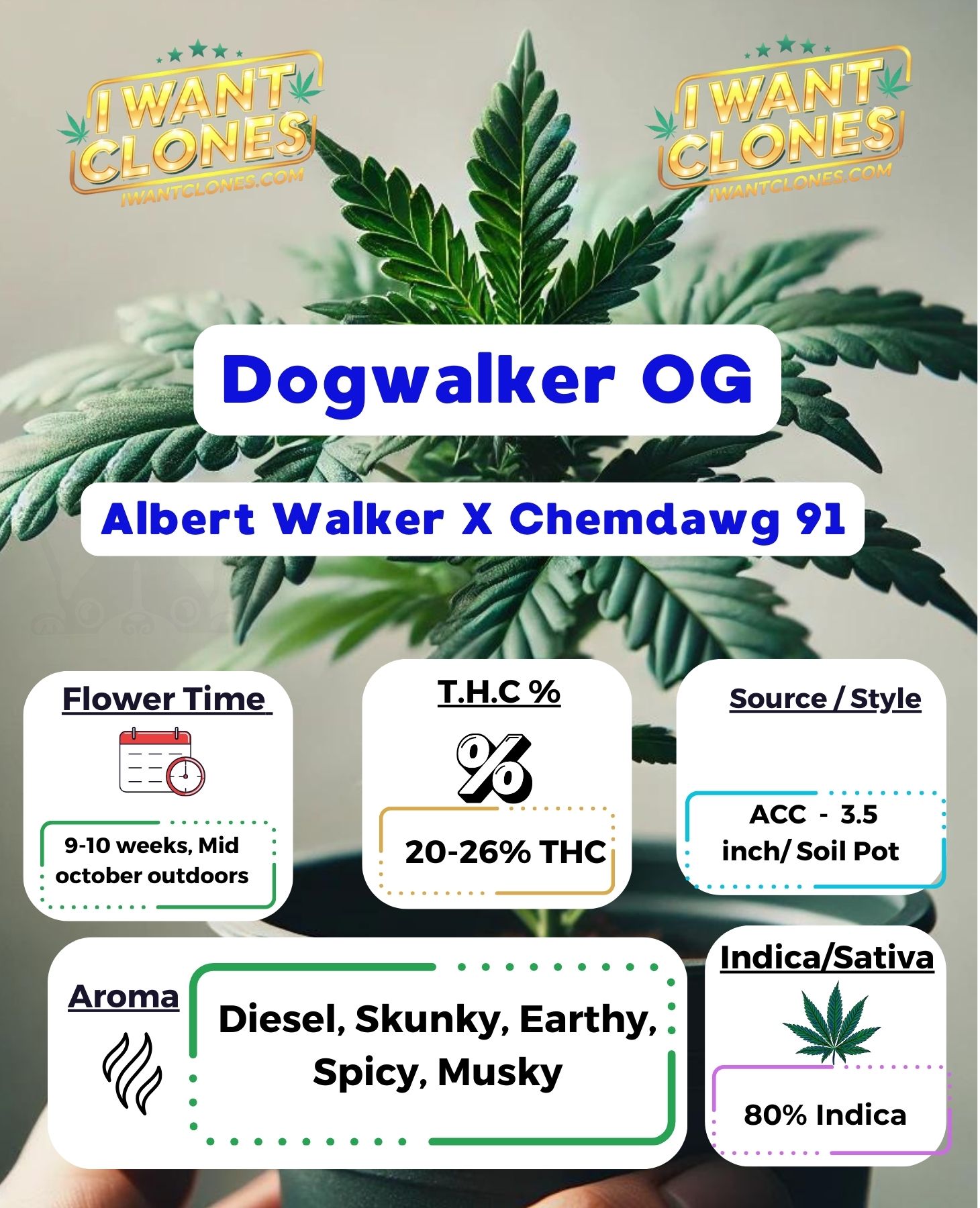
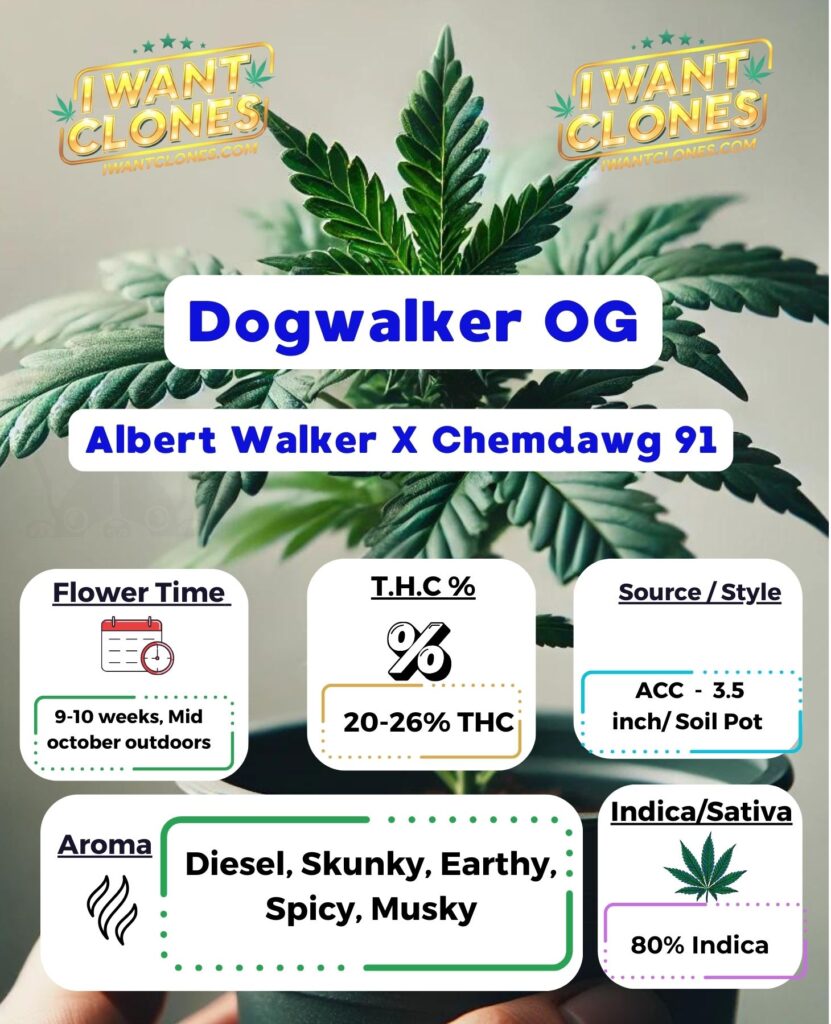
The Dogwalker OG strain is a heavy-hitting indica-dominant hybrid created by Karma Genetics, combining the legendary Albert Walker OG with the iconic Chemdawg 91 to produce one of the most pungent, resinous OG crosses on the market today. If you want the real thing in your garden, a verified clone is the only path — seeds produce too much variation to guarantee authentic Dogwalker OG expression. At IWantClones.com, we carry true-to-type Dogwalker OG clones cut from verified mother plants so you know exactly what you are growing.
Key Takeaways
- Genetics: Albert Walker OG × Chemdawg 91, bred by Karma Genetics (Netherlands)
- THC range: 20–28%, making this one of the stronger OG-lineage strains available
- Flower time: approximately 9 weeks (63 days) from flip to harvest
- Indoor yield: 350–450 g/m² with proper training and a dialed environment
- Dominant terpenes: myrcene, beta-caryophyllene, limonene, and alpha-pinene — earthy, diesel, pine, and skunk
- Best use case: evening and nighttime; experienced consumers who want classic OG depth and body effect
- Top grow priority: airflow and humidity control — dense OG buds are extremely vulnerable to botrytis above 55% RH
What Is the Dogwalker OG Strain?
Dogwalker OG is the creation of Karma Genetics, a Dutch seed company founded by the breeder known as Dank Duchess. Karma Genetics has built a reputation over many years for working with top-shelf OG Kush and Chemdog genetics, producing consistent, high-quality crosses that resonate with connoisseurs who want the classic California OG experience with a refined genetic backbone. Dogwalker OG is arguably the flagship expression of that vision.
The cross brings together two powerhouse parent strains. On one side is Albert Walker OG, a legendary OG Kush phenotype named after the notorious British spy — and rightly so, because this plant is as covert and devastating as its namesake. Albert Walker OG is prized for extreme resin production, a dense trichome coat that rivals almost any OG phenotype out there, and a pungent aroma profile heavy on fuel, damp earth, and pine. It is the kind of genetics that experienced OG hunters search years to find.
On the other side is Chemdawg 91, one of the single most influential cannabis genetics of the modern era. Chemdawg 91 is widely regarded as a parent of both OG Kush and Sour Diesel lineages, meaning it sits at the root of an enormous portion of the popular strains grown today. Chemdawg 91 brings raw chemical potency, a sharp diesel edge, and a complex, layered aroma that pushes Dogwalker OG well beyond a typical OG hybrid. The combination is not subtle — this is a strain that announces itself the moment the jar opens.
You can read more about Dogwalker OG’s community reputation and user reviews at Leafly’s Dogwalker OG strain profile, which aggregates hundreds of real-world reports from consumers across legal markets.
Dogwalker OG Terpene and Aroma Profile
Dogwalker OG has one of the most recognizable terpene profiles in the OG category. The name itself is a nod to the aroma — step into the woods with a wet dog after a rainstorm, add a layer of diesel fumes and skunk, and you are somewhere close to what this strain smells like when you crack open a properly cured jar. That is not a knock. For OG lovers, that profile is exactly what they are chasing.
The terpene stack is led by myrcene, which delivers the deep earthy, musky, slightly herbal base note that underlies the entire profile. Myrcene is the most common terpene in OG-lineage strains and contributes significantly to the heavy, sedating body effect that Dogwalker OG is known for. Right behind it is beta-caryophyllene, which adds the spicy, diesel-fuel bite that hits the back of the nose and throat and gives this strain its edge. Caryophyllene is unique among terpenes in that it also acts as a dietary cannabinoid by binding to CB2 receptors.
Limonene adds a citrus brightness that cuts through the heavier earth and diesel notes, giving the aroma a touch of lemon-orange that keeps the overall profile from becoming flat or one-dimensional. Finally, alpha-pinene brings a clean forest/pine character that ties the whole experience together — it is what makes Dogwalker OG smell like the outdoors rather than just a gas station.
On the exhale, the flavor follows the nose closely: skunk and diesel up front, pine and damp earth on the mid-palate, and a subtle floral sweetness on the finish that is easy to miss in a less-than-perfect cure but unmistakable in a well-dried, slow-cured batch. This is a strain where the cure matters enormously. Rush it, and you lose the layered character that makes Dogwalker OG worth growing in the first place.
Dogwalker OG Strain Effects and Experience
Dogwalker OG is not a beginner strain. At 20–28% THC, this is a potent indica-dominant hybrid that earns every bit of its reputation for power. New consumers and those with low tolerance should approach carefully — this is the kind of strain where one too many hits on the couch can turn into an unplanned two-hour nap.
The onset is euphoric and surprisingly uplifting for such a heavy indica hybrid. There is a mental lift that arrives within the first ten minutes — a mood elevation and mental calm that clears away the noise of the day. This is not a heady, racing sativa high. It is more like a warm blanket being placed over your thoughts. Anxiety and mental chatter tend to quiet down quickly, which is part of why this strain has such a devoted following among consumers who deal with chronic stress.
As the high develops, the body effect takes over. Deep relaxation moves through the limbs, the muscles soften, and the pull toward the couch becomes real. In moderate doses, Dogwalker OG sits in that comfortable zone of relaxed-but-functional. In larger doses, the sedative weight increases substantially and the experience becomes much more couch-locked and sleep-oriented. Most experienced consumers describe it as the ideal evening strain — something you reach for when the day is done and you want to fully decompress.
The high lasts longer than average — typically two to three hours of sustained effect — which reflects the potency and the robust terpene profile working together. Dogwalker OG is consistently recommended for evening and nighttime use. It pairs well with a good meal, a movie, or simply winding down before sleep. It is not the right choice before a workout, a creative brainstorm session, or any situation where you need to stay sharp and productive.
Dogwalker OG Strain at a Glance
| Attribute | Details |
|---|---|
| Genetics | Albert Walker OG × Chemdawg 91 |
| Breeder | Karma Genetics (Netherlands, founded by Dank Duchess) |
| Type | Indica-dominant hybrid |
| THC | 20–28% |
| Dominant Terpenes | Myrcene, beta-caryophyllene, limonene, alpha-pinene |
| Flower Time | ~9 weeks (63 days) |
| Yield Indoor | 350–450 g/m² with training |
| Best For | Evening/nighttime use, experienced consumers, OG connoisseurs |
Growing the Dogwalker OG Strain: What to Expect
Dogwalker OG is a rewarding strain to grow, but it rewards growers who are dialed in rather than growers who are winging it. This is not a forgiving beginner strain — it has specific needs, it reacts noticeably to environmental stress, and it requires active management to hit its yield and quality potential. If you have grown OG-lineage cannabis before, most of what you know applies here. If Dogwalker OG is your first OG-style grow, expect a learning curve that is well worth the effort.
Vegetative Stage and Plant Structure
Dogwalker OG shows classic indica-dominant structure in veg — compact internodal spacing, broad dark-green fan leaves, and dense branching that can get crowded quickly if left unmanaged. Plants grow to medium-tall heights, hitting somewhere in the 3–4 foot range indoors before the flip depending on how long you veg. In flower, expect a moderate stretch — typically 30–50% above the pre-flip height — so plan your canopy height accordingly.
During veg, the plant builds a robust lateral branch structure that sets the stage for multiple colas in flower. This branching tendency is exactly what you want to work with during training. Give Dogwalker OG at least 4–6 weeks of veg time under an 18/6 light schedule to build the structural mass that supports a productive flower phase. Rushing into flower with a small, underdeveloped plant will cost you at harvest.
Flowering Timeline
Flip to a 12/12 light schedule and Dogwalker OG kicks into flower quickly. The stretch is visible in the first two weeks, followed by rapid bud site development in weeks three and four. By week five, the buds are stacking and the terpene profile starts to become apparent — you will notice the diesel and skunk aroma building in the tent or room. Week six through eight is peak bulk and trichome development. By week nine, trichomes are predominantly cloudy, and the harvest window opens.
At exactly 63 days (9 weeks), you are typically hitting the sweet spot for the full OG body effect. If you want a slightly more energetic, cerebral experience, harvest at 7.5–8 weeks when trichomes are all-cloudy with little to no amber. For the deep, heavy, sedative effect that defines the Dogwalker OG reputation, let it run the full 63 days or even push to day 66 and watch for 10–20% amber trichomes alongside 80–90% cloudy. Use a jeweler’s loupe or digital microscope — it is the only way to call the harvest with confidence. Our harvest timing guide walks through exactly how to read trichomes at every stage.
Training Techniques for Dogwalker OG
Training is not optional with Dogwalker OG — it is the difference between a good harvest and a great one. The natural growth structure produces a central dominant main cola with multiple secondary branches that trail behind in size and light exposure. Without intervention, you get uneven canopy development and underperforming lower bud sites.
The most effective approach is to top Dogwalker OG early in veg — around the 5th or 6th node — to break apical dominance and encourage two equal main colas to develop. From there, topping and LST (low-stress training) work together to create an even, wide canopy with multiple bud sites at the same height and receiving equal light. Tie branches down and out as they grow to open up the canopy and expose lower bud sites to direct light.
A SCROG (screen of green) setup is particularly effective with Dogwalker OG. Weave the branches through a screen set at 12–16 inches above the pot, filling the canopy evenly before the flip. This maximizes light penetration and creates a near-uniform bud development across the entire plant footprint. The dense branching that characterizes this strain becomes an asset in a SCROG setup rather than a management problem.
Defoliation and lollipopping are also important tools with Dogwalker OG. The dense foliage can block light and trap humidity around bud sites, which creates conditions for mold. Defoliate aggressively in the final days of veg and again at week 3 of flower to remove fan leaves blocking bud sites. Lollipop the lower third of the plant at the flip — strip out any small bud sites that will never receive meaningful light and redirect that plant energy upward into the main canopy colas.
Feeding and Nutrients
Dogwalker OG is a heavy feeder in flower, and getting the nutrient schedule right makes a visible difference in bud density, trichome coverage, and final aroma quality. During veg, keep nitrogen levels moderate-to-high to support the rapid growth and lateral branching development. Transition nutrients at the flip to bring nitrogen down and begin building phosphorus and potassium levels as flower develops.
In weeks four through seven of flower, you are in peak bud-building territory. This is when Dogwalker OG demands the most from your phosphorus and potassium inputs. Push P/K hard during this window — you will see the buds respond with improved density and trichome development. Back off nitrogen aggressively at this stage; excess nitrogen in mid-to-late flower produces leafy, airy buds and mutes the terpene expression.
CalMag supplementation is essential throughout the grow. Dogwalker OG shows sensitivity to calcium and magnesium deficiencies, particularly under LED lighting where uptake can be affected. Supplement CalMag at 2–5 mL per gallon from early veg through week 6 of flower, then begin flushing or reducing inputs in the final 1–2 weeks depending on your medium and growing philosophy. Our complete cannabis clone feeding guide covers the full nutrient schedule from transplant through harvest.
Watering frequency is where many growers make their biggest mistake with Dogwalker OG. As an indica-dominant strain with a compact, dense root structure, Dogwalker OG prefers distinct wet-dry cycles rather than consistently moist media. Let the medium dry out significantly between waterings — lift the pot and feel the weight difference. Overwatering is the number one preventable issue in OG grows. Wet roots choke oxygen uptake, slow growth, invite root pathogens, and ultimately reduce yield and quality.
Environment and Climate
Dogwalker OG grows best in a tightly controlled environment. During veg, temperatures of 70–82°F with relative humidity in the 50–70% range keep the plant comfortable and growing vigorously. At the flip, begin bringing both temperature and humidity down to prepare the plant for the demands of flower.
In flower, target 65–78°F with relative humidity held firmly between 40–50%. This is non-negotiable. Dogwalker OG’s dense, compact OG buds are a botrytis (bud rot) magnet at anything above 55% RH, especially during the final weeks of flower when bud density is at its peak and airflow through the canopy is most restricted. A single bout of botrytis can take out an entire cola or spread across the plant within 48 hours in a humid environment.
Airflow and circulation are your primary tools against mold and pest pressure. Run oscillating fans at canopy level and above to keep air moving continuously through and around the plants. If you are running a tent, make sure your inline fan and carbon filter are sized appropriately for the space — slightly oversized is always better than undersized. Keep an eye on your VPD (vapor pressure deficit) chart and dial in both temperature and RH together rather than treating them as separate variables. Our climate and environment guide walks through VPD management in detail for indoor grows.
Common Issues When Growing Dogwalker OG
Botrytis (bud rot) is the most serious threat to a Dogwalker OG grow and the issue that most often catches growers off guard. The same dense, resinous bud structure that makes this strain so visually impressive in a cured jar is also what makes it vulnerable to moisture accumulation inside the colas. Botrytis typically starts in the center of a dense bud or at a stem junction and works its way outward, turning tissue gray and then brown before it becomes visible on the surface. By the time you see gray fuzz on the outside of a bud, significant internal damage has already occurred. The fix is prevention: keep RH below 50% in flower, run continuous airflow, and inspect colas visually every few days in weeks six through nine.
Spider mites are the other major pest risk with Dogwalker OG. The dense leaf canopy provides excellent cover for mite populations to establish before they are noticed. Check the undersides of fan leaves regularly — look for tiny moving dots and the telltale speckling on leaf surfaces caused by mite feeding. Address any infestation immediately with appropriate pest management protocols. Prevention through a clean grow environment and quarantine procedures for any new plants entering your space is far more effective than treatment after an infestation is established.
Overwatering has already been mentioned, but it deserves emphasis again because it is so common with growers who are accustomed to growing sativa-dominant or hybrid strains that tolerate more frequent watering. When in doubt, wait another day before watering Dogwalker OG. The plants will thank you.
Nutrient sensitivity can appear in Dogwalker OG, particularly with nitrogen toxicity (clawing, dark-green leaves, tips curling down) and occasional sensitivity to high-salt synthetic nutrient regimens. If you are running synthetics at manufacturer-recommended rates and seeing signs of stress, dial back to 75% of recommended dosage and see how the plant responds. Keeping EC levels moderate rather than pushing them high is generally the better strategy with this strain.
Harvesting, Drying, and Curing Dogwalker OG
The harvest decision with Dogwalker OG is one of the most important choices you make in the entire grow. Trichome maturity determines the character of the experience the finished product delivers — and Dogwalker OG has a notably different effect profile at different stages of trichome development.
For the full, classic Dogwalker OG experience — the deep body relaxation, the sedative warmth, the heavy OG effect this strain is famous for — harvest when trichomes are 80–90% milky/cloudy with 10–20% amber appearing on the bud trichomes (not the leaf trichomes, which amber faster). This typically lines up with day 63–66. If you harvest before any amber appears, at all-cloudy trichomes, you get a more cerebral, energetic, and uplifting effect that is noticeably lighter. Both are valid outcomes — it just depends on what you want from the finished product.
After cutting, trim to your preference (wet or dry trim both work with Dogwalker OG) and hang in a controlled drying environment at 60–65°F and 55–60% RH. Dry slowly for 10–14 days. Rushing the dry at high temperatures or low humidity destroys terpenes and produces harsh, flat-smelling cannabis that does not do justice to the complexity of this strain’s profile. When the smaller stems snap cleanly rather than bending, the buds are ready to jar.
The cure is where Dogwalker OG’s terpene profile really develops and deepens. Move dried buds into glass mason jars, pack them loosely (do not compress), and seal. Maintain 58–62% RH in the jars — Boveda or Integra packs make this easy. Burp the jars twice daily for the first week by opening them for a few minutes to exchange air and release moisture. After the first week, move to once daily, then once every two to three days. A 2–3 week cure minimum is needed to bring out the full skunk/pine/diesel complexity. A 4–6 week cure will elevate the experience noticeably — the flavors round out, the aroma deepens, and the smoke becomes smoother.
Why Clones Are the Only Way to Get Real Dogwalker OG Genetics
Here is the honest reality about Dogwalker OG seeds: Karma Genetics produces exceptional genetics, but cannabis seeds — even from the best breeders — introduce genetic variation across phenotypes. When you pop a pack of Dogwalker OG seeds, you are not guaranteed to get the specific phenotype that built this strain’s reputation. You might pop ten seeds and get ten plants that all smell, grow, and smoke differently from one another, because that is what sexual reproduction produces. Phenotype hunting is a real, time-intensive process that requires growing multiple plants and selecting the one that best expresses the target traits.
The strain that dispensaries carry, that reviewers praise, and that connoisseurs seek out is not “Dogwalker OG seeds” — it is a specific clone line. It is the phenotype that was selected out of a seed run, recognized as exceptional, and then preserved through cloning. Every clone cut from that mother is genetically identical to it. When you grow a verified Dogwalker OG clone, you are growing the exact same genetics that made the strain famous — not a genetic lottery ticket.
At IWantClones.com, we work exclusively with verified clone lines cut from confirmed mother plants. We do not sell seeds or make claims about unnamed, unverified phenotypes. When you order Dogwalker OG clones from us, you receive rooted cuttings from the actual Dogwalker OG clone line — ready to transplant, ready to veg, ready to produce the results this strain is known for. That is the clone advantage: genetic certainty, predictable performance, and zero phenotype guesswork.
If you are comparing Dogwalker OG to other heavy hitters in the OG and Chem space, check out our GMO Cookies strain clone guide for another deep-dive into a similarly potent, pungent, and beloved indica-dominant powerhouse. We also carry a full selection of high-THC cannabis clones if you are building out a garden of heavy hitters.
Legal Note
Cannabis law is changing. As of April 23, 2026, the DEA/DOJ placed FDA-approved marijuana products and state-licensed medical marijuana into Schedule III. However, recreational and adult-use cannabis remains Schedule I under federal law. A broader federal rescheduling hearing is scheduled to run June 29–July 15, 2026. Laws vary significantly by state, county, and municipality. Always verify your local and state regulations before purchasing, possessing, cultivating, or consuming cannabis or cannabis products. Nothing on this page constitutes legal advice. IWantClones.com sells clones only where permitted by applicable state law for licensed adult-use consumers.
Frequently Asked Questions
How strong is Dogwalker OG compared to other OG strains?
Dogwalker OG is one of the more potent entries in the OG category, testing at 20–28% THC. That puts it significantly above the average OG hybrid and in the same tier as strains like GMO Cookies and Triangle Kush. The combination of high THC and a terpene profile dominated by myrcene and caryophyllene produces a notably heavy, sedative body effect that experienced OG consumers seek out specifically. This is not a casual daytime strain.
Is Dogwalker OG hard to grow indoors?
Dogwalker OG is moderately challenging to grow and is better suited to intermediate and experienced growers than complete beginners. The most demanding aspects are humidity and airflow management (botrytis risk is high in dense OG buds), watering discipline (overwatering is the most common mistake), and training requirements to maximize yield. With proper environment control and active canopy management, it produces exceptional results indoors.
What does Dogwalker OG smell like when it is growing?
During late flower, Dogwalker OG produces a powerful, unmistakable aroma of pungent skunk, pine forest, and sharp diesel fuel with an earthy, damp-wood undertone. The scent intensifies significantly in weeks 6–9 of flower and is extremely detectable — a quality carbon filter and well-sealed exhaust system are not optional for indoor growers concerned about odor. The aroma deepens and becomes more complex after a proper 3–4 week cure.
How long does Dogwalker OG take to flower?
Dogwalker OG has a flowering time of approximately 9 weeks (63 days) from the flip to a 12/12 light schedule. You can harvest slightly early at 7.5–8 weeks for a more uplifting, cerebral experience, or push to 9.5 weeks for maximum amber trichome development and the deepest sedative body effect. Always confirm with a jeweler’s loupe or digital microscope rather than relying on the calendar alone.
Why should I buy Dogwalker OG clones instead of seeds?
Dogwalker OG seeds produce significant phenotypic variation — you can pop a pack of ten seeds and get ten meaningfully different plants in terms of aroma, structure, potency, and effect. The Dogwalker OG that has earned its reputation is a specific clone line, preserved through cuttings from a selected mother plant. A verified clone guarantees you are growing the actual genetics — not a genetic lottery. Clones also save 2–4 weeks of grow time by skipping the seedling stage entirely.
Get Dogwalker OG Clones Shipped to Your Door
If Dogwalker OG belongs in your next grow — and if you are an OG enthusiast, it absolutely does — the only way to get true-to-type genetics is through a verified clone. At IWantClones.com, we take the guesswork out of it. Our Dogwalker OG clones come from confirmed mother plants, are rooted and ready to transplant, and ship directly to your door in states where adult-use cultivation is legal.
We stand behind the genetics we carry because we only carry clone lines we have verified. No seed runs, no phenotype uncertainty, no surprises in the garden. Just the real Dogwalker OG — the same dense, frosty, pungent, diesel-skunk-pine powerhouse that OG connoisseurs have been hunting for years.
Ready to grow? Order Dogwalker OG clones now and get verified genetics delivered to your door. Check availability, shipping schedule, and current stock on the product page. We update inventory regularly, and Dogwalker OG sells out fast when it is in stock — so do not wait if you see it available.
Questions about growing, environment, or feeding? Our team is here to help. Browse the full IWantClones.com grow library for guides on training, nutrients, climate management, and harvest timing to get the most out of every clone you grow.
Dogwalker OG’s Chemdawg 91 side connects it to the whole Diesel dynasty — our East Coast Sour Diesel strain and clone guide tells that story. For cuts shipping now, browse our indica clones.