
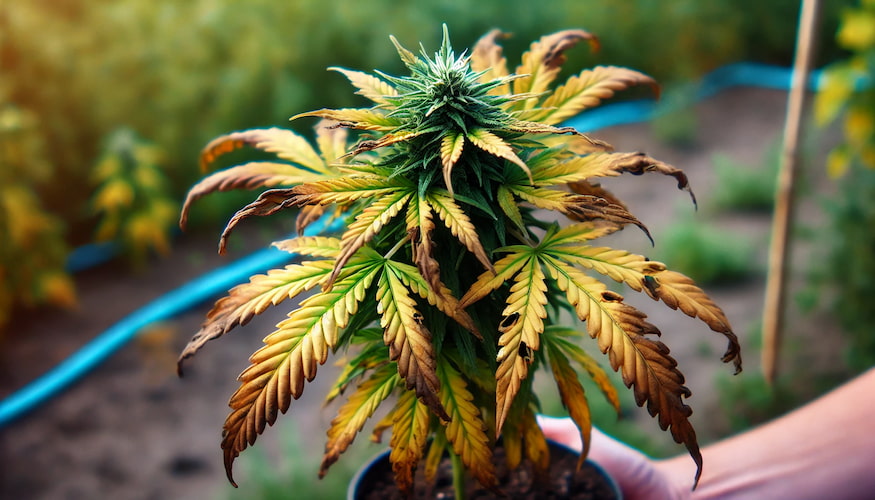
Hop latent viroid (HLVd) is a microscopic infectious RNA molecule that infiltrates cannabis plants and systematically dismantles their ability to produce potent, high-yielding buds — often without obvious symptoms until harvest time reveals the damage. HLVd is the cause of “dudding disease,” a condition that can slash yields by 50% or more and cut THC content nearly in half. Once it enters your garden, it spreads invisibly through shared tools, contaminated clone stock, and mechanical contact.
The only way to know for certain whether your plants are infected is PCR (polymerase chain reaction) molecular testing. Prevention, sanitation, and starting with verified clean genetics are the only reliable defenses.
Key Takeaways
- HLVd (hop latent viroid) is an infectious RNA pathogen — not a fungus or bacterium — that causes “dudding disease” in cannabis, reducing yields by 30–50% and THC content by up to 50%.
- Infected plants often look healthy in veg; symptoms typically appear in flower as reduced trichome production, stunted growth, brittle stems, and abnormally small, airy buds.
- HLVd spreads through contaminated cutting tools, infected clone stock, mechanical contact, and possibly some insects — it does NOT spread through air or soil alone.
- PCR (polymerase chain reaction) testing is the only reliable method to confirm HLVd infection; visual inspection alone is not sufficient.
- There is no cure once a plant is infected; infected plants must be removed and destroyed to protect the rest of your garden.
- Starting with tested, clean-stock clones from a verified source is the single most effective HLVd prevention strategy available to growers.
What Is Hop Latent Viroid?
Hop latent viroid is not a virus, fungus, or bacterium. It is a viroid — the smallest known class of infectious biological agent, consisting of a tiny circular strand of RNA with no protein coat. Viroids replicate using the host plant’s own cellular machinery, which makes them particularly insidious and impossible to treat once established.
HLVd was first identified in hop plants (Humulus lupulus), a close botanical relative of cannabis (Cannabis sativa). Researchers began documenting HLVd in cannabis populations in California around 2019–2020, and subsequent testing quickly revealed it had already spread widely through commercial and home-grow operations across the United States. A 2021 study published in PLOS Pathogens found HLVd present in roughly 90% of tested symptomatic plants at large California cannabis operations — and in a significant percentage of asymptomatic ones as well.
The “latent” in hop latent viroid is the key word for growers to understand. Plants can carry HLVd and appear completely healthy through the entire vegetative stage. The disease frequently stays hidden until flower, when the stress of reproductive growth reveals the infection through dramatically reduced cannabinoid and trichome production.
Why It’s Called “Dudding Disease”
Australian cannabis growers coined the term “dudding disease” long before the pathogen was formally identified. “Duds” were plants that looked normal but produced underwhelming buds — fewer trichomes, lower potency, smaller and airier flower structure than expected. For years, growers blamed these duds on poor genetics, environmental stress, or bad luck.
We now know that dudding is caused by HLVd disrupting the plant’s gene expression, specifically its ability to synthesize the secondary metabolites (terpenes and cannabinoids) that make cannabis valuable. The viroid essentially hijacks the plant’s resources, diverting energy away from resin production and into its own replication cycle.
The economic damage from dudding is severe. Commercial operations have reported crop losses worth hundreds of thousands of dollars per season from undetected HLVd contamination. For home growers running a small tent or room, a single infected mother plant can silently inoculate every clone taken from it over months or years.
HLVd Symptoms: What to Look For
HLVd is deceptive because its symptoms overlap with other common problems — nutrient deficiencies, light stress, overwatering, and poor genetics can all produce similar visible signs. This is why visual inspection alone cannot confirm or rule out HLVd. That said, knowing what to look for helps you flag plants for testing before the damage gets worse.
Vegetative Stage Symptoms
In many cases, HLVd-infected plants show no symptoms in veg at all. When symptoms do appear early, they tend to be subtle:
- Slightly reduced internodal spacing (plants look more compact than expected for the strain)
- Leaves that are smaller or more cupped than normal
- Slower overall growth rate compared to healthy plants of the same strain and age
- Stems that feel noticeably more brittle and snap rather than bend
Because these signs are subtle and easily attributed to other causes, most growers don’t catch HLVd in veg without proactive testing.
Flower Stage Symptoms
Flower is where HLVd tends to reveal itself most clearly. The metabolic demands of bud production expose the viroid’s impact on the plant’s biochemistry:
- Reduced trichome production: Buds look visually “flat” or frosted only lightly. Under a loupe or microscope, trichome density is obviously lower than expected for the strain.
- Lower potency: Lab-tested THC and terpene percentages come back significantly below typical strain averages — sometimes by 30–50%.
- Airy, loose bud structure: Flowers that should be dense and compact develop with poor bract swelling and sparse trichome coverage.
- Stunted plant height: Overall plant height and canopy size may be 20–40% below what the strain normally produces.
- Brittle stems: Stems and branches become woody and brittle, snapping rather than bending under lateral stress.
- Smaller-than-normal leaves: Fan leaves and sugar leaves may be smaller, sometimes with slight distortion or malformation.
- Extended flower time: Some infected plants take longer to reach apparent maturity without ever fully developing.
HLVd Symptom Reference Table
| Symptom | Growth Stage | Severity | Also Caused By |
|---|---|---|---|
| Stunted growth / reduced plant size | Veg & Flower | Moderate to severe | Rootbound conditions, nutrient lockout, light stress |
| Brittle, snapping stems | Veg & Flower | Moderate | Calcium deficiency, stem boring insects |
| Reduced trichome density | Flower | Severe | Light deficiency, heat stress, poor genetics |
| Low THC/terpene lab results | Harvest | Severe | Premature harvest, light deprivation |
| Airy, loose bud structure | Flower | Moderate to severe | High heat, low light intensity, poor airflow |
| Small or cupped leaves | Veg | Mild to moderate | pH problems, overwatering, virus infection |
| Slower-than-expected growth | Veg | Mild | Cold temperatures, under-feeding, root issues |
Important: No combination of these symptoms definitively confirms HLVd. If you see multiple symptoms together — especially reduced trichomes paired with brittle stems and stunted growth — treat it as a red flag and test before taking any more clones from the plant.
How HLVd Spreads
Understanding HLVd transmission is critical because prevention depends entirely on stopping the routes it uses to move from plant to plant. HLVd does not travel through the air or spread through soil the way many fungal pathogens do. It moves through direct biological contact — specifically through contaminated sap.
Contaminated Tools
This is the number one vector in most garden outbreaks. When you cut a clone from an infected mother plant, HLVd-laden sap coats your blade. The very next cut you make — into a healthy plant — inoculates it. A single pair of unsterilized scissors can infect every plant you touch in a single session.
Standard cleaning (rinsing with water, wiping on a cloth) does not eliminate HLVd. The viroid is extremely stable and resistant to desiccation. Effective sterilization requires either:
- 10–20% bleach solution (sodium hypochlorite) — soak for at least 1 minute
- 70% isopropyl alcohol — flame briefly after soaking, or use a fresh alcohol wipe between every cut
- Commercial sterilants like Physan 20 at labeled rates
The gold standard in professional operations is to use disposable blades — one blade per plant — and never reuse without sterilization. It takes discipline but it is the most reliable mechanical control available.
Infected Clone Stock
Purchasing clones from unverified sources is how HLVd enters most gardens in the first place. A clone cut from an infected mother carries HLVd in every cell. You can quarantine it, grow it out, and it will look healthy in veg — then devastate your flower room. This is why the quality and testing practices of your clone source matter enormously.
At IWantClones.com, every clone we ship comes from rigorously maintained mother stock. Our sourcing and quality control protocols are described in detail on our quality and sourcing page. When you buy clones from our shop, you are getting cuttings from genetics that have been selected and maintained with contamination prevention as a core priority — not random cuts from a commercial flower room where HLVd rates can be alarmingly high.
Mechanical Contact and Insects
Beyond tools, HLVd can spread through any mechanical contact that transfers sap between plants — leaves rubbing together, branches interleaving in dense canopies, and even workers moving through the garden without washing hands between handling plants. Tight spacing in SOG (sea of green) setups creates ideal conditions for inadvertent mechanical transmission.
There is preliminary evidence that some piercing-sucking insects — particularly aphids and possibly russet mites — can act as vectors for HLVd transmission, though this is less well-established than tool transmission. Controlling insect populations in your garden is good practice regardless.
HLVd does NOT reliably transmit through seeds. Sexual reproduction through seeds appears to largely reset the viroid load, which means seed-grown plants from infected stock are typically free of HLVd. This is one advantage seeds hold over clones from untested sources — though verified clean clones still offer the genetic consistency and time-to-harvest advantages that make them worth the investment.
Testing for HLVd: PCR Is the Gold Standard
PCR testing — polymerase chain reaction — is the only method that can reliably confirm the presence or absence of HLVd in a plant. Visual inspection, even by experienced growers, cannot rule out HLVd. A plant can be actively infected and look completely healthy.
How PCR Testing Works
PCR testing works by amplifying specific genetic sequences from a tissue sample. A small amount of plant material — typically a fresh leaf punch — is processed to extract RNA. The lab then uses HLVd-specific primers to amplify any HLVd RNA present in the sample. If HLVd RNA is present in any quantity, the amplification produces a detectable signal. If the plant is clean, no signal appears.
PCR is sensitive enough to detect HLVd even in asymptomatic plants at very early stages of infection. This makes it invaluable for testing incoming clone stock before introducing it to your garden, and for testing mother plants before a cloning run.
Where to Get Plants Tested
Several commercial cannabis testing laboratories offer HLVd PCR panels as part of their plant health testing services. Labs such as Plant Sciences Inc., Medicinal Genomics, and AgriScience Labs offer direct-to-grower testing kits that allow you to collect samples at home and mail them in for analysis. Costs typically range from $25–$75 per sample depending on the panel breadth.
If you are running a mother plant program and taking regular clones, testing your mothers every 3–6 months is a reasonable preventive practice — more frequently if you have had any contamination events or have introduced new genetics.
When to Test
- Before bringing any new clone into your space — quarantine and test first
- Any time you see symptoms consistent with HLVd in one or more plants
- After any contamination event (a visitor handled plants, tools were mixed up)
- Routinely for mother plants used in ongoing clone programs (every 3–6 months)
- Before purchasing clones if the source cannot provide their own testing documentation
Prevention and Sanitation Protocols
Because there is no treatment for HLVd — infected plants cannot be cured — prevention is everything. A rigorous sanitation protocol is not optional if you want to keep your garden clean. Here is how to build one.
Tool Sterilization Between Every Cut
Make sterilization automatic. Keep a spray bottle of 70% isopropyl alcohol or a container of 10–20% bleach solution at your bench at all times. Soak blades between every plant — not every session, every plant. If you are taking a cloning run of 20 cuttings from 20 different mothers, that is 20 sterilization steps minimum.
Many professional growers use disposable scalpel blades (available in bulk from surgical supply companies) and swap to a fresh blade after each mother. This eliminates the question of whether sterilization was thorough enough.
Quarantine All New Genetics
Never introduce a new clone directly into your main garden. Quarantine all incoming plants in a physically separate space — separate air circulation, separate tools, separate worker entry sequence — for a minimum of 2–4 weeks. During quarantine, submit samples for PCR testing. Only after a clean test result should new genetics enter your garden.
If you are dealing with rooting issues during quarantine, our guide on why clones fail to root can help you troubleshoot without confusing rooting problems with disease symptoms.
Source Verified Clean Stock
The most impactful single decision you can make is where you source your clones. Clone stock from operations that do not test their mothers for HLVd is a gamble — and given the reported prevalence rates in commercial California operations, it is not a good one. Look for clone suppliers who can document:
- Mother plant PCR testing results (negative for HLVd)
- Sanitation protocols in their production facility
- Segregated quarantine procedures for new incoming genetics
This is exactly the standard we hold ourselves to at IWantClones.com. Our quality and sourcing practices reflect a commitment to genetic integrity that most retail clone operations cannot match. When you are investing time, money, and grow space into a run, the last thing you want is to discover at harvest that your clones were contaminated before they ever arrived.
Sanitation Beyond Tools
Tool sterilization is the most critical step, but a comprehensive sanitation program covers more ground:
- Hand washing: Wash hands thoroughly between handling different plants, or wear disposable gloves and change them between plants
- Surface disinfection: Regularly sanitize grow room surfaces, trays, pots, and any equipment that contacts plant material
- Visitor protocols: Limit who enters your grow space and ensure visitors do not handle plants without gloves
- Clone tool segregation: Dedicate separate tools to cloning vs. general plant work; never use the same scissors for both
- Disposal of infected material: Bag and seal infected plants before removing them from the grow space to prevent sap transfer during removal
What to Do If You Find HLVd in Your Garden
If PCR testing confirms HLVd in one or more plants, act quickly and decisively. The longer infected plants remain in your space, the higher the risk of additional transmission.
Immediate Steps
- Stop all cloning immediately until you know the scope of the problem. Do not take cuttings from any plant until tested.
- Test all remaining plants — particularly any that were worked on with the same tools as the confirmed infected plant.
- Remove and destroy infected plants. Double-bag them in heavy plastic before moving through your garden. Do not compost infected material.
- Sterilize everything. All tools, all surfaces, all trays, all pots. A thorough bleach wash followed by isopropyl wipe-down is appropriate.
- Trace the source. Where did these clones come from? Did you introduce new genetics recently? Share your findings with your clone source if they are a commercial operation — they need to know.
Rebuilding Your Mother Plant Program
After an HLVd outbreak, rebuilding your genetic library from verified clean stock is the right move. Starting over with tested clones from a documented clean source is far better than attempting to maintain a contaminated mother population and hoping the problem resolves itself — it will not. HLVd does not clear from infected plants under any conditions.
When evaluating your genetics going forward, also consider whether your current strains and clone sources align with your production goals. Our future of cannabis genetics overview and our cannabis clone troubleshooting guide are good resources as you reset your program.
HLVd and Clone Quality: Why Source Matters More Than Price
The cannabis clone market is not regulated the same way across all states, and many retail clone operations do not test their mother plants for HLVd. At $98.88 per clone through IWantClones.com, you are paying for genetics sourced through a network backed by 15+ years of cannabis genetics expertise at SeedsHereNow.com, with protocols designed to minimize pathogen risk. That is a fundamentally different product than a $20 clone from a dispensary with no documented testing program.
Consider the math: a single HLVd-infected run can cost you half your expected yield and half your expected potency. If you are growing 10 plants in a 4×8 tent expecting to harvest 2 lbs at 25% THC, HLVd could turn that into 1 lb at 13% THC. At any reasonable market value for flower, the economic loss from one bad run dwarfs the cost differential between verified clean clones and untested cheap ones.
For growers building or rebuilding a mother plant program, our clone strain selection guide can help you identify which genetics will serve your production goals while you think about which strains to invest in for long-term mothers.
HLVd and the Future of Clean Cannabis Genetics
The cannabis industry is increasingly aware of HLVd as a systemic threat. Several states with licensed adult-use markets are beginning to require or incentivize pathogen testing as part of commercial cultivation standards. As the regulatory environment evolves — with the April 2026 DEA placement of FDA-approved and state-licensed medical marijuana into Schedule III representing a significant federal shift — the expectation of documented pathogen testing is likely to become a baseline professional standard rather than an optional extra. Verify your current state and local laws before purchasing or cultivating cannabis clones, as rules vary significantly by jurisdiction.
For home growers, the practical implication is simple: the habits you build now around testing, sanitation, and sourcing verified clean stock are the same habits that professional operations use. Implementing them at any scale protects your investment and your enjoyment of the plant.
Browse our current clone inventory and check our latest drops for available genetics.
Frequently Asked Questions
What is hop latent viroid (HLVd)?
Hop latent viroid (HLVd) is a microscopic infectious RNA pathogen — smaller than any virus — that infects cannabis plants and causes “dudding disease.” It disrupts gene expression, reducing cannabinoid and terpene production by up to 50%, and cannot be treated or cured once a plant is infected.
How does HLVd spread between cannabis plants?
HLVd spreads primarily through contaminated cutting tools that transfer infected sap from plant to plant. It also spreads through infected clone stock and direct mechanical contact between plants. HLVd does not spread reliably through air, soil, or seeds — tool sanitation and clean clone sourcing are the main preventive measures.
Can you tell if a cannabis plant has HLVd just by looking at it?
No. HLVd often produces no visible symptoms in the vegetative stage. Even in flower, symptoms like reduced trichomes, stunted growth, and brittle stems overlap with other problems. PCR (polymerase chain reaction) molecular testing is the only reliable way to confirm HLVd infection.
Is there a cure or treatment for HLVd in cannabis?
No. There is currently no treatment that eliminates HLVd from an infected plant. Infected plants must be removed and destroyed. Prevention through sanitation, quarantine, PCR testing of incoming genetics, and sourcing from tested clean stock is the only reliable defense.
How do I sterilize tools to prevent HLVd spread?
Soak blades in 10–20% bleach solution or 70% isopropyl alcohol for at least one minute between cuts on different plants. Many professional growers use single-use disposable scalpel blades — one per plant — to eliminate sterilization uncertainty entirely. Standard water rinses do not kill HLVd.
Why should I buy clones from a tested source rather than a local dispensary?
Many dispensaries and unlicensed sellers do not test mother plants for HLVd. An infected clone looks healthy in veg and delivers devastating yield and potency losses in flower. Paying more for documented clean-stock clones from a verified source is substantially cheaper than the cost of a contaminated grow run.