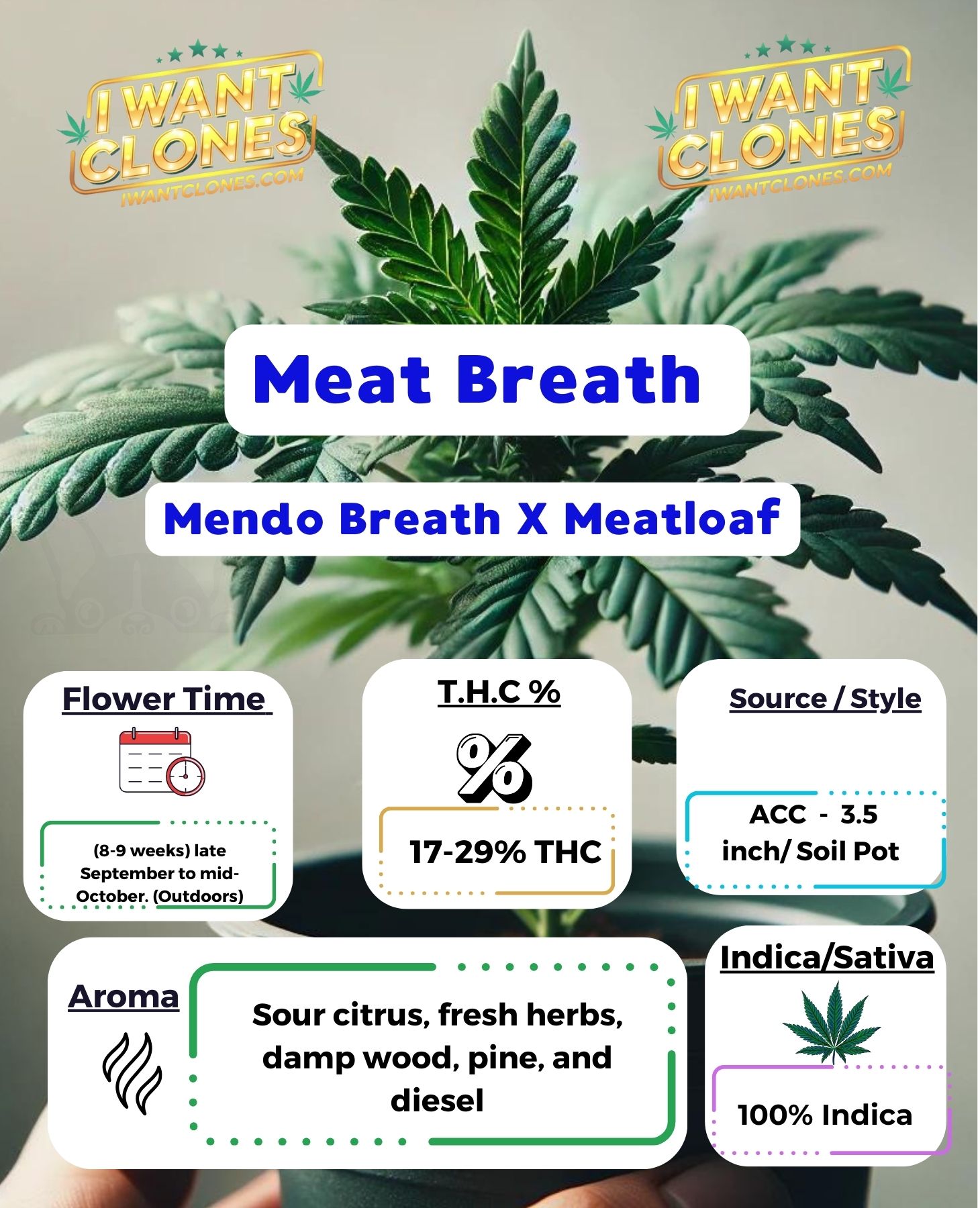
Meat Breath Strain & Clone Grow Guide

Meat Breath strain is a heavy indica-dominant cross of Meatloaf x Mendo Breath, bred by Thug Pug Genetics, and it lives up to every bit of its unusual name. Expect dense, dark purple-green buds dripping in trichomes, a savory-gas aroma layered over grape and berry, and a full-body stone that hits hard and stays awhile. THC regularly tests between 25–30%, making this one of the more potent workhorses in the indica world.

Key Takeaways

  • Lineage: Meatloaf x Mendo Breath, bred by Thug Pug Genetics — a cross purpose-built for potency and aroma.
  • THC Range: 25–30%, with a heavy sedative effect profile suited for evening use.
  • Flower Time: 8–9 weeks indoors; harvest outdoors in late October in most climates.
  • Yield: 450–550g/m² indoors; up to 600g per plant outdoors under ideal conditions.
  • Difficulty: Intermediate — humidity control and strong airflow are non-negotiable due to dense bud structure.
  • Best Grown From Clones: Verified genetics are critical for this strain; Meat Breath clones from IWantClones.com ship rooted and ready to run at $98.88.

Lineage & Genetics: Where Meat Breath Comes From

Thug Pug Genetics — the Michigan-based breeder known for funky, gas-forward cultivars — created Meat Breath by crossing two already-powerful indicas: Meatloaf and Mendo Breath. Both parents punch above their weight, and the offspring inherited the best of both.

Meatloaf contributes the savory, earthy funk that gives the strain its name. It’s a deeply sedating indica known for diesel-forward terpenes and resin-caked buds. Mendo Breath — itself a cross of OG Kush Breath (OGKB) and Mendo Montage — brings the grape and vanilla sweetness, plus an exceptional coat of trichomes. You can read more about the Mendo Breath side of the family tree in our Mendo Breath strain guide.

The result is a strain that sits solidly on the indica end of the spectrum. Phenotype expression can vary somewhat — some phenos lean heavier into the grape sweetness, others go full savory gas — but all of them share that signature dense structure and resin production. For a deep dive into the OG Kush Breath lineage that runs through the Mendo side, Wikipedia’s cannabis strains overview provides useful background on how these modern designer crosses are classified.

Meat Breath Strain Specs at a Glance

Trait Details
Genetics Meatloaf x Mendo Breath
Breeder Thug Pug Genetics
Type Indica-dominant hybrid
THC Content 25–30%
CBD Content <1%
Flower Time (Indoor) 8–9 weeks
Outdoor Harvest Late October
Indoor Yield 450–550g/m²
Outdoor Yield Up to 600g per plant
Plant Height Medium-compact (2–4 ft indoor, up to 5 ft outdoor)
Dominant Terpenes Myrcene, Caryophyllene, Limonene
Grow Difficulty Intermediate
Odor Level Very high — carbon filter required

Terpene Profile & Aroma: What Does Meat Breath Smell Like?

The aroma on Meat Breath strain is one of the most distinctive in the indica category. The dominant smell is savory gas with a dank, earthy funk that clings to your hands long after you’ve handled the buds. Underneath that top layer you get grape, berry, and a faint vanilla sweetness that softens the whole profile just enough to make it complex without being overwhelming.

Three terpenes drive most of the character here:

  • Myrcene — the most abundant terpene in most Meat Breath phenotypes. Myrcene is responsible for the earthy, musky base note and contributes significantly to the sedative, body-heavy effects.
  • Caryophyllene — adds the spicy, peppery gas that gives the strain its edge. Caryophyllene is also a CB2 receptor agonist, which is part of why heavy caryophyllene strains often feel so grounding in the body.
  • Limonene — present in smaller amounts but important. It rounds out the citrus and fruit notes and contributes some uplifting character before the indica weight takes over.

When you crack open a jar of properly cured Meat Breath, the room knows immediately. This is not a strain for growers who want to keep a low olfactory profile — a quality carbon filter is not optional, it’s mandatory. We’ll cover that more in the odor management section below.

Effects & Potency

Meat Breath strain hits fast and lands heavy. The initial onset is often a warm pressure behind the eyes and a settling weight in the shoulders that signals the indica body stone is coming. Within 15–20 minutes most users report a full-body relaxation that ranges from deeply comfortable to fully couch-locked, depending on tolerance and dose.

The high THC content (25–30%) means this strain respects no casual users. Even experienced consumers often find Meat Breath to be a “one or two and done” situation. The sedative lean is strong — this is not a functional daytime strain for most people. It’s an evening plant, bred for wind-down sessions and a hard sleep.

Euphoria is present in the early stages, often described as a calm, contented mental quiet rather than a racey or creative high. Over time that mental state drifts toward drowsiness. Most users who push past two or three sessions with Meat Breath end up horizontal. Plan accordingly.

If you enjoy the effect profile of heavy indica crosses like Dosi Punch, it’s worth checking out our Dosi Punch strain guide — there’s meaningful overlap in the kind of experience both strains deliver.

Note: Cannabis remains Schedule I for adult-use and recreational purposes under federal law. State-licensed medical cannabis products were moved to Schedule III by the DEA/DOJ on April 23, 2026, and a broader federal rescheduling hearing runs June 29–July 15, 2026. Always verify your state and local laws before purchasing or growing cannabis.

Growing Meat Breath: Full Cultivation Guide

Meat Breath strain is rated intermediate for a reason. The genetics are stable and the plant is willing, but the dense bud structure that makes it such a heavy producer also makes it a magnet for mold and bud rot if you’re not actively managing your environment. Get the basics right and this strain rewards you generously. Skip them and you’ll watch your harvest rot from the inside out.

Environment & Climate Requirements

Meat Breath thrives in a controlled indoor environment. The target parameters during veg are straightforward: temperatures between 70–80°F, relative humidity (RH) between 50–60%, and strong airflow at canopy level. During flower, drop the RH progressively — target 45–50% in early flower, 40–45% in mid-flower, and 35–40% in the final two to three weeks before harvest.

This humidity descent matters more with Meat Breath than with most strains because the buds get exceptionally dense. Gray mold (Botrytis cinerea) loves nothing more than a tight, humid bud cluster with poor airflow through the interior. Oscillating fans, good intake/exhaust, and regular defoliation are your primary defenses. The UC Davis Cooperative Extension offers solid baseline guidance on indoor climate management for dense-flowering crops that translates well to cannabis cultivation.

Outdoor growers in warm, dry climates — think Southern California, parts of Colorado, or similar Mediterranean-style zones — will get great results. Humid coastal or Pacific Northwest climates are harder. If your fall season is wet, you’ll need to harvest a touch early or use bag or shelter systems to protect late-stage buds from rain and humidity spikes.

Veg Stage: Building the Frame

Meat Breath is a compact, bushy plant in veg — classic indica structure with wide internodal spacing relative to its height. Plants don’t stretch dramatically, which is good news for indoor spaces with vertical limitations. Expect a medium-compact plant that tops out between 2–4 feet indoors and up to 5 feet outdoors.

Veg for 4–6 weeks from clone to give the plant enough frame to support the weight it will carry in flower. Meat Breath is a heavy producer, and a plant that gets topped and trained properly in veg will distribute that weight far better than one allowed to run as a single cola.

Top the main stem early — at node 3 or 4 — to encourage lateral branching. A bushy, multi-cola plant with a flat canopy is exactly what this strain wants to be. After the initial top, low-stress training (LST) is your best tool: bend and tie outer branches down to open the canopy, expose lower nodes to light, and set yourself up for a productive SCROG run.

Speaking of transplanting: if you’re moving a freshly received clone into a larger container, our complete up-potting guide walks through the process in detail, including timing and container sizing for indica cultivars like this one.

Flowering Stage: What to Expect Week by Week

Flip to 12/12 once your canopy is where you want it. Meat Breath will show pre-flowers within 5–7 days of the flip and will start stacking bud sites quickly. Here’s a rough breakdown of what to expect across the 8–9 week flower period:

  • Weeks 1–2 (Stretch): Expect 20–40% height increase. Meat Breath doesn’t stretch dramatically by indica standards, but it still adds significant internodal distance. Continue LST adjustments to keep the canopy level.
  • Weeks 3–4 (Bud Formation): Bud sites begin stacking. Calyxes start swelling. This is the window for your first major defoliation pass — remove large fan leaves that are blocking light to bud sites underneath the canopy. See our guide on defoliation and lollipopping for the specific technique that works best on bushy indica cultivars.
  • Weeks 5–6 (Rapid Development): Buds are stacking fast now. You’ll see the purple and dark green coloration starting to develop, especially in plants exposed to slightly cooler nighttime temperatures (65–68°F). Trichome development accelerates. Odor goes through the roof — if your carbon filter isn’t pulling full capacity, this is when you’ll notice.
  • Weeks 7–8 (Ripening): Calyx swell peaks. Most of the THC is accumulating in these weeks. Keep humidity below 40% if possible. Trichomes will transition from clear to cloudy. Stop defoliating — the plant needs all its leaf surface to fuel final resin production.
  • Week 9 (Final Flush and Harvest Window): Some phenos are done at 8 weeks, others need the full 9. Trichome inspection is your guide. See the harvest timing section below.

Feeding Schedule for Meat Breath

Meat Breath is a heavy feeder. If you’re used to lighter sativa-dominant strains, adjust your expectations — this plant wants more nutrients, especially in the back half of flower.

During veg, run a standard balanced formula with moderate nitrogen. Nothing exotic is required, but don’t starve it. Meat Breath grown in depleted soil or on minimal feeds will show yellowing faster than most indica cultivars.

When you flip to flower, make three feeding adjustments:

  1. Reduce nitrogen, increase phosphorus and potassium. Classic bloom transition. Meat Breath responds especially well to elevated phosphorus during weeks 4–7 when bud density is building. A phosphorus-forward bloom booster at 1.5x the recommended dose is not unusual on this strain.
  2. Add cal-mag from week 1 of flower. Dense indica cultivars with heavy resin production consume calcium and magnesium at elevated rates. Deficiency shows up as interveinal chlorosis or tip burn. Get ahead of it — 5–10ml/gallon of a cal-mag supplement through week 7 is standard practice for Meat Breath.
  3. Taper and flush in the final 10–14 days. Meat Breath holds onto nutrients in its dense flowers. A proper flush — or in living soil, a plain-water wind-down — helps deliver a cleaner-tasting final product. Heavy residual nutrients in dense buds is a primary reason growers get harsh smoke even from good genetics.

For a full breakdown of what to feed and when — including specific product recommendations and EC/PPM targets by growth stage — our comprehensive cannabis clone nutrient guide covers the full feeding arc from clone to harvest.

Training Techniques That Work for Meat Breath

The compact, bushy structure of Meat Breath strain makes it one of the better indicas for training. It responds predictably to the common techniques, and investing a few weeks of LST work in veg pays significant dividends in flower.

Topping: Do it early — at node 3 or 4 on a clone that’s established in its container. Top once, let the two main shoots develop, then consider a second topping once those shoots have 2–3 nodes each. This creates a 4-cola frame that works excellently in SCROG.

LST (Low Stress Training): The workhorse technique for Meat Breath. Because the plant is compact and branches don’t extend dramatically on their own, LST bending opens up the interior of the canopy and trains multiple bud sites to an even height. Use soft ties or garden wire — avoid anything that cuts into stems under tension. Adjust ties every 2–3 days during active veg growth.

SCROG (Screen of Green): Meat Breath’s bushy structure fills a SCROG net efficiently. Install the net 12–14 inches above the container. Tuck new growth under the net during veg and the first 1–2 weeks of flower (before buds start forming). A well-executed SCROG on Meat Breath can produce an extremely even canopy that maximizes light penetration and supports the dense bud weight without branches falling over in flower.

Lollipopping: Remove all growth below the SCROG net or below the bottom third of the plant. This is particularly important for Meat Breath because its lower growth in shade produces larfy popcorn buds that consume resources without adding meaningful yield. A clean lollipop job at flip forces the plant to direct energy into the top canopy where light reaches. Our defoliation and lollipopping guide has the exact timing and approach for dense indica cultivars.

Odor Management

This section exists because the smell of Meat Breath strain in flower is not casual. By week 5, a tent with four plants running Meat Breath at full tilt will fill an entire house with a pungent, savory-gas aroma that travels through closed doors. This is not a complaint about the strain — it’s one of the most compelling aromatic profiles in modern cannabis — but it’s practical information you need before you plant.

Run a carbon filter sized for 25–30% more CFM than your grow space technically requires. Meat Breath in late flower is exactly the scenario those conservatively-rated filters struggle with. Replace carbon every 12–18 months if you run multiple cycles. A filter that’s lost its adsorption capacity won’t get the job done with a strain this pungent.

Harvest Timing

Harvest timing on Meat Breath strain is about trichome maturity, not calendar dates. Use a jeweler’s loupe (40–60x) or a digital microscope to inspect the trichomes on the buds themselves — not the leaves, which mature faster and will skew your read early.

  • Clear trichomes: Plant is not ready. THC is still developing.
  • Mostly cloudy, few amber: Peak THC, energetic-leaning effect for an indica. Most Meat Breath growers don’t want to harvest here.
  • 70–80% cloudy, 20–30% amber: The sweet spot for Meat Breath’s signature heavy body stone. This is where most growers targeting the full indica experience should cut.
  • 50%+ amber: More sedative, more CBN conversion. Some consumers prefer this for maximum couch-lock; others find it too heavy and sleep-inducing.

For a full walkthrough on reading trichomes and nailing your harvest window, our dedicated harvest timing guide covers exactly how to make the call with confidence.

Clone vs. Seed: Why We Recommend Clones for Meat Breath

Growing Meat Breath from seed introduces a gamble that most serious cultivators don’t want to take. Thug Pug Genetics produces excellent work, but any seed stock introduces phenotypic variation — some phenos lean savory, some lean sweet, some express more purple, some less. If you’ve heard about a specific Meat Breath cut from a trusted source and you want that exact expression, seed is not the path to get there.

Clones solve this completely. A rooted Meat Breath clone taken from a verified, stable mother is genetically identical to that mother. You know exactly what terpene profile you’re getting, exactly what the yield history is, and exactly how it responds to training and feeding. There’s no guessing, no culling males, no waiting to see what pheno you landed.

Beyond genetic certainty, clones save 3–4 weeks compared to germinating and nursing seedlings. A rooted clone goes straight into veg, which compresses your time to harvest meaningfully.

At IWantClones.com, we source our clones from professionally maintained mothers through our partner network at SeedsHereNow.com. Every clone ships rooted and healthy, ready to transplant on arrival. You can order Meat Breath clones here for $98.88 with shipping to legal states.

Always confirm that cannabis cultivation is permitted under your state and local laws before ordering. Regulations vary significantly, and it’s your responsibility to verify compliance in your jurisdiction.

Frequently Asked Questions

What is Meat Breath strain?

Meat Breath strain is an indica-dominant cannabis hybrid bred by Thug Pug Genetics from a cross of Meatloaf and Mendo Breath. It’s known for its savory-gas aroma, dense purple-green buds, heavy trichome coverage, and high THC content typically ranging from 25–30%. The effects are heavily sedative and full-body, making it a popular evening and nighttime strain among experienced consumers.

How long does Meat Breath take to flower?

Meat Breath has an indoor flower time of 8–9 weeks from the flip to 12/12 lighting. Some phenotypes finish on the earlier end at 8 weeks, while others benefit from the full 9 weeks to reach peak trichome maturity. Always confirm harvest readiness by inspecting trichomes with a loupe rather than relying solely on the calendar date.

Is Meat Breath hard to grow?

Meat Breath is rated intermediate difficulty. The plant trains well, feeds aggressively, and produces generously — but its extremely dense bud structure makes it highly susceptible to bud rot and gray mold if humidity isn’t actively managed. Strong airflow, progressive humidity reduction through flower, and timely defoliation are non-negotiable for a successful run with this strain.

What does Meat Breath smell like?

Meat Breath has a complex, pungent aroma dominated by savory gas and earthy funk, with underlying notes of grape, berry, and faint vanilla sweetness. The smell is pronounced — by mid-to-late flower, it’s one of the most aromatic strains in any grow room. A properly rated carbon filter is essential for odor control during cultivation.

Where can I buy Meat Breath clones?

At IWantClones.com, we offer rooted Meat Breath clones for $98.88, backed by the genetics sourcing network at SeedsHereNow.com. Clones ship to legal states and arrive rooted and ready to transplant. Always verify that cannabis cultivation is legal in your state and locality before ordering.

Final Thoughts on Meat Breath Strain

Meat Breath strain earns its reputation as a serious heavy-hitter. The genetics from Thug Pug Genetics land exactly what they promise: a potent, aromatic, full-body indica with legitimate yield potential and a terpene profile that stands out in any room. It demands intermediate-level attention — primarily around humidity management and airflow — but it’s not a plant that punishes you for minor mistakes the way some finicky strains do. Get the environment dialed, feed it well, train the canopy flat, and Meat Breath will deliver a harvest that justifies every hour you put into it.

If you’re ready to skip the seed lottery and start with verified genetics, order Meat Breath clones from IWantClones.com today. We source from professionally maintained mothers, and every clone ships rooted and ready to grow. Questions about which strain fits your setup? Browse related guides like our Mendo Breath strain guide or our Dosi Punch strain guide to compare your options before you commit.

Share

Comments are closed.

Also recommended

Meat Breath Strain & Clone Grow Guide

July 24, 2026

Meat Breath strain is a heavy indica-dominant cross of Meatloaf x Mendo Breath, bred by Thug Pug Genetics, and it lives up to every bit of its unusual name. Expect dense, dark purple-green buds dripping in trichomes, a savory-gas aroma layered over grape and berry, and a full-body stone that hits hard and stays awhile. THC regularly tests between 25–30%, making this one of the more potent workhorses in the indica world.

Key Takeaways

  • Lineage: Meatloaf x Mendo Breath, bred by Thug Pug Genetics — a cross purpose-built for potency and aroma.
  • THC Range: 25–30%, with a heavy sedative effect profile suited for evening use.
  • Flower Time: 8–9 weeks indoors; harvest outdoors in late October in most climates.
  • Yield: 450–550g/m² indoors; up to 600g per plant outdoors under ideal conditions.
  • Difficulty: Intermediate — humidity control and strong airflow are non-negotiable due to dense bud structure.
  • Best Grown From Clones: Verified genetics are critical for this strain; Meat Breath clones from IWantClones.com ship rooted and ready to run at $98.88.

Lineage & Genetics: Where Meat Breath Comes From

Thug Pug Genetics — the Michigan-based breeder known for funky, gas-forward cultivars — created Meat Breath by crossing two already-powerful indicas: Meatloaf and Mendo Breath. Both parents punch above their weight, and the offspring inherited the best of both.

Meatloaf contributes the savory, earthy funk that gives the strain its name. It’s a deeply sedating indica known for diesel-forward terpenes and resin-caked buds. Mendo Breath — itself a cross of OG Kush Breath (OGKB) and Mendo Montage — brings the grape and vanilla sweetness, plus an exceptional coat of trichomes. You can read more about the Mendo Breath side of the family tree in our Mendo Breath strain guide.

The result is a strain that sits solidly on the indica end of the spectrum. Phenotype expression can vary somewhat — some phenos lean heavier into the grape sweetness, others go full savory gas — but all of them share that signature dense structure and resin production. For a deep dive into the OG Kush Breath lineage that runs through the Mendo side, Wikipedia’s cannabis strains overview provides useful background on how these modern designer crosses are classified.

Meat Breath Strain Specs at a Glance

Trait Details
Genetics Meatloaf x Mendo Breath
Breeder Thug Pug Genetics
Type Indica-dominant hybrid
THC Content 25–30%
CBD Content <1%
Flower Time (Indoor) 8–9 weeks
Outdoor Harvest Late October
Indoor Yield 450–550g/m²
Outdoor Yield Up to 600g per plant
Plant Height Medium-compact (2–4 ft indoor, up to 5 ft outdoor)
Dominant Terpenes Myrcene, Caryophyllene, Limonene
Grow Difficulty Intermediate
Odor Level Very high — carbon filter required

Terpene Profile & Aroma: What Does Meat Breath Smell Like?

The aroma on Meat Breath strain is one of the most distinctive in the indica category. The dominant smell is savory gas with a dank, earthy funk that clings to your hands long after you’ve handled the buds. Underneath that top layer you get grape, berry, and a faint vanilla sweetness that softens the whole profile just enough to make it complex without being overwhelming.

Three terpenes drive most of the character here:

  • Myrcene — the most abundant terpene in most Meat Breath phenotypes. Myrcene is responsible for the earthy, musky base note and contributes significantly to the sedative, body-heavy effects.
  • Caryophyllene — adds the spicy, peppery gas that gives the strain its edge. Caryophyllene is also a CB2 receptor agonist, which is part of why heavy caryophyllene strains often feel so grounding in the body.
  • Limonene — present in smaller amounts but important. It rounds out the citrus and fruit notes and contributes some uplifting character before the indica weight takes over.

When you crack open a jar of properly cured Meat Breath, the room knows immediately. This is not a strain for growers who want to keep a low olfactory profile — a quality carbon filter is not optional, it’s mandatory. We’ll cover that more in the odor management section below.

Effects & Potency

Meat Breath strain hits fast and lands heavy. The initial onset is often a warm pressure behind the eyes and a settling weight in the shoulders that signals the indica body stone is coming. Within 15–20 minutes most users report a full-body relaxation that ranges from deeply comfortable to fully couch-locked, depending on tolerance and dose.

The high THC content (25–30%) means this strain respects no casual users. Even experienced consumers often find Meat Breath to be a “one or two and done” situation. The sedative lean is strong — this is not a functional daytime strain for most people. It’s an evening plant, bred for wind-down sessions and a hard sleep.

Euphoria is present in the early stages, often described as a calm, contented mental quiet rather than a racey or creative high. Over time that mental state drifts toward drowsiness. Most users who push past two or three sessions with Meat Breath end up horizontal. Plan accordingly.

If you enjoy the effect profile of heavy indica crosses like Dosi Punch, it’s worth checking out our Dosi Punch strain guide — there’s meaningful overlap in the kind of experience both strains deliver.

Note: Cannabis remains Schedule I for adult-use and recreational purposes under federal law. State-licensed medical cannabis products were moved to Schedule III by the DEA/DOJ on April 23, 2026, and a broader federal rescheduling hearing runs June 29–July 15, 2026. Always verify your state and local laws before purchasing or growing cannabis.

Growing Meat Breath: Full Cultivation Guide

Meat Breath strain is rated intermediate for a reason. The genetics are stable and the plant is willing, but the dense bud structure that makes it such a heavy producer also makes it a magnet for mold and bud rot if you’re not actively managing your environment. Get the basics right and this strain rewards you generously. Skip them and you’ll watch your harvest rot from the inside out.

Environment & Climate Requirements

Meat Breath thrives in a controlled indoor environment. The target parameters during veg are straightforward: temperatures between 70–80°F, relative humidity (RH) between 50–60%, and strong airflow at canopy level. During flower, drop the RH progressively — target 45–50% in early flower, 40–45% in mid-flower, and 35–40% in the final two to three weeks before harvest.

This humidity descent matters more with Meat Breath than with most strains because the buds get exceptionally dense. Gray mold (Botrytis cinerea) loves nothing more than a tight, humid bud cluster with poor airflow through the interior. Oscillating fans, good intake/exhaust, and regular defoliation are your primary defenses. The UC Davis Cooperative Extension offers solid baseline guidance on indoor climate management for dense-flowering crops that translates well to cannabis cultivation.

Outdoor growers in warm, dry climates — think Southern California, parts of Colorado, or similar Mediterranean-style zones — will get great results. Humid coastal or Pacific Northwest climates are harder. If your fall season is wet, you’ll need to harvest a touch early or use bag or shelter systems to protect late-stage buds from rain and humidity spikes.

Veg Stage: Building the Frame

Meat Breath is a compact, bushy plant in veg — classic indica structure with wide internodal spacing relative to its height. Plants don’t stretch dramatically, which is good news for indoor spaces with vertical limitations. Expect a medium-compact plant that tops out between 2–4 feet indoors and up to 5 feet outdoors.

Veg for 4–6 weeks from clone to give the plant enough frame to support the weight it will carry in flower. Meat Breath is a heavy producer, and a plant that gets topped and trained properly in veg will distribute that weight far better than one allowed to run as a single cola.

Top the main stem early — at node 3 or 4 — to encourage lateral branching. A bushy, multi-cola plant with a flat canopy is exactly what this strain wants to be. After the initial top, low-stress training (LST) is your best tool: bend and tie outer branches down to open the canopy, expose lower nodes to light, and set yourself up for a productive SCROG run.

Speaking of transplanting: if you’re moving a freshly received clone into a larger container, our complete up-potting guide walks through the process in detail, including timing and container sizing for indica cultivars like this one.

Flowering Stage: What to Expect Week by Week

Flip to 12/12 once your canopy is where you want it. Meat Breath will show pre-flowers within 5–7 days of the flip and will start stacking bud sites quickly. Here’s a rough breakdown of what to expect across the 8–9 week flower period:

  • Weeks 1–2 (Stretch): Expect 20–40% height increase. Meat Breath doesn’t stretch dramatically by indica standards, but it still adds significant internodal distance. Continue LST adjustments to keep the canopy level.
  • Weeks 3–4 (Bud Formation): Bud sites begin stacking. Calyxes start swelling. This is the window for your first major defoliation pass — remove large fan leaves that are blocking light to bud sites underneath the canopy. See our guide on defoliation and lollipopping for the specific technique that works best on bushy indica cultivars.
  • Weeks 5–6 (Rapid Development): Buds are stacking fast now. You’ll see the purple and dark green coloration starting to develop, especially in plants exposed to slightly cooler nighttime temperatures (65–68°F). Trichome development accelerates. Odor goes through the roof — if your carbon filter isn’t pulling full capacity, this is when you’ll notice.
  • Weeks 7–8 (Ripening): Calyx swell peaks. Most of the THC is accumulating in these weeks. Keep humidity below 40% if possible. Trichomes will transition from clear to cloudy. Stop defoliating — the plant needs all its leaf surface to fuel final resin production.
  • Week 9 (Final Flush and Harvest Window): Some phenos are done at 8 weeks, others need the full 9. Trichome inspection is your guide. See the harvest timing section below.

Feeding Schedule for Meat Breath

Meat Breath is a heavy feeder. If you’re used to lighter sativa-dominant strains, adjust your expectations — this plant wants more nutrients, especially in the back half of flower.

During veg, run a standard balanced formula with moderate nitrogen. Nothing exotic is required, but don’t starve it. Meat Breath grown in depleted soil or on minimal feeds will show yellowing faster than most indica cultivars.

When you flip to flower, make three feeding adjustments:

  1. Reduce nitrogen, increase phosphorus and potassium. Classic bloom transition. Meat Breath responds especially well to elevated phosphorus during weeks 4–7 when bud density is building. A phosphorus-forward bloom booster at 1.5x the recommended dose is not unusual on this strain.
  2. Add cal-mag from week 1 of flower. Dense indica cultivars with heavy resin production consume calcium and magnesium at elevated rates. Deficiency shows up as interveinal chlorosis or tip burn. Get ahead of it — 5–10ml/gallon of a cal-mag supplement through week 7 is standard practice for Meat Breath.
  3. Taper and flush in the final 10–14 days. Meat Breath holds onto nutrients in its dense flowers. A proper flush — or in living soil, a plain-water wind-down — helps deliver a cleaner-tasting final product. Heavy residual nutrients in dense buds is a primary reason growers get harsh smoke even from good genetics.

For a full breakdown of what to feed and when — including specific product recommendations and EC/PPM targets by growth stage — our comprehensive cannabis clone nutrient guide covers the full feeding arc from clone to harvest.

Training Techniques That Work for Meat Breath

The compact, bushy structure of Meat Breath strain makes it one of the better indicas for training. It responds predictably to the common techniques, and investing a few weeks of LST work in veg pays significant dividends in flower.

Topping: Do it early — at node 3 or 4 on a clone that’s established in its container. Top once, let the two main shoots develop, then consider a second topping once those shoots have 2–3 nodes each. This creates a 4-cola frame that works excellently in SCROG.

LST (Low Stress Training): The workhorse technique for Meat Breath. Because the plant is compact and branches don’t extend dramatically on their own, LST bending opens up the interior of the canopy and trains multiple bud sites to an even height. Use soft ties or garden wire — avoid anything that cuts into stems under tension. Adjust ties every 2–3 days during active veg growth.

SCROG (Screen of Green): Meat Breath’s bushy structure fills a SCROG net efficiently. Install the net 12–14 inches above the container. Tuck new growth under the net during veg and the first 1–2 weeks of flower (before buds start forming). A well-executed SCROG on Meat Breath can produce an extremely even canopy that maximizes light penetration and supports the dense bud weight without branches falling over in flower.

Lollipopping: Remove all growth below the SCROG net or below the bottom third of the plant. This is particularly important for Meat Breath because its lower growth in shade produces larfy popcorn buds that consume resources without adding meaningful yield. A clean lollipop job at flip forces the plant to direct energy into the top canopy where light reaches. Our defoliation and lollipopping guide has the exact timing and approach for dense indica cultivars.

Odor Management

This section exists because the smell of Meat Breath strain in flower is not casual. By week 5, a tent with four plants running Meat Breath at full tilt will fill an entire house with a pungent, savory-gas aroma that travels through closed doors. This is not a complaint about the strain — it’s one of the most compelling aromatic profiles in modern cannabis — but it’s practical information you need before you plant.

Run a carbon filter sized for 25–30% more CFM than your grow space technically requires. Meat Breath in late flower is exactly the scenario those conservatively-rated filters struggle with. Replace carbon every 12–18 months if you run multiple cycles. A filter that’s lost its adsorption capacity won’t get the job done with a strain this pungent.

Harvest Timing

Harvest timing on Meat Breath strain is about trichome maturity, not calendar dates. Use a jeweler’s loupe (40–60x) or a digital microscope to inspect the trichomes on the buds themselves — not the leaves, which mature faster and will skew your read early.

  • Clear trichomes: Plant is not ready. THC is still developing.
  • Mostly cloudy, few amber: Peak THC, energetic-leaning effect for an indica. Most Meat Breath growers don’t want to harvest here.
  • 70–80% cloudy, 20–30% amber: The sweet spot for Meat Breath’s signature heavy body stone. This is where most growers targeting the full indica experience should cut.
  • 50%+ amber: More sedative, more CBN conversion. Some consumers prefer this for maximum couch-lock; others find it too heavy and sleep-inducing.

For a full walkthrough on reading trichomes and nailing your harvest window, our dedicated harvest timing guide covers exactly how to make the call with confidence.

Clone vs. Seed: Why We Recommend Clones for Meat Breath

Growing Meat Breath from seed introduces a gamble that most serious cultivators don’t want to take. Thug Pug Genetics produces excellent work, but any seed stock introduces phenotypic variation — some phenos lean savory, some lean sweet, some express more purple, some less. If you’ve heard about a specific Meat Breath cut from a trusted source and you want that exact expression, seed is not the path to get there.

Clones solve this completely. A rooted Meat Breath clone taken from a verified, stable mother is genetically identical to that mother. You know exactly what terpene profile you’re getting, exactly what the yield history is, and exactly how it responds to training and feeding. There’s no guessing, no culling males, no waiting to see what pheno you landed.

Beyond genetic certainty, clones save 3–4 weeks compared to germinating and nursing seedlings. A rooted clone goes straight into veg, which compresses your time to harvest meaningfully.

At IWantClones.com, we source our clones from professionally maintained mothers through our partner network at SeedsHereNow.com. Every clone ships rooted and healthy, ready to transplant on arrival. You can order Meat Breath clones here for $98.88 with shipping to legal states.

Always confirm that cannabis cultivation is permitted under your state and local laws before ordering. Regulations vary significantly, and it’s your responsibility to verify compliance in your jurisdiction.

Frequently Asked Questions

What is Meat Breath strain?

Meat Breath strain is an indica-dominant cannabis hybrid bred by Thug Pug Genetics from a cross of Meatloaf and Mendo Breath. It’s known for its savory-gas aroma, dense purple-green buds, heavy trichome coverage, and high THC content typically ranging from 25–30%. The effects are heavily sedative and full-body, making it a popular evening and nighttime strain among experienced consumers.

How long does Meat Breath take to flower?

Meat Breath has an indoor flower time of 8–9 weeks from the flip to 12/12 lighting. Some phenotypes finish on the earlier end at 8 weeks, while others benefit from the full 9 weeks to reach peak trichome maturity. Always confirm harvest readiness by inspecting trichomes with a loupe rather than relying solely on the calendar date.

Is Meat Breath hard to grow?

Meat Breath is rated intermediate difficulty. The plant trains well, feeds aggressively, and produces generously — but its extremely dense bud structure makes it highly susceptible to bud rot and gray mold if humidity isn’t actively managed. Strong airflow, progressive humidity reduction through flower, and timely defoliation are non-negotiable for a successful run with this strain.

What does Meat Breath smell like?

Meat Breath has a complex, pungent aroma dominated by savory gas and earthy funk, with underlying notes of grape, berry, and faint vanilla sweetness. The smell is pronounced — by mid-to-late flower, it’s one of the most aromatic strains in any grow room. A properly rated carbon filter is essential for odor control during cultivation.

Where can I buy Meat Breath clones?

At IWantClones.com, we offer rooted Meat Breath clones for $98.88, backed by the genetics sourcing network at SeedsHereNow.com. Clones ship to legal states and arrive rooted and ready to transplant. Always verify that cannabis cultivation is legal in your state and locality before ordering.

Final Thoughts on Meat Breath Strain

Meat Breath strain earns its reputation as a serious heavy-hitter. The genetics from Thug Pug Genetics land exactly what they promise: a potent, aromatic, full-body indica with legitimate yield potential and a terpene profile that stands out in any room. It demands intermediate-level attention — primarily around humidity management and airflow — but it’s not a plant that punishes you for minor mistakes the way some finicky strains do. Get the environment dialed, feed it well, train the canopy flat, and Meat Breath will deliver a harvest that justifies every hour you put into it.

If you’re ready to skip the seed lottery and start with verified genetics, order Meat Breath clones from IWantClones.com today. We source from professionally maintained mothers, and every clone ships rooted and ready to grow. Questions about which strain fits your setup? Browse related guides like our Mendo Breath strain guide or our Dosi Punch strain guide to compare your options before you commit.

Written by James Bean

Recent Posts

Cannabis Grow Glossary: 50 Terms Every Grower Should Know

Master 50 essential cannabis growing terms — from phenotype and VPD to SCROG and HLVd. The definitive glossary for beginner and intermediate growers. Learn more at IWantClones.com.

Read More
Papaya Punch Strain & Clone Grow Guide

Grow the papaya punch strain like a pro. Lineage, terpenes, feeding, training & humidity tips — plus rooted Papaya Punch clones from $98.88.

Read More
Preventing Bud Rot & Powdery Mildew on Cannabis

Learn bud rot prevention strategies that actually work: humidity control, airflow, VPD, defoliation, and what to do if botrytis or PM hits your plants.

Read More

Subscribe Today!

Get 10% off when you sign up for our weekly updates!

About Us

At IWantClones.com, we are dedicated to providing top-quality cannabis clones to growers of all levels.

Subscribe Today!

Subscribe our newsletter to get our latest update & news
We currently accept credit/debit card payments, cash, check, money order, bitcoin (BTC), litecoin (LTE), bitcoin cash (BCH), and dogecoin (DOGE).
© 2026 seedsherenow.com All Rights Reserved
magnifiercross linkedin facebook pinterest youtube rss twitter instagram facebook-blank rss-blank linkedin-blank pinterest youtube twitter instagram