
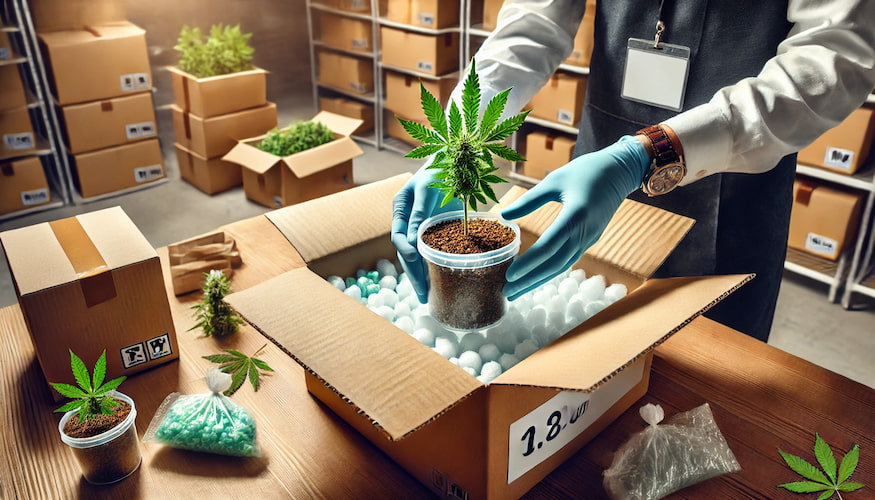
Cannabis clones are shipped as rooted cuttings—live plant material in an established growing medium—packed to retain moisture, prevent stem damage, and survive 12 to 24 hours of dark, temperature-variable transit. At IWantClones.com, every order ships overnight via a temperature-appropriate carrier in a discreet, plain outer box with no external cannabis branding. The packaging is engineered to keep roots moist and stems upright so the clone is alive and ready to grow the moment you open the box.
Understanding how cannabis clones are shipped—what goes into the packaging, why overnight is non-negotiable, and what you should see (and not see) when the box arrives—is the difference between a smooth start and a stressful scramble. This guide covers all of it.
- Overnight shipping is standard—clones are perishable live plant material and cannot survive 2- to 3-day ground transit.
- All shipments use discreet, plain outer packaging—no cannabis branding, no product names on the outside.
- IWantClones.com ships to U.S. addresses only—interstate commerce of live cannabis plant material is federally regulated.
- Rooted plugs or cubes retain moisture during transit—you should NOT see bone-dry medium upon arrival.
- Slight wilting on arrival is normal—clones that have been in the dark 12 to 24 hours often droop, then recover quickly.
- The 3-day guarantee clock starts at delivery timestamp—photograph issues immediately and contact us within 72 hours.
Key Takeaways
- Reputable sellers ship rooted clones overnight in discreet, plain packaging with moisture and stem support.
- IWantClones ships within the U.S. only, with overnight delivery on clone orders.
- Mild transit stress such as slight droop or yellowing is normal and usually recovers within a few days.
- Inspect every clone on arrival against a checklist covering roots, leaves, stems, and pests.
- Real problems—broken stems, rot, or infestation—qualify for the 3-day guarantee.
- Proper acclimation after inspection is what turns a shipped cutting into a thriving plant.
Why Shipping Live Cannabis Clones Is Different From Shipping Seeds or Dry Goods
Cannabis seeds are dormant—they can survive weeks in a padded envelope. Dry goods are shelf-stable. Clones are neither. A rooted cannabis clone is a fully active living organism that requires gas exchange, moisture, and the right temperature to survive in transit.
When a clone is packed into a shipping box, three biological processes are happening simultaneously inside:
- Transpiration: The plant is still losing water vapor through its leaves. Without moisture-retaining packaging, a clone can wilt severely within hours.
- Respiration: The plant is consuming oxygen and releasing CO₂. As CO₂ builds up in a sealed box, the plant experiences a kind of hypercapnic stress—it does not kill the plant immediately, but it weakens it, which is why the box must be opened promptly on arrival.
- Root oxygen demand: The root zone requires oxygen. Packaging that crushes or waterlogged the medium can suffocate roots during transit even if the plant looks fine externally.
These biological realities are why how cannabis clones are shipped is a specialized process—not something you can improvise with bubble wrap and a first-class stamp.
How Professionals Pack Cannabis Clones for Shipping
The Growing Medium: Rooted Plugs and Cubes
At IWantClones.com, clones are established in rooted plugs or rockwool cubes before they ever enter a shipping box. A rooted plug (such as an Oasis or Rapid Rooter plug) is an inert, pre-formed medium that holds just the right amount of moisture without becoming waterlogged. Rockwool cubes serve the same function and are common in commercial clone operations.
The plug or cube is moisture-prepped before packing—hydrated to field capacity so it will not dry out during a 12- to 24-hour overnight transit window. The medium is not soaked to the point of dripping; excess moisture in a sealed box promotes mold and anaerobic root conditions.
Moisture Management Inside the Box
Beyond the plug itself, well-packed clone shipments use moisture-retaining materials around and between the plugs to buffer humidity inside the box. This creates a microenvironment with elevated relative humidity—typically 70% to 80% — that slows leaf transpiration and prevents the severe wilting that would happen in a dry cardboard box.
Some packers use damp peat or coco coir surrounding the plugs. Others use moisture-wicking foam sheets. The exact material varies by operation, but the goal is consistent: maintain humidity without pooling free water that could foster pathogen growth during transit.
Physical Support: Keeping Stems Upright
A crushed or kinked stem can kill or permanently stunt a clone. Proper clone packaging holds each stem upright and prevents lateral movement during handling. This typically involves:
- Individual cells or dividers in a tray format that prevents clone-to-clone contact and stem collision.
- Padding on top of the tray to limit vertical movement if the box is inverted (which happens—couriers are not careful with plants).
- A rigid outer box that resists compression from stacking.
The outer box is always a plain, unbranded corrugated cardboard box. There is no indication of cannabis contents on the outside. This is not just good sense—it protects the package from theft and keeps attention away from what is inside. Our full breakdown of packaging tips for cannabis clone transport goes deeper on materials and methods used by professional operations.
Why Overnight Shipping Is Non-Negotiable for Clones
Overnight shipping for cannabis clones is not a premium add-on—it is the minimum viable shipping window for live plant material. Here is why 2-day or ground shipping is not offered for clones and why you should be skeptical of any clone retailer that does:
At 24 hours in a sealed box with limited gas exchange, a cannabis clone is operating at the edge of survivable stress. Root oxygen depletion begins degrading root health. CO₂ accumulation slows metabolic processes. Moisture equilibrium inside the package shifts as temperature cycles. By 36 to 48 hours, survival rates drop significantly—especially in summer heat or winter cold.
Overnight shipping keeps that transit window at 12 to 18 hours in most U.S. markets, which is within the survivable stress range for a properly packed, healthy, rooted clone. Anything longer is a gamble with the plant’s life.
Temperature is the other factor that makes overnight essential. A package sitting on a hot tarmac in Phoenix in July can reach internal temperatures above 100°F. At those temperatures, proteins in plant cells begin to denature and root rot pathogens become active. Overnight shipping limits the time a package spends in heat-exposed environments (airport tarmacs, courier hubs) versus temperature-controlled vehicles.
For a complete breakdown of the logistics and timing, see our dedicated page on clone shipping and delivery.
U.S.-Only Shipping: Why IWantClones.com Does Not Ship Internationally
IWantClones.com ships to U.S. addresses only. This is not a business preference—it reflects federal law and practical realities about live cannabis plant material in interstate and international commerce.
Cannabis remains a Schedule I controlled substance under federal law for most purposes, despite state-level legalization in many U.S. states. On April 23, 2026, the DEA placed FDA-approved marijuana products and state-licensed medical marijuana into Schedule III—but recreational cannabis and unlicensed commerce remain Schedule I. International shipping of live cannabis plant material would cross federal customs lines and expose both shipper and receiver to significant legal risk.
Even within the U.S., we ship only to states where cannabis clones can be legally received. Before ordering, verify your state’s current laws—cannabis clone laws vary significantly by state and can change. Our state laws on cannabis clones page is a useful starting reference, though we always recommend confirming your current state regulations directly, as laws evolve. Always verify your own state and local rules before ordering; this article is not legal advice.
What Transit Stress Looks Like (and Why It Is Not a Defect)
Understanding transit stress is essential to evaluating your shipment accurately. A stressed clone is not a bad clone. It is a living organism that has been through a genuinely difficult 12 to 24 hours, and most of them recover completely with the right care.
The most common transit stress symptoms you will see on arrival:
Wilting and Drooping Leaves
Wilting is the most common arrival symptom and the one that most alarms new growers. It happens because the clone has been transpiring moisture through its leaves in a closed environment where it cannot draw replacement water through its roots efficiently. The leaf turgor (internal water pressure) drops, and the leaves visibly droop.
In most cases, wilting from transit reverses within 4 to 8 hours of being placed under a humidity dome with a light misting. The plant rehydrates its tissue quickly once it has access to moisture and the stomata can regulate normally again.
Pale or Yellowing Lower Leaves
Lower fan leaves often yellow during shipping. This is a normal senescence (aging) response—the plant redirects nitrogen from lower leaves to support new growth under stress. Remove yellowed lower leaves cleanly with sanitized scissors. One or two yellowing lower leaves is not a quality indicator.
Slightly Condensed or Compacted Appearance
Clones sometimes arrive looking slightly more compact or “squished” than they would in optimal conditions. Stems that were upright may have a slight lean. As long as the stem is not kinked or crushed, this is cosmetic—the plant will resume normal structure within days of acclimation.
Leaf Curl or Cupping
Mild upward leaf curl (cupping) on arrival can indicate slightly elevated temperature during transit or low humidity. As long as it is mild and the leaves are not crispy, this typically resolves within 24 hours under a dome.
Arrival Inspection Checklist: What To Examine on Every Clone
A systematic inspection takes about 5 minutes and gives you a clear picture of what you received. Work through this checklist before placing clones under lights or in your grow space.
| Inspection Point | What to Look For | Healthy / Normal | Concern / Action Required |
|---|---|---|---|
| Root color | Color and firmness of roots exiting plug/cube | White to cream; firm; fibrous | Brown or black; slimy; foul odor = root rot → contact us |
| Root density | Amount of root mass visible | Roots visible at base or sides of plug | No roots visible at all (may still root; watch closely) |
| Stem base | Color and firmness at soil/medium line | Firm, green to light tan | Soft, dark, mushy = damping off or botrytis → document and contact us |
| Upper stem | Overall rigidity and color | Firm, green; slight wilting acceptable | Hollow, collapsed, or black-streaked stem → contact us |
| Leaf color (upper) | Color uniformity of upper canopy | Medium to dark green; may be slightly pale | Widespread mottling, mosaic patterns, or bronzing = possible virus or mite damage |
| Leaf color (lower) | Lower leaf condition | 1 to 2 yellow lower leaves acceptable | more than 3 yellow leaves, or rapid spread = nitrogen/pH issue; inspect roots |
| Leaf undersides | Pest evidence under magnification (30× loupe) | Clean; no visible insects, eggs, or webbing | Stippling, webbing, tiny moving dots = spider mites → quarantine immediately |
| Growing tips | Status of newest growth points | Green, intact; may be slightly pale from dark transit | Brown, dead, or powdery white = tip die-off or powdery mildew → document and contact us |
| Medium moisture | Moisture level of plug/cube | Moist but not dripping; springs back slightly when squeezed | Bone dry = dehydration risk; soaking wet and slimy = root rot risk |
| Overall vigor | General plant appearance | Leaves may droop but plant has visible volume and structure | Completely flattened, no leaf structure, multiple dead branches = DOA → contact us immediately |
Inspect every clone, not just the ones that look problematic at first glance. A pest infestation on one clone can jump to your entire grow space within days if you skip the inspection step.
What Is Normal vs. a Real Problem: Making the Call
Normal—No Action Beyond Standard Acclimation
These symptoms are expected and resolve with proper care:
- Mild to moderate overall wilting that perks up within 12 hours under a dome
- One or two yellowing lower fan leaves
- Slightly pale green color on upper foliage
- Light tan coloration at root tips (oxidation, not rot—confirm by checking for firmness)
- Minor leaf curl or cupping that was not present at the source nursery
- Slight lean to the stem from box positioning
Borderline—Watch Closely for 24 Hours
These symptoms could go either way and require close monitoring:
- Two to three yellow leaves (normal if lower; concerning if spreading upward rapidly)
- Root tips with slight browning but firm texture (monitor; do not flood the medium)
- One dead lower leaf branch with healthy growth above it
- Wilting that has not significantly improved after 24 hours under a dome
If borderline symptoms do not improve or worsen after 24 hours, photograph everything and contact us. The 72-hour guarantee window still has time remaining.
Real Problems—Document and Contact Us Immediately
These symptoms indicate a legitimate issue that warrants a guarantee claim:
- Brown, slimy, foul-smelling roots
- Soft, collapsed, or black stem at the base
- Active pest infestation (visible insects, eggs, or webbing under magnification)
- Powdery white coating on leaves (powdery mildew)
- Plant completely dead on arrival—no turgidity, no green tissue
- More than half of all leaves showing rapid yellowing, spotting, or necrosis
How To File a Guarantee Claim
Our 3-day guarantee exists because we know things can go wrong in transit despite best efforts. Here is the exact process:
- Note your delivery timestamp. This is the confirmed delivery time from your carrier tracking notification—not when you opened the box. The 72-hour clock starts here.
- Photograph everything before touching it. Take photos of the unopened box exterior, the open box interior showing how clones were packed, and close-up shots of each affected clone (roots, stem base, leaves, any pest evidence).
- Do not discard any packaging. Keep the original box and all packing materials in case the carrier requires documentation for a damage claim.
- Contact IWantClones.com with your order number and photos within 72 hours of delivery. Describe what you observed and when.
- We review and respond within one business day. Valid claims are resolved with replacement clones shipped on the next available overnight window, or store credit.
What accelerates a claim resolution: clear photos, your order number in the first message, and a specific description of the symptoms. What slows it down: photos taken 48 hours after arrival after the plant condition changed significantly, missing order details, or contacting us after the 72-hour window.
For context on our sourcing and quality control standards, see our page on ensuring the quality of cannabis clones and addressing sourcing concerns.
Do Clones Survive Shipping? The Honest Answer
Yes—consistently, when the shipment is packed correctly and travels overnight. The question “do clones survive shipping?” is one we hear constantly from first-time buyers who are understandably skeptical. Here is the honest breakdown:
When a clone is well-rooted (roots established in a plug or cube rather than just a raw cutting), properly moistened, protected from stem damage, and shipped with a 12- to 18-hour transit time, survival rates are very high. The rooting stage is the vulnerability window—a clone that has not established roots in its medium is far more susceptible to transit stress than a properly rooted plant.
This is why we only ship established, rooted clones—not fresh cuttings. A fresh cutting with no root mass has almost no buffer against the moisture loss and respiration stress of shipping. A rooted clone with 1 to 2 inches of white root structure in its medium can handle overnight transit without significant damage in most conditions.
Temperature extremes are the main survival threat, which is why we monitor weather forecasts and may hold shipments during extreme heat or cold events. If your area is experiencing a heat wave or a polar blast, we may contact you to delay your order to the next shipping window. This is not a delay to be frustrated about—it is us protecting your order.
According to UC Davis Extension’s cannabis cultivation resources, plant material in transit faces similar stressors to those in cold storage—moisture loss, CO₂ accumulation, and darkness—which is why minimizing transit time is the primary mitigation strategy.
After Inspection: Handing Off to the Acclimation Protocol
Once your inspection is complete and you have confirmed the clones are healthy (or documented any issues for a claim), the next step is acclimation. This is where the shipping phase ends and the growing phase begins.
The key acclimation steps after your inspection:
- Light misting with pH-adjusted plain water (6.0 to 6.5 soil/coco; 5.8 to 6.0 hydro)
- Placement under low-intensity light (150 to 250 µmol/m²/s) with a humidity dome
- No nutrients for the first 24 to 48 hours
- Gradual light and airflow ramp-up over 3 to 5 days
- First transplant only after new growth appears and roots are visibly active
Our detailed step-by-step guide for the first 48 hours after your cannabis clones arrive walks through each of these steps with specific parameters, a full hour-by-hour timeline table, and solutions for common acclimation problems.
For the growing environment that will support your clones through early veg, see our guide on climate and environment for cannabis clones.
Frequently Asked Questions About Shipping Cannabis Clones
How are cannabis clones packaged for shipping?
Cannabis clones are shipped as rooted cuttings in pre-moistened growing plugs or rockwool cubes, secured in divided trays to prevent stem collision, surrounded by moisture-retaining material to maintain 70% to 80% humidity, and packed in a rigid, plain corrugated outer box with no external cannabis branding. The entire package is designed to survive 12 to 18 hours of overnight transit.
Why does IWantClones.com only ship overnight?
Cannabis clones are alive and actively respiring in their shipping box. CO₂ accumulates, moisture depletes, and root oxygen drops over time. Overnight shipping keeps the transit window at 12 to 18 hours — within the survivable range for a properly rooted clone. Two-day or ground shipping exposes clones to unacceptable mortality risk, especially in summer or winter temperature extremes.
What states can IWantClones.com ship cannabis clones to?
IWantClones.com ships to U.S. addresses only, limited to states where receiving cannabis clones is legally permissible. Cannabis laws vary significantly by state and change frequently. Before ordering, verify your state’s current laws. Our state laws page is a useful starting reference, but always confirm with your current state regulations directly—this is not legal advice.
Is it normal for clones to look wilted when they arrive?
Yes. Mild to moderate wilting is a normal result of 12 to 24 hours of dark, enclosed transit with limited fresh airflow. Most clones perk up within 4–12 hours of being placed under a humidity dome with a light misting. Wilting that does not improve after 24 hours under a dome, or that is accompanied by soft/mushy stems, may indicate a real problem worth documenting.
How do I know if my clones arrived with pests?
Inspect the undersides of all leaves under a 30× loupe immediately on arrival, before clones enter your grow space. Spider mites appear as tiny moving dots or leave fine webbing; thrips leave silver streaking; fungus gnats lay eggs at the soil surface. Any confirmed pest presence qualifies for a guarantee claim within 72 hours—quarantine affected clones from your grow immediately.
What happens if my clones arrive dead or diseased?
Photograph everything—packaging, roots, stems, and leaves — immediately before doing anything else. Contact IWantClones.com with your order number and photos within 72 hours of the delivery timestamp. Valid claims (arrival dead, diseased, or with active pest infestation) receive replacement clones or store credit. The 72-hour window starts at the carrier’s confirmed delivery time, not when you open the box.