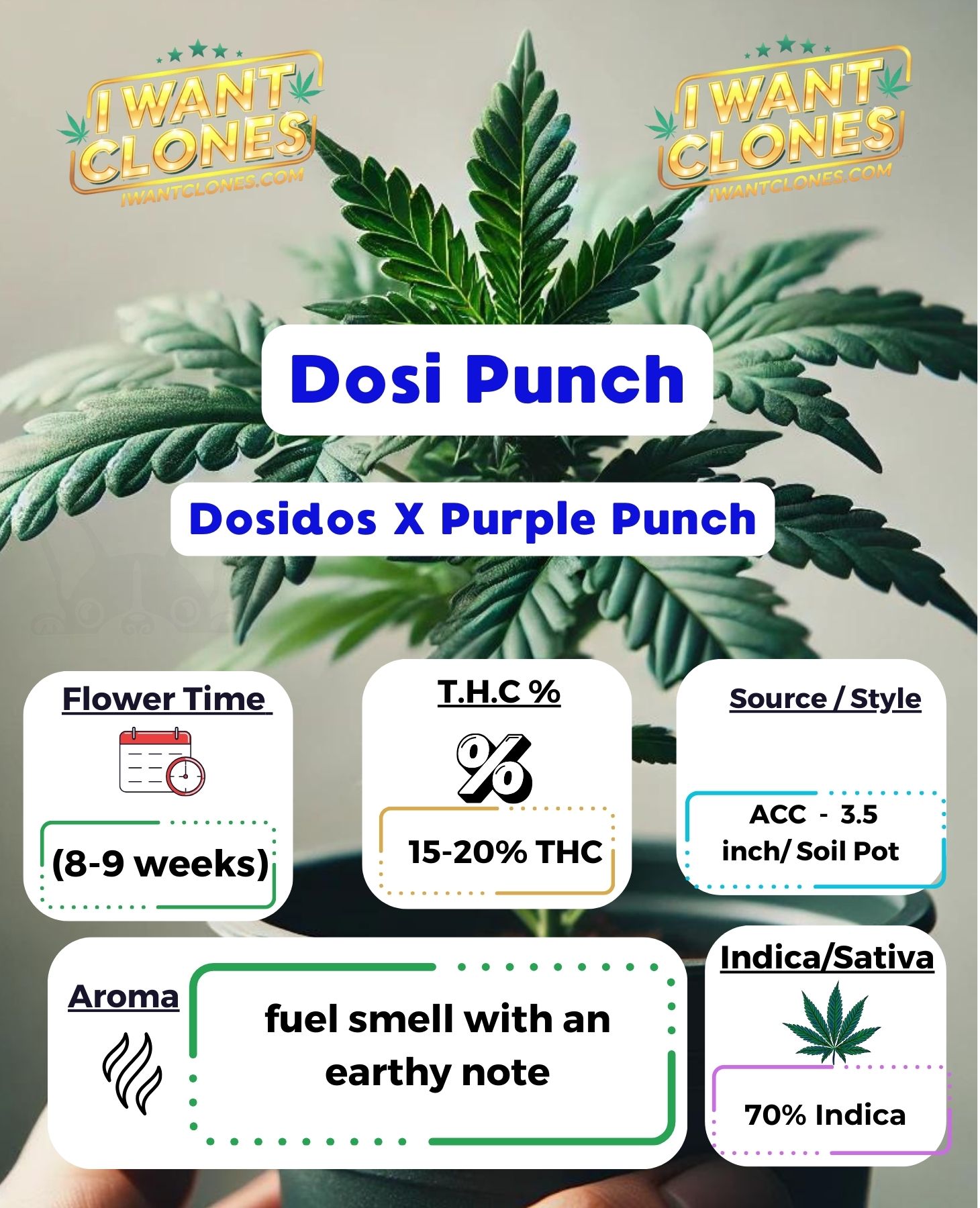
Dosi Punch is a heavy indica-dominant hybrid created by crossing Do-Si-Dos with Purple Punch. It delivers THC levels commonly testing between 25–30%, with deeply relaxing body effects, sweet grape and cookie flavors, and a tendency to produce striking purple phenotypes. Flower time runs 8–9 weeks indoors, making it a reliable finisher for growers who want both shelf appeal and knockout potency.
At IWantClones.com, we stock verified Dosi Punch clones so you start with the exact genetics — no seed variation, no guessing which phenotype you’ll land on.
Key Takeaways
- Dosi Punch is a Do-Si-Dos × Purple Punch cross, combining OGKB/Cookies heritage with Larry OG × Granddaddy Purple parentage.
- THC typically tests 25–30%; CBD is very low (<1%), making this a high-potency evening strain.
- Terpene profile centers on caryophyllene, limonene, and linalool — delivering sweet grape, cookie dough, and light floral notes.
- Flowering time is 8–9 weeks indoors; outdoor harvest falls around mid-October in most US climates.
- Purple phenos express reliably when nighttime temps drop to 60–65°F in late flower.
- Best suited for evening use, sleep support, stress relief, and appetite stimulation — not a daytime workhorse.
Dosi Punch Lineage: Where These Genetics Come From
To understand Dosi Punch, you need to understand both parent strains — because each brings a distinct genetic legacy to the table.
Do-Si-Dos (The OGKB/Cookies Side)
Do-Si-Dos (also written “Dosidos” or “Do-Si-Dos”) was developed by Archive Seed Bank as a cross of OGKB (OG Kush Breath) × Face Off OG. OGKB itself is a phenotype of Girl Scout Cookies that became famous for its extreme resin production, heavy sedative effect, and a distinctive earthy-sweet aroma. Face Off OG adds dense structure and deep OG terpenes.
The result: Do-Si-Dos is one of the most award-winning indica-leaning hybrids in modern US cannabis culture. It regularly produces 28–30% THC in optimal grows, with a thick layer of trichomes that makes it a hash maker’s favorite. The Cookies genetic backbone is what gives Dosi Punch its cookie dough and mint undertones.
Purple Punch (The Grape Lineage)
Purple Punch was bred by Supernova Gardens as a cross of Larry OG × Granddaddy Purple (GDP). Larry OG is an OG Kush derivative known for clean citrus-fuel terpenes; Granddaddy Purple (Ken Estes, 2003) brought the purple anthocyanin expression and sweet grape-candy aroma that made it legendary. Purple Punch is deeply indica, fast-finishing, and produces striking purple coloration with very high visual bag appeal.
When you combine Do-Si-Dos and Purple Punch, you get Dosi Punch — a strain that stacks two knockout indicas on top of each other, inheriting heavy sedation from both sides, grape and cookie terps that complement each other, and a structural tendency toward dense, colorful, resin-coated buds.
Dosi Punch Strain Profile at a Glance
| Attribute | Detail |
|---|---|
| Lineage | Do-Si-Dos × Purple Punch |
| Genetic Background | OGKB / Face Off OG / Larry OG / Granddaddy Purple |
| Classification | Indica-dominant hybrid (~70% indica) |
| THC Range | 25–30% |
| CBD | <1% |
| Primary Terpenes | Caryophyllene, Limonene, Linalool |
| Aroma / Flavor | Sweet grape, cookie dough, light floral, earthy kush |
| Flowering Time (Indoor) | 8–9 weeks |
| Outdoor Harvest | Mid-October |
| Yield (Indoor) | Moderate-heavy (1.5–2 oz/ft² with training) |
| Plant Height | Medium (3–4 ft indoor with topping) |
| Difficulty | Beginner-friendly to intermediate |
| Best Use | Evening, sleep support, relaxation |
Effects and Who Dosi Punch Is For
Dosi Punch hits fast and hits hard. Most users report an initial warm, euphoric head rush that transitions within 15–20 minutes into a full-body sedation. At higher doses, couch-lock is common — this is not a productive daytime strain. The effect profile is driven by the combined OG and Cookies sedative backbone, amplified by the Purple Punch relaxation.
What Users Report
- Relaxation: Deep muscle and body tension relief within minutes of onset.
- Euphoria: Initial mood lift before the indica effects take over.
- Sleepiness: Most users find this strain best consumed 1–2 hours before bed.
- Appetite stimulation: Classic munchies effect, consistent across phenotypes.
- Duration: Effects typically last 2–3 hours at moderate doses.
This strain is ideal for experienced cannabis consumers looking for a heavy evening session, or for medical patients (where legally permitted) seeking sleep and pain support. Beginners should approach Dosi Punch with caution given the very high THC content. Always consume cannabis responsibly and in compliance with your state and local laws.
Terpene Breakdown
Caryophyllene (spicy, peppery) is the dominant terpene and the one responsible for the strain’s body-relaxing, anti-inflammatory reputation. Limonene adds brightness and contributes to the initial mood-lifting effect. Linalool (also found in lavender) deepens the sedative quality and adds light floral complexity to the aroma. Together, these three terpenes produce a profile that’s simultaneously dessert-sweet and earthy.
Growing Dosi Punch: What to Expect
Dosi Punch is a rewarding strain to grow. It’s not a finicky plant — it tolerates minor feeding fluctuations and adapts well to both soil and coco/hydro setups. That said, there are a few things that separate a good grow from a great one with this genetics.
Starting with a Clone vs. Seed
Growing from a verified Dosi Punch clone means you’re working with a genetically confirmed female plant from the start. Seeds introduce phenotypic variation — you might get a more sativa-leaning individual, or a plant that doesn’t express the purple coloration. With a clone, you know exactly what you’re growing. We ship rooted Dosi Punch clones overnight across the US, and every plant comes with our 3-day no-bullshit guarantee.
For tips on getting your clones off to the right start after they arrive, our guide on what to do when clones arrive covers everything from unboxing to first watering.
Vegetative Stage (3–5 Weeks)
Dosi Punch grows with a medium-compact structure during veg. It doesn’t stretch aggressively, which makes it manageable in tent grows. Plan for a final canopy height of 3–4 feet indoors if you top early. Veg under 18/6 light cycle; the plant responds well to both HID and modern LED full-spectrum fixtures.
Start nitrogen-heavy feeding once the clone is established (usually 10–14 days after transplant). Keep VPD in the 0.8–1.0 kPa range during early veg to maximize growth rates. For detailed VPD management, see our VPD guide for cannabis clones.
Training Techniques for Dosi Punch
Because Dosi Punch has a naturally bushy, branchy structure, it responds exceptionally well to training. Two methods stand out:
- Topping: Top the main stem once above the 4th or 5th node during veg. This creates 2 dominant colas and encourages lateral branching. A second topping 10–14 days later creates 4 dominant sites. Topping also keeps the plant height manageable for tent growers.
- LST (Low Stress Training): Bend and tie branches outward during veg to spread the canopy. This maximizes light penetration and creates an even bud site distribution. Combined with topping, LST can dramatically increase yield per square foot.
Our guide on topping and LST for cannabis clones walks through both techniques in detail with timing recommendations.
Transitioning to Flower
Switch to a 12/12 light schedule when your canopy is at roughly 50–60% of your target final height — Dosi Punch will stretch about 30–40% during the first two weeks of flower. Begin transitioning nutrients toward a lower nitrogen, higher phosphorus and potassium profile at flip. Our veg-to-flower transition guide covers the full two-week transition window.
Flowering Stage (8–9 Weeks)
Dosi Punch builds buds quickly in early flower and really stacks resin in weeks 5–7. The calyxes swell noticeably in weeks 6 and 7; trichomes turn milky-white by week 8, with amber trichomes appearing by late week 8 through week 9. Most growers targeting heavy sedation harvest toward the end of week 9 when 15–20% of trichomes have turned amber.
Keep humidity below 45% RH during weeks 6–9 to protect dense buds from botrytis (bud rot). The indica structure means the colas can get very dense — good airflow is essential. For a detailed harvest timing breakdown, see our harvest timing guide.
Unlocking the Purple Phenotype
Purple coloration in Dosi Punch is driven by anthocyanins — pigments that express when the plant experiences cool nighttime temperatures. To trigger and intensify purple coloration:
- Drop nighttime temps to 60–65°F for the last 3–4 weeks of flower.
- Maintain daytime temps at 75–80°F for a clear day/night differential.
- Don’t stress the plant with nutrient deficiencies — true purple is genetic and temperature-driven, not a sign of nitrogen lockout.
Not every Dosi Punch clone will go full purple — expression varies by phenotype. But with proper temperature management, most phenos will show at least purple hues on the calyxes and leaves by week 7–8.
Feeding Dosi Punch: Nutrients and Schedule
Dosi Punch is a moderate-to-heavy feeder during mid-to-late flower. Here’s a simplified nutrient framework:
| Growth Phase | Key Nutrients | EC Range (Coco/Hydro) |
|---|---|---|
| Early Veg (weeks 1–2 post-transplant) | Balanced N-P-K, rooting enzymes | 0.8–1.2 |
| Mid-Late Veg | Higher N, cal-mag, silica | 1.4–1.8 |
| Early Flower (weeks 1–3) | Transition to lower N, increase P/K | 1.6–2.0 |
| Mid Flower (weeks 4–6) | High P/K, bloom boosters, cal-mag | 2.0–2.4 |
| Late Flower (weeks 7–9) | Taper nutrients, finisher/ripener | 1.4–1.8 |
| Flush (final 7–10 days) | Plain pH-corrected water | <0.5 |
For soil growers, use the same phase logic but rely on runoff EC/pH rather than input EC. Keep soil pH between 6.2–6.8. Cal-mag supplementation is important with Dosi Punch, especially in RO water or coco environments — the strain shows early magnesium deficiency if cal-mag is skimped. Our comprehensive cannabis clone nutrient guide goes deeper on feeding schedules by medium.
Environment and Climate for Dosi Punch
Dosi Punch thrives in a controlled indoor environment. Ideal parameters:
- Veg temps: 75–82°F daytime, 68–75°F nighttime
- Flower temps: 75–80°F daytime, 60–68°F nighttime (cooler nights encourage purple expression)
- Humidity (veg): 55–70% RH
- Humidity (flower): 40–50% RH weeks 1–5; drop to 35–45% in weeks 6–9
- CO2: 1000–1200 ppm in sealed environments with strong lighting
- Airflow: Consistent canopy airflow to prevent hot spots and mold in dense colas
Dosi Punch can be grown outdoors in US climates that don’t get early frost — it’s ready mid-October. In humid climates, watch the dense buds closely for mold. Our climate and environment guide covers environmental management in detail.
Yield Expectations and Harvest
A well-trained Dosi Punch plant in a 5-gallon container under 600W HID or equivalent LED can yield 1.5–2 oz per square foot. Larger containers and more aggressive training (SCROG or multi-top) push the top end. The buds are extremely dense and heavy — you may need to support larger colas with bamboo stakes or trellis netting in the final weeks.
Trichome-based harvest timing is the gold standard with Dosi Punch. A jeweler’s loupe or digital microscope (60x minimum) gives you the clearest picture. Milky/cloudy trichomes mean peak THC; a mix of milky and 15–20% amber trichomes indicates the sedative CBN is starting to accumulate — ideal for sleep-focused effects. For more on reading trichomes and other harvest indicators, see our detailed harvest timing guide.
Drying and Curing Dosi Punch for Maximum Quality
After spending 8–9 weeks bringing Dosi Punch through flower, the dry and cure stage determines whether you end up with genuinely great product or merely good weed. This strain’s high resin content and dense bud structure make it both rewarding and unforgiving at this stage.
Drying Dosi Punch
Hang whole branches upside down in a dark room at 60°F and 60% RH. The sugar leaves left on during a dry trim slow moisture loss and protect the trichomes — Dosi Punch is a strain where dry trimming pays off. With its very dense calyxes, the interior of large colas retains moisture well past when the outside feels dry. Plan for a full 10–14 day hang dry before testing readiness.
Use the stem snap test: when small stems break cleanly rather than bending, the bud is ready to trim and jar. If you rush this step with Dosi Punch and jar buds that are still slightly moist in the center, you’ll get mold — it’s a predictable consequence of the density. Check daily from day 9 onward.
Keep airflow gentle and indirect. Point a fan at the wall, not the buds. Direct airflow on Dosi Punch buds accelerates drying unevenly and blows off terpenes before they’ve had a chance to stabilize. For a complete post-harvest walkthrough, see our drying and curing cannabis guide.
Curing Dosi Punch for Best Flavor
Dosi Punch’s grape and cookie terpenes really come through during a proper cure. The green chlorophyll harshness that’s present right after drying fades significantly over the first two weeks in sealed glass jars. By week 4, the sweet grape and floral notes open up considerably. By week 6–8, you’re getting the strain’s full aromatic expression.
Pack jars 75–80% full, add a Boveda 62% humidity pack, and burp twice daily for the first week. Reduce to once daily in week 2, then every 2–3 days through week 4. Target 58–62% RH inside jars — this is non-negotiable with a terp-forward strain like Dosi Punch where flavor is a major part of the value.
Making the Most of Dosi Punch: Tips from Experience
A few things we’ve seen growers learn the hard way with this strain:
- Don’t skimp on cal-mag. Dosi Punch shows calcium deficiency earlier than most strains — look for brown leaf tip spotting mid-veg as an early warning sign. Preventive cal-mag dosing from week 2 onward eliminates this.
- Support those colas. The OGKB side of Dosi Punch produces colas that can get very heavy by weeks 7–8. Bamboo stakes or trellis netting in the final three weeks prevents branches from snapping under their own weight.
- Control VPD in flower. Dosi Punch at high humidity + high temps in late flower is a mold problem waiting to happen. Keep night temps cool (which also triggers purple expression) and run a dehumidifier if needed. Our VPD guide for cannabis clones has the specific numbers by growth stage.
- Be patient with the cure. Dosi Punch at 2 weeks cured is good. Dosi Punch at 6 weeks cured is exceptional. The grape and cookie terps take time to fully stabilize and express. If you can hold off, it’s worth it.
- Clone your best plant. If you grow multiple Dosi Punch plants, you may land on a pheno with exceptional purple expression or aroma. Take clones from that mother plant before you harvest it — you can run that exact phenotype again and again. Our mother plant guide explains how to maintain a mother indefinitely.
Dosi Punch vs. Related Strains
If you’re deciding between Dosi Punch and similar indicas in our catalog, here’s how it compares to a close neighbor:
| Trait | Dosi Punch | Sundae Driver |
|---|---|---|
| Lineage | Do-Si-Dos × Purple Punch | FPOG × Grape Pie |
| THC Range | 25–30% | 20–24% |
| Primary Flavor | Grape, cookie dough | Creamy, fruity, vanilla |
| Effect Feel | Heavy sedation, couch-lock | Relaxed, balanced, less sedating |
| Flower Time | 8–9 weeks | 9–10 weeks |
| Purple Expression | Strong (temp-triggered) | Moderate |
| Best For | Evening/sleep | Evening/daytime hybrid |
If you want something similar but slightly less sedating, our Sundae Driver clone guide is worth reading. For a broader comparison of high-potency options, check our high-THC cannabis clone strains overview.
Where to Buy Dosi Punch Clones
At IWantClones.com — backed by SeedsHereNow.com and 15+ years of genetics expertise — we ship verified, rooted Dosi Punch clones overnight to legal US states. Each clone is pre-rooted, confirmed female, and covered by our 3-day guarantee. No seeds, no phenotype lottery, no wasted grow cycles.
Order Dosi Punch clones here — or browse the full selection at our clone shop. We accept credit/debit, and cryptocurrency including BTC, LTC, BCH, and DOGE.
Cannabis laws vary by state. Always verify your local home-grow regulations before ordering. See our home-grow laws by state guide for current information.
Dosi Punch Growing Tips: Maximizing Color and Resin
Growing Dosi Punch well is one thing; coaxing the absolute best out of it — maximum purple expression, heaviest possible resin coating, and dense bud structure that doesn’t collapse into mold — is another. These are the techniques that separate a good grow from a showcase one.
Temperature Drops for Purple Phenotype Expression
The purple coloration in Dosi Punch comes from anthocyanins — pigments that accumulate in plant tissue when temperatures drop in the cooler end of the strain’s tolerance range. The trigger isn’t just “cold” in the abstract; it requires a meaningful day-to-night temperature differential sustained over several weeks. During the final three to four weeks of flower, aim for daytime temps between 75–80°F and nighttime temps of 60–65°F. A differential of 15°F or more is what causes the anthocyanin pathway to activate visibly.
Don’t force this too early — dropping temps aggressively in weeks 1–3 of flower slows bud development before the plant has built its structure. Start the temperature-drop protocol around week 5 or 6 indoors, after the buds have already stacked and started fattening. You’ll see color changes beginning in the calyxes first, then moving outward to the sugar leaves and sometimes the fan leaves. Not every phenotype will go fully purple — some express only on the calyx tips — but consistent cool nights bring out whatever anthocyanin potential the plant has. If your tent is in a naturally warm space in summer, a small AC unit running on a timer during the dark cycle is the most practical solution.
One important clarification: true anthocyanin-driven purple is genetic and temperature-activated. Purple coloration appearing alongside yellowing leaves, brown spots, or other symptoms during veg or early flower is more likely a nutrient problem (phosphorus or magnesium deficiency can cause purpling as a stress response) than genuine genetic expression. Know the difference before deciding to lower temps further.
Defoliation for Dense, Light-Penetrated Buds
Dosi Punch throws dense, branchy lateral growth that can shade lower bud sites significantly by weeks 3–4 of flower. Strategic defoliation — removing select fan leaves that block light and restrict airflow — directly improves bud density and trichome production on sites that were previously shaded.
The most effective timing is a moderate defoliation at the flip to 12/12 (removing the largest fan leaves blocking bud sites) and again around day 21 of flower when the pre-flower stretch is complete. At that point you can see clearly which bud sites are buried and which are exposed. Remove leaves selectively rather than aggressively — taking too many leaves too late in flower stresses the plant and reduces photosynthetic capacity at a time when it needs energy for bud development. A good rule of thumb: if a fan leaf is blocking two or more developing bud sites and removing it would clearly improve light and air access, it goes. If it’s exposed and contributing to canopy coverage, leave it.
Good airflow through the canopy is especially important with Dosi Punch because of its bud density. Dense calyxes with restricted airflow create a mold environment. Post-defoliation airflow improvement is one of the best mold-prevention steps you can take with this strain.
Mold Prevention in Dense Dosi Punch Buds
Dosi Punch’s extremely dense, compact bud structure is beautiful but creates a genuine botrytis risk in the final weeks if humidity isn’t managed precisely. Here’s the practical approach: keep RH below 45% from week 5 of flower onward, dropping to 35–40% in weeks 7–9. Run oscillating fans through — not just around — the canopy. Avoid watering late in the day so soil doesn’t off-gas moisture into a dark, closed tent overnight. Inspect the interior of the largest colas weekly by gently spreading the calyxes with clean fingertips — catching botrytis early (it appears as brown-gray fuzzy tissue inside the bud) means losing one bud site, not the entire plant.
- Keep relative humidity under 45% from week 5 of flower; target 35–40% in weeks 7–9.
- Use defoliation to open airflow pathways through the canopy in early flower.
- Water in the morning — not late afternoon or evening — to minimize overnight humidity spikes.
- Inspect large cola interiors weekly from week 6 onward; remove any infected tissue immediately with clean scissors.
- If your environment is naturally humid, a dedicated dehumidifier running through the dark cycle is the single highest-impact investment you can make for this strain.
Combining proper temperature management (which also triggers purple expression) with low RH in late flower means you’re solving two goals simultaneously: the cool, dry environment that prevents mold is the same environment that maximizes anthocyanin expression. These goals reinforce each other perfectly.
Frequently Asked Questions
What strains make up Dosi Punch?
Dosi Punch is a cross of Do-Si-Dos and Purple Punch. Do-Si-Dos comes from OGKB (OG Kush Breath) × Face Off OG; Purple Punch comes from Larry OG × Granddaddy Purple. Together they produce a deeply indica, high-THC, grape-and-cookie-flavored strain.
How long does Dosi Punch take to flower?
Dosi Punch flowers in 8–9 weeks indoors under a 12/12 light cycle. Outdoor growers in most US climates can expect harvest around mid-October. Waiting until 15–20% of trichomes turn amber produces the most sedative effect.
Does Dosi Punch always turn purple?
Purple expression depends on genetics and environment. Dosi Punch has strong purple potential from its Granddaddy Purple lineage. To trigger it, drop nighttime temps to 60–65°F during the last 3–4 weeks of flower. Not every phenotype will fully purple — some show hues on calyxes and fan leaves only.
How potent is Dosi Punch?
Dosi Punch typically tests between 25–30% THC, making it one of the more potent indicas available as a verified clone. CBD is under 1%. It is not recommended as a beginner’s first strain due to the intensity of its sedative effects at higher doses.
Is Dosi Punch good for beginners to grow?
Dosi Punch is beginner-friendly in terms of plant resilience — it tolerates feeding variations and adapts well to different grow mediums. The main challenge is managing humidity during late flower to prevent mold in its very dense buds. Starting from a verified clone eliminates the seed germination and sexing steps entirely.
What’s the best growing medium for Dosi Punch?
Dosi Punch performs well in quality cannabis potting soil, coco coir, and hydroponic systems. Coco coir gives the most feeding control and tends to produce larger yields with heavier resin. Soil with good drainage and mycorrhizal inoculants produces excellent terpene expression. Avoid waterlogged, heavy mixes that restrict root oxygen.