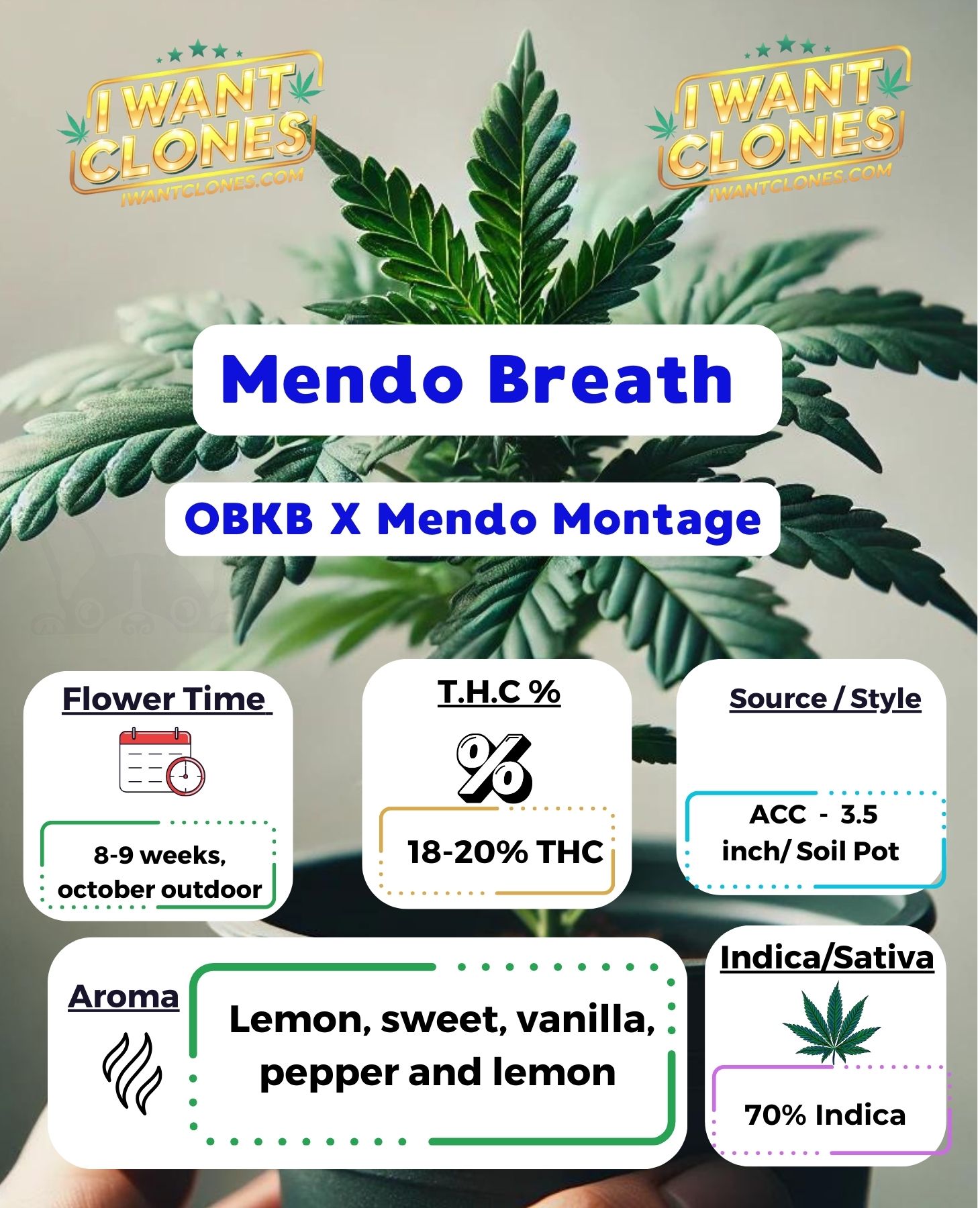
Mendo Breath is a pure indica-dominant hybrid created by Gage Green Genetics as a cross of OGKB (OG Kush Breath) × Mendo Montage. It delivers a rich vanilla, caramel, and earthy terpene profile with THC levels that typically test between 19–24%, producing deeply relaxing body effects best suited for evening use. Flower time runs 8–9 weeks indoors, and the plant builds extremely dense, resinous buds with robust yields when properly trained.
At IWantClones.com, we carry verified Mendo Breath clones — rooted, confirmed female, and shipped overnight across legal US states with our 3-day guarantee.
Key Takeaways
- Mendo Breath is bred by Gage Green Genetics as a cross of OGKB (OG Kush Breath) × Mendo Montage — two legendary Northern California indica lines.
- THC typically ranges 19–24%; terpenes skew sweet with dominant vanilla, caramel, and OG earth notes.
- Primary terpenes include myrcene, caryophyllene, and limonene — producing a sweet, gas, and earthy aromatic blend.
- Flowering time is 8–9 weeks indoors; outdoor harvest is late September to mid-October depending on climate.
- Buds are extremely dense and heavy — humidity management is critical in the final weeks of flower.
- Best suited for evening relaxation, stress relief, body tension, and sleep — not a daytime strain.
Mendo Breath Lineage: The Genetics Behind the Strain
Gage Green Genetics (based in California) built their reputation on crafting strains that combine heavy OG heritage with Northern California landrace and regional genetics. Mendo Breath is one of their signature creations, and understanding the two parent strains explains exactly why it performs the way it does.
OGKB (OG Kush Breath)
OGKB — short for OG Kush Breath — is a phenotype of the original Girl Scout Cookies (GSC) family that emerged out of the Bay Area cannabis scene in the early 2010s. It’s known for extreme resin production, a distinctively doughy-earthy aroma with hints of spice and fuel, and sedative indica effects. OGKB became one of the most influential genetic building blocks in modern cannabis breeding — it’s the same backbone found in Do-Si-Dos, Mendo Breath, and dozens of other acclaimed modern strains.
What OGKB brings to Mendo Breath: dense bud structure, heavy trichome coverage, deeply relaxing indica effect, and that foundational OG fuel-and-earth base note that runs underneath the sweeter vanilla top notes.
Mendo Montage
Mendo Montage is a Northern California cultivar with roots in the legendary Mendocino County cannabis-growing tradition — an area known historically for producing some of the most aromatic, terp-forward outdoor cannabis in the US. The specific genetics of Mendo Montage are held by Gage Green; it’s selected for sweet, complex terpenes and strong Mendocino-region indica characteristics.
What Mendo Montage brings to the cross: the distinct vanilla and caramel sweetness that separates Mendo Breath from standard OG hybrids, along with the dense Northern California bud structure and a slightly higher yield potential.
The Result: Mendo Breath
The combination of OGKB’s resin production and kush sedation with Mendo Montage’s sweet terpene profile produces a strain that’s both highly aromatic and powerfully relaxing. The vanilla-caramel notes are genuinely distinctive — Mendo Breath is one of the few cannabis strains where you can smell the sweetness clearly even before breaking the buds open. It’s a strain that lives up to the hype when grown correctly, and growing it from a verified clone ensures you’re working with the right phenotype from the start.
Mendo Breath Strain Profile at a Glance
| Attribute | Detail |
|---|---|
| Breeder | Gage Green Genetics |
| Lineage | OGKB (OG Kush Breath) × Mendo Montage |
| Classification | Indica-dominant (~75% indica) |
| THC Range | 19–24% |
| CBD | <1% |
| Primary Terpenes | Myrcene, Caryophyllene, Limonene |
| Aroma / Flavor | Vanilla, caramel, sweet earth, OG fuel undertones |
| Flowering Time (Indoor) | 8–9 weeks |
| Outdoor Harvest | Late September – Mid October |
| Yield (Indoor) | Moderate-heavy (1.5–2+ oz/ft² with training) |
| Plant Height | Medium-compact (2.5–4 ft indoor with topping) |
| Difficulty | Beginner-friendly |
| Best Use | Evening, relaxation, sleep support |
Effects: What Mendo Breath Feels Like
Mendo Breath produces a classic heavy indica experience with a notably pleasant onset. The initial effect is a warm body relaxation that spreads from the shoulders down, accompanied by a gentle mental ease that most users describe as stress-melting. Unlike strains with jarring head effects, Mendo Breath eases you into its sedation — it’s smooth and comfortable rather than overwhelming.
Effect Profile
- Body relaxation: Deep muscle and tension relief, starting within 10–15 minutes of onset.
- Mental calm: Quiets racing thoughts without heavy cerebral intensity.
- Sedation: Builds gradually — most users are ready for sleep within 1–2 hours of consumption.
- Appetite stimulation: Reliably triggers appetite, consistent across phenotypes.
- Duration: 2–3 hours at moderate doses; can extend with larger amounts.
Mendo Breath at 19–24% THC is potent but not extreme — it’s an accessible heavy indica for people who want real sedation without the 30% THC intensity of something like Dosi Punch. It’s a good strain for cannabis consumers who have some experience but aren’t chasing the absolute ceiling of potency.
Terpene Details
Myrcene is the dominant terpene — it’s the most common terpene in cannabis and is largely responsible for the earthy, musky base note as well as the couch-lock sedative effect that myrcene-heavy strains are known for. Caryophyllene (spicy, peppery) adds complexity and contributes to body-relaxing properties. Limonene provides brightness and citrus uplift in the aroma, balancing the earthy-sweet profile. The vanilla and caramel notes aren’t from a single terpene — they emerge from the specific combination of secondary terpenes (including linalool and terpinolene in some phenos) that Gage Green selected for in the Mendo Montage parent.
Always consume cannabis responsibly and in accordance with your state and local laws. Cannabis is for legal adult use where permitted.
Growing Mendo Breath: Complete Cultivation Guide
Mendo Breath is one of the more forgiving indica strains to grow, particularly for growers moving from beginner to intermediate. The plant’s compact structure, resilience to minor feeding errors, and naturally dense bud sites make it a high-reward grow without excessive complexity. Here’s what to know at each stage.
Why Start with a Mendo Breath Clone
Mendo Breath is available from Gage Green as seeds, but growing from seed means phenotypic variation — individual plants can differ meaningfully in aroma profile, structure, and yield. A verified Mendo Breath clone from IWantClones.com guarantees you’re working with a confirmed female from a selected phenotype. You skip germination, sexing, and the risk of pulling a non-representative pheno. For growers who want consistent results across multiple grows, a clone is the only logical starting point.
When your clone arrives, our guide on what to do when clones arrive walks you through proper acclimation, first watering, and setting up your clone for a strong establishment.
Vegetative Stage (3–5 Weeks)
Mendo Breath is naturally compact during veg — it doesn’t stretch as aggressively as sativa-dominant hybrids, and the branching structure is orderly rather than unruly. For most growers, 3–4 weeks of veg from a rooted clone is enough before flipping to flower.
Maintain a consistent 18/6 light cycle during veg. Mendo Breath responds well to both HPS/HID setups and full-spectrum LED — the key is providing 400–600 µmol/m²/s of PPFD at canopy level during veg, ramping up toward 800–1000 in flower. Keep VPD in the 0.8–1.2 kPa range for optimal growth. Our VPD guide explains how to dial this in with basic equipment.
Training Mendo Breath for Maximum Yield
Because Mendo Breath is compact and branchy, training dramatically improves light distribution and bud site count. The two most effective approaches:
- Topping: Top the main stem at node 4 or 5 to create two dominant colas. A second topping 10–14 days later creates four main colas. Mendo Breath’s bushy natural structure makes it ideal for multi-top training — it recovers quickly and branches out evenly.
- SCROG (Screen of Green): Run a trellis net or scrog screen 12–16 inches above the container. Train branches through the net during veg to create a flat, even canopy. Mendo Breath fills a screen efficiently, and the even canopy translates directly to uniform bud development across all sites.
- LST (Low Stress Training): If you’d rather not top, LST bending during veg opens up the plant and gets lower branches to canopy height without cutting. Less yield upside than topping + SCROG, but zero recovery time.
For step-by-step technique guidance, our topping and LST guide covers timing and execution in detail. If you’re growing multiple plants, maintaining a mother plant of Mendo Breath lets you take unlimited clones from a single verified phenotype.
Transitioning to Flower
Flip to 12/12 when the plant is at roughly 50% of your target final height — Mendo Breath stretches 40–60% during the first two weeks of flower, which is on the higher end for a pure indica. Account for this when deciding when to flip, especially in smaller tents. During the transition week, begin shifting nutrients toward a lower-nitrogen, higher phosphorus/potassium profile to signal the plant into reproductive mode. Our veg-to-flower transition guide explains the two-week transition window in full.
Flowering Stage (8–9 Weeks)
Mendo Breath builds bud sites rapidly in early flower and starts stacking real weight by weeks 4–5. By week 6, the buds are notably dense — denser than most comparable indica hybrids — and by week 7 trichome coverage becomes impressive. Trichomes progress from clear to milky/cloudy by week 8; amber trichomes begin appearing toward the end of week 8 and into week 9.
The ideal harvest window for most Mendo Breath growers is late week 8 to early week 9, when 10–20% of trichomes have turned amber. This produces the classic heavy, relaxing indica effect profile. Harvesting earlier (all milky) gives a slightly more energetic, less sedative result.
For detailed trichome assessment and other harvest readiness indicators, see our harvest timing guide.
Humidity Management in Late Flower: Critical Step
Mendo Breath’s extremely dense bud structure is both its best feature and its biggest vulnerability. Botrytis cinerea (gray mold / bud rot) is a real risk with this strain if humidity climbs above 50% RH in late flower. Growers who have lost a Mendo Breath harvest almost always point to humidity as the cause.
Best practices to protect your harvest:
- Keep flower-stage RH below 45% from week 5 onward; target 35–40% in weeks 7–9.
- Run a dehumidifier if your environment doesn’t naturally drop to these levels.
- Ensure consistent airflow directly through the canopy — oscillating fans, not just perimeter airflow.
- Inspect dense bud sites weekly for any signs of brown interior tissue or white fuzzy mold.
- If any infected bud is found, remove it immediately and increase airflow around that section of the plant.
Our climate and environment guide covers RH management with specific equipment recommendations.
Nutrient Program for Mendo Breath
Mendo Breath is a moderate feeder — it doesn’t push as hard on nutrients as some high-THC hybrids, and it tends to show nutrient sensitivity if you overfeed. Start conservatively and increase based on plant response.
| Growth Phase | Focus Nutrients | Notes |
|---|---|---|
| Clone Establishment (weeks 1–2) | Light balanced feed, rooting enzymes | Don’t push N hard until roots are established |
| Veg (weeks 2–5) | Nitrogen-forward, cal-mag, silica | Silica strengthens cell walls, aids dense buds |
| Transition (flip to flower, weeks 1–2 of flower) | Reduce N, boost P, maintain K | Avoid nitrogen toxicity going into flower |
| Mid Flower (weeks 3–6) | High P/K, bloom booster, cal-mag | Monitor for calcium deficiency in dense buds |
| Late Flower (weeks 7–9) | Taper to finisher/ripener, reduce P/K | Avoid overfeeding late — hurts terpene quality |
| Flush (final 7–10 days) | Plain pH-corrected water only | Improves flavor and smoke quality significantly |
Mendo Breath is sensitive to calcium and magnesium deficiency — particularly in coco or with RO water. Cal-mag supplementation throughout the grow is not optional. For soil growers, maintain pH between 6.2–6.8 in the root zone. For a comprehensive feeding program, see our cannabis clone nutrient guide.
Ideal Environment for Mendo Breath
Mendo Breath is a Northern California strain, which means it evolved in a Mediterranean-style climate: warm days, cool nights, low humidity. Replicate those conditions and the plant thrives.
- Veg temperature: 75–82°F daytime, 68–75°F nighttime
- Flower temperature: 72–80°F daytime, 65–72°F nighttime
- Veg humidity: 55–70% RH
- Flower humidity: 45–55% RH weeks 1–4; 35–45% RH weeks 5–9
- CO2: 800–1200 ppm in sealed room with strong lighting
- Airflow: Continuous canopy circulation — dense bud sites need it
Outdoor cultivation works well in most US climates with a September-to-October harvest window. Mendo Breath is hardy enough for outdoor grows but should be monitored closely in high-humidity regions during late flower. See our guide on growing cannabis clones in humid climates if you’re in the South or Pacific Northwest.
Yield Expectations
A well-trained Mendo Breath plant in a 5-gallon container under quality lighting can yield 1.5–2+ oz per square foot. Because the buds are so dense, the weight-to-size ratio is extremely favorable — Mendo Breath harvests often surprise growers when they actually put numbers on the scale. Larger containers (7–10 gallon) and multi-top or SCROG training push yields further.
After harvest, proper drying and curing is especially important with Mendo Breath’s dense buds to preserve terpene quality and prevent mold in jars. We cover this in detail in our drying and curing cannabis guide.
Mendo Breath vs. Dosi Punch: How They Compare
Growers often compare Mendo Breath and Dosi Punch because both are heavy OGKB-lineage indicas with great bag appeal. Here’s how they stack up:
| Trait | Mendo Breath | Dosi Punch |
|---|---|---|
| Lineage | OGKB × Mendo Montage | Do-Si-Dos × Purple Punch |
| Breeder | Gage Green Genetics | Multiple (Archive-adjacent) |
| THC Range | 19–24% | 25–30% |
| Primary Flavor | Vanilla, caramel, earthy kush | Grape, cookie dough, floral |
| Terpene Dominant | Myrcene, Caryophyllene | Caryophyllene, Limonene |
| Effect Intensity | Heavy relaxation, smooth onset | Very heavy, fast couch-lock |
| Purple Expression | Rare to moderate | Strong (temp-triggered) |
| Flower Time | 8–9 weeks | 8–9 weeks |
| Bud Density | Extremely dense | Very dense |
If you want the highest possible THC and purple bag appeal, Dosi Punch wins. If you want a smoother onset, more complex vanilla-caramel terpenes, and a strain that’s slightly more accessible, Mendo Breath is your pick. Our full Dosi Punch clone grow guide covers that strain in the same depth as this one if you want to compare in detail.
For a broader look at top-shelf indica options, browse our high-THC cannabis clone strains page.
Where to Buy Mendo Breath Clones
IWantClones.com carries verified, rooted Mendo Breath clones — confirmed female, ready to transplant, and shipped overnight to legal US states. Every order comes with our 3-day no-bullshit guarantee. We accept credit/debit, BTC, LTC, BCH, and DOGE. Checkout processes through SeedsHereNow.com.
Browse the full clone catalog at our clone shop, or check our current promotions for bulk discounts and seasonal deals.
Cannabis laws vary by state. Verify your local home-grow laws before placing an order. See our 2026 home-grow laws by state guide for current information.
Mendo Breath Indoor vs. Outdoor Growing
Mendo Breath was developed from Northern California genetics — specifically the Mendocino County growing tradition — and that heritage shows up in how it performs across different environments. Both indoor and outdoor cultivation are viable options, but the tradeoffs are real.
Indoors, Mendo Breath gives you full control over the two variables that matter most: temperature (important for terpene intensity in late flower) and humidity (critical given the dense bud structure). Under quality LED or HID lighting in a properly ventilated tent or room, Mendo Breath produces consistent, repeatable results. Expect 8 weeks from flip to harvest under a 12/12 cycle, with yields of 1.5–2+ oz per square foot under optimized conditions with proper training. The plant’s naturally compact indoor structure — staying in the 2.5–4 foot range with topping — makes it well-suited to 4×4 tents and similarly sized rooms. Indoor growing also makes it easy to dial in the 35–40% late-flower RH that this strain demands.
Outdoors, Mendo Breath performs best in dry, warm climates that replicate its Mediterranean-style Northern California home conditions. In states like California, Oregon, Colorado, and the Mountain West, it’s an excellent outdoor producer — harvest falls in late September to early October, ahead of the first frost in most of these regions. Plants grown outdoors in large containers or in-ground can reach 4–6 feet or more, producing meaningfully more total weight per plant than an indoor run. The challenge is the same as indoors: dense buds in humid conditions are mold-prone.
If you’re in the Southeast, Pacific Northwest, or anywhere with a wet fall, outdoor Mendo Breath requires active monitoring and ideally some form of rain cover or greenhouse structure in the final 3–4 weeks. A simple hoophouse or lean-to poly cover over the flowering zone dramatically reduces botrytis risk in rainy climates without the full cost of a greenhouse. Inspect outdoor plants at least every 3–4 days from week 6 of flowering onward, checking the interior of large colas rather than just the visible surface.
Common Mendo Breath Growing Challenges
For a beginner-rated strain, Mendo Breath has a few specific vulnerabilities worth knowing before you start. These are the most common reasons this grow goes wrong — and how to avoid them.
Dense-Bud Mold Risk
This is the most predictable Mendo Breath failure mode. The issue is structural: Mendo Breath buds are so dense that even when the outside surface feels dry and ambient RH seems acceptable, moisture can be trapped deep inside large colas. Botrytis (gray mold) establishes itself in that interior moisture pocket and spreads quickly before the exterior shows any sign of infection. Growers who lose a Mendo Breath harvest almost always point to humidity as the cause — specifically, letting RH creep above 50% in weeks 6–8.
The solution is threefold. First, keep RH below 45% from week 5 of flower — don’t wait until you see a problem. Second, use strategic defoliation in early flower (around day 18–21) to open airflow pathways through the canopy and reduce stagnant air pockets around dense bud sites. Third, physically inspect the interior of large colas weekly from week 6 onward by gently spreading the bud structure — look for brown, mushy, or gray-fuzzy tissue inside the bud rather than on the surface. If you find infected tissue, remove it immediately with clean scissors and improve airflow around that plant. Catching botrytis early means losing one cola; missing it for a week in humid conditions can mean losing the plant.
Slower Vegetative Growth
Mendo Breath has a moderately slower vegetative pace than some high-vigor hybrids. Growers accustomed to rapid-stretching sativa crosses sometimes mistake this for a problem or a sign that something is wrong. It isn’t — the plant is building a dense, organized root system and sturdy lateral structure during this period, and that investment pays off in flower. The practical implication: plan for 4–5 weeks of veg from a rooted clone rather than assuming 3 weeks will be sufficient. Pushing the flip too early results in a smaller final canopy and noticeably lower total yield. Feed at a moderate nitrogen rate during veg (silica supplementation helps build sturdy cell walls) and let Mendo Breath take the time it needs before flipping.
Calcium and Magnesium Deficiency
Mendo Breath shows calcium and magnesium deficiencies earlier than average, particularly in coco coir or when grown with reverse osmosis (RO) water. Early signs include brown speckling on mid-canopy leaves and slight interveinal chlorosis on newer growth. Preventive cal-mag supplementation from week 2 of veg through mid-flower is the standard approach — don’t wait for symptoms before adding cal-mag to your feeding program. In soil, this is less acute due to the buffering capacity of a good organic mix, but still worth monitoring in later flower stages when the plant is uptaking more minerals overall.
Frequently Asked Questions
Who bred Mendo Breath and what is it crossed with?
Mendo Breath was bred by Gage Green Genetics as a cross of OGKB (OG Kush Breath) and Mendo Montage. OGKB is a Girl Scout Cookies phenotype; Mendo Montage is a Northern California indica line selected for sweet, complex terpenes. The cross combines heavy kush sedation with distinctive vanilla and caramel aromatics.
What does Mendo Breath taste and smell like?
Mendo Breath has a notably sweet, complex aroma dominated by vanilla and caramel with earthy OG kush undertones and subtle fuel/gas notes. The flavor on exhale mirrors the smell closely — sweet and creamy upfront, earthy and slightly spicy on the finish. It’s one of the more distinctive-smelling indicas in any catalog.
How long does Mendo Breath take to flower?
Mendo Breath flowers in 8–9 weeks indoors under a 12/12 light cycle. Most growers harvest at late week 8 to early week 9 when 10–20% of trichomes have turned amber, which produces the strain’s characteristic heavy relaxation profile. Outdoor harvest falls late September to mid-October in most US climates.
Is Mendo Breath hard to grow?
Mendo Breath is beginner-friendly. It tolerates minor feeding variation, adapts to soil and coco/hydro, and responds well to basic training techniques. The main challenge is humidity management during late flower — the extremely dense buds are mold-susceptible above 50% RH in weeks 6–9. Good airflow and a dehumidifier solve this.
What THC percentage does Mendo Breath test at?
Mendo Breath typically tests between 19–24% THC under optimized indoor growing conditions. CBD is below 1%. It’s potent but not at the 30% ceiling of newer ultra-high-THC hybrids, making it accessible for intermediate consumers who want real sedation without extreme intensity.
Can I grow Mendo Breath outdoors?
Yes. Mendo Breath was developed from Northern California genetics and performs well outdoors in warm, dry climates with harvest in late September to mid-October. In humid regions (Southeast, Pacific Northwest), humidity monitoring is essential to protect the dense buds from botrytis in the final weeks. A greenhouse or partial cover helps in wet climates.
Mendo Breath’s genetics run all through the modern Breath family. To see what its offspring became, read our Garlic Breath strain and clone guide, or browse the current lineup of indica clones for sale.