
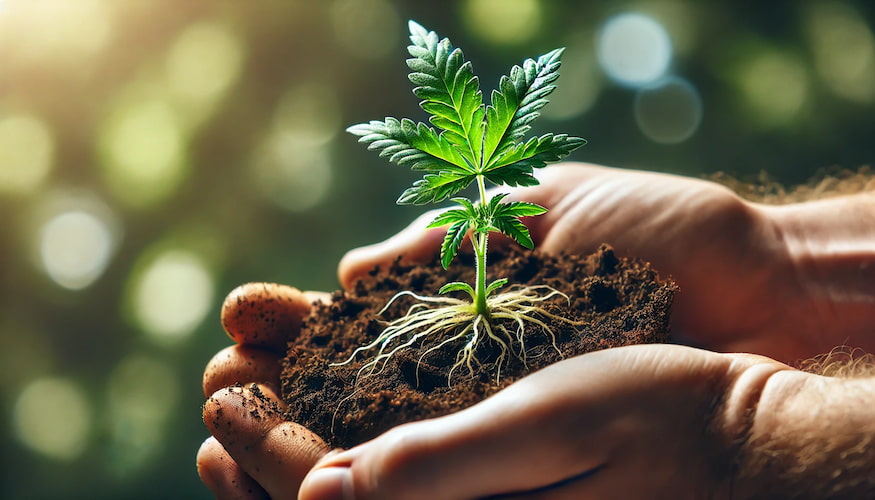
New cannabis strains are created by crossing male and female plants from different genetic lines, then selecting the best offspring and repeating the process over multiple generations. Breeders evaluate hundreds — sometimes thousands — of individual plants to find the one that nails the target traits: aroma, potency, yield, structure, and finish time. Once they find that winner, it takes years of additional crossing and selection to make those traits reliably consistent in seeds.
Understanding how this works helps you make smarter choices as a grower. It explains why two plants from the same seed pack can grow completely differently, why some strains cost more than others, and why a high-quality clone from a proven mother plant is worth every penny.
Key Takeaways
- A plant’s genotype is its genetic blueprint; its phenotype is how those genes actually express in a specific growing environment.
- F1 hybrids are the direct offspring of two distinct parent lines and often show increased vigor, but individual plants can vary significantly.
- Backcrossing reinforces specific traits from a parent plant and is used to stabilize desirable characteristics across generations.
- Pheno hunting is the process of growing many seeds to find the single best-performing individual — it can take hundreds of plants and years of work.
- A clone taken from a keeper phenotype preserves that plant’s exact genetics indefinitely, eliminating the need to hunt all over again.
- True genetic stabilization of a new strain typically takes 4 to 8 or more years of consistent selection work.
Genotype vs. Phenotype: The Foundation of Cannabis Breeding
Before you can understand cannabis breeding, you need to understand two words that breeders use constantly: genotype and phenotype. These aren’t interchangeable, and confusing them leads to a lot of misunderstanding about how genetics work.
Genotype
The genotype is the complete genetic blueprint of a cannabis plant — the DNA it inherited from its parents. Think of it as the instruction manual written in the plant’s cells. The genotype determines the full range of possible traits that plant could ever express. It doesn’t change based on environment. Every cell in the plant carries the same genotype from seed to harvest.
The genotype sets the ceiling and the floor. A plant can’t express traits that aren’t encoded in its DNA, no matter how good your growing conditions are. That’s why starting with quality genetics matters. You can’t coax exceptional terpenes out of a plant that wasn’t bred for them.
Phenotype
The phenotype is how those genes actually express in a specific plant grown in a specific environment — the plant you see, smell, touch, and harvest. Phenotype is the result of genotype plus environment. Temperature, light spectrum, nutrition, humidity, and even stress all influence how genes express.
Here’s the part that surprises most new growers: two plants with identical genotypes can show different phenotypes in different environments. Grow the same clone in a hot, dry room versus a cool, humid one, and you may get noticeably different results in aroma, color, and even structure. The genetics are identical — the expression differs.
Why This Matters for Breeders
Breeders select parent plants based on phenotype — the plant they can actually observe. But what they’re really trying to do is select for the underlying genotype. They want to identify plants whose genetic code will reliably produce those desirable traits when passed to offspring, regardless of minor environmental variation. That’s the art of reading a phenotype and understanding what it says about the genotype beneath it.
This is also why cannabis clones — which are genetically identical to their source plant — are so valuable. The clone doesn’t introduce new genetic variables. You already know what its genotype produces.
How Breeders Select Parent Plants
Selecting the right parents is the most critical step in cannabis breeding. A breeder doesn’t just grab two random plants and cross them. They evaluate candidates across a range of traits over weeks and sometimes months before making a selection decision.
Traits Breeders Evaluate
Vigor: How fast and strong does the plant grow from seedling through vegetative stage? A vigorous plant wastes no energy. It roots quickly, responds well to training, and recovers from stress. Vigor is partly a sign of genetic quality and partly an indicator of how the strain will perform for home growers who don’t have commercial-scale environmental control.
Terpene profile: Aroma and flavor are often the primary selection criteria in modern breeding. Breeders smell plants throughout their lifecycle — during veg, early flower, peak flower, and after curing. They’re looking for complexity, intensity, and desirable scent profiles: gas, fruit, candy, earth, floral, or whatever the target is. Terpenes are volatile, and a great nose on a plant often signals the presence of a diverse, complex chemical profile.
Yield: How much flower does the plant produce, measured in grams per plant or grams per square foot? Yield matters for commercial viability and for the home grower who wants a return on their investment. A strain that produces beautiful, aromatic buds but consistently yields 15 grams per plant has limited practical value for most growers.
Potency: Cannabinoid percentages — particularly THC and CBD — are assessed through lab testing in professional breeding operations. Some breeders also assess potency subjectively. High potency is often (though not always) a breeding goal, but balance and effect quality matter more to many modern breeders than raw THC percentage.
Structure: How does the plant grow? Node spacing affects how many bud sites develop. Branch strength determines whether the plant can support heavy buds without stakes. Plant height and width affect how many plants fit in a given space. A plant with poor structure can still produce excellent flower, but it creates extra work for the grower.
Flowering time: How many weeks does the plant need to finish from the flip to 12/12 lighting (or in outdoor grows, from the natural light trigger)? This is critical for outdoor growers in northern climates where the season ends early. A strain that takes 11 weeks to finish is a problem in Oregon if the rains come hard in October. Breeders often work to maintain the flowering speed of at least one parent line.
Pest and mold resistance: Does the plant show natural resistance to powdery mildew, botrytis, spider mites, or other common threats? This is increasingly important in outdoor and greenhouse breeding programs. A plant that collapses every time humidity spikes isn’t a good parent, even if it has a great terpene profile. Resistance traits can be bred in over time through careful selection.
The Crossing Process: How Seeds Are Made
The mechanics of cannabis crossing are straightforward even if the science behind it is complex. Cannabis is a dioecious plant, meaning it produces separate male and female plants. (Hermaphrodites exist but are generally undesirable in a breeding program.)
A male cannabis plant produces pollen sacs that open and release pollen when mature. Breeders collect this pollen — often by placing a bag over a pollen sac just before it opens and shaking the plant. The collected pollen is stored in a cool, dry place and remains viable for weeks to months if handled correctly.
The breeder then applies pollen to the pistils of a selected female plant. The pistils are the small, hair-like structures that emerge from the calyxes. Each pollinated pistil can produce one seed. The female plant, once pollinated, begins diverting energy into seed production rather than resin. Seeds mature over 4-6 weeks.
Each seed is a unique genetic combination of both parents. Even seeds from the same cross carry slightly different combinations of genetic material from each parent. This variation is what breeders work with — and what they ultimately try to reduce through stabilization.
Research on plant genetics and crossing methodology is well-documented in peer-reviewed literature. The National Library of Medicine’s PubMed database contains extensive research on cannabis genetics, terpene biosynthesis, and cannabinoid inheritance patterns for those who want to go deeper.
F1 Hybrids: First Generation Crosses
When two genetically distinct parent lines are crossed, the resulting offspring are called the F1 generation — short for First Filial. These are the seeds you get from crossing, say, a pure Afghan IBL against a Haze IBL. The F1s are the direct children of those two distinct parents.
F1 hybrids often show what breeders call hybrid vigor, also known as heterosis. Heterosis is the tendency of hybrid offspring to outperform both parents in growth rate, yield, and overall vitality. It’s a well-documented phenomenon across plant and animal breeding. F1 cannabis hybrids often grow faster, root more aggressively, and produce more flower than either parent alone. This is one reason so many commercial strains are F1 or near-F1 hybrids.
The catch: F1 hybrids are often genetically diverse. Because each seed is a unique combination of both parents’ genetic material, different plants from the same F1 seed pack may grow significantly differently. One might lean heavily toward the Afghan parent — short, dense, fast-flowering. Another might express more Haze influence — tall, stretchy, later to finish. Both are valid F1 plants, but they’re very different to grow. This is normal and expected. It’s not a sign of bad genetics; it’s just how F1s work.
The F2 Generation: Where Variation Explodes
If you take two F1 plants and cross them together, you get the F2 generation. This is where genetic variation increases dramatically. Recessive traits that were masked in the F1 generation begin to emerge. Plants from an F2 population can look wildly different from each other — some may resemble grandparent lines more than either F1 parent.
Breeders use F2 populations strategically. Growing out a large F2 population lets a breeder survey the full range of genetic potential hiding in a cross. This is where the most interesting phenotypes often appear. It’s also where the most unstable, unusual, and challenging plants show up. F2 populations require the breeder to evaluate many more plants to find keepers, but the keepers they find may be genuinely exceptional — expressing recombinations of traits that didn’t appear in the F1 generation.
The F2 stage is exciting and chaotic. It’s not a place for growers who want consistency. It’s a place for breeders who are hunting for something extraordinary.
Backcrossing: Locking In What You Love
Backcrossing (abbreviated BX) is the process of crossing F1 or F2 offspring back to one of the original parent plants. It’s used to reinforce specific traits from that parent — particularly recessive characteristics that might otherwise get diluted across generations.
For example, if a breeder creates an F1 hybrid and the resulting plants have great potency but inconsistent terpene profiles, they might backcross the best F1 back to the original parent that had the strongest terpene expression. This increases the proportion of that parent’s genetic contribution in the offspring.
Backcross notation is standardized in the breeding community: BX1 means one round of backcrossing has occurred, BX2 means two rounds, BX3 means three, and so on. Each round of backcrossing moves the genetics closer to the target parent. After several rounds, the offspring may share 75%, 87.5%, or more of their genetics with one original parent while still retaining key traits from the other.
The trade-off is real. Backcrossing sacrifices some genetic diversity for stability and predictability. The more backcrossed a line is, the more consistent it becomes — but also the narrower its genetic range. Breeders balance this trade-off based on their goals.
IBL: Inbred Lines and Old-School Stability
An IBL — Inbred Line — is produced by breeding siblings together (sibling crosses or self-fertilization) over four to eight or more generations. This is how old-school genetics were stabilized before modern hybrid breeding became common.
IBLs are highly consistent. Plant an IBL seed pack and most of the plants will look, grow, and produce very similarly. The genetic variation has been reduced through repeated inbreeding. Most classic genetics — original Skunk #1, Northern Lights, Early Pearl — were IBLs that breeders spent years developing.
The trade-off with IBLs is reduced vigor. Inbreeding gradually reduces genetic diversity, which can lead to slower growth, reduced yields, and increased sensitivity to environmental stress. This is the flip side of consistency. IBLs are predictable but sometimes finicky. They’re the foundation of modern cannabis genetics — nearly every hybrid on the market today traces its lineage back to classic IBLs from the 1970s, 80s, and 90s.
Understanding the future of cannabis genetics means understanding where those foundations are heading as breeders develop new tools and techniques for selection and stabilization.
Selecting and Stabilizing Genetics: Years of Work
After crossing, a breeder “pops” hundreds of seeds and grows them all the way through to harvest. This is expensive, time-consuming, and space-intensive. Commercial breeders often run 200-500 plants per selection round. The goal is to find the “keeper” phenotypes — the plants that express the target traits most strongly and consistently.
Once keepers are identified, they’re selected as potential parents for the next round of crossing. The best male and the best female (or the best two females if using a reversed female for pollen) get crossed together. The offspring of that cross get grown out, evaluated, and selected again. This process repeats across multiple generations.
A fully stable, consistent line may take 4 to 8 or more years to develop. There are no shortcuts that don’t come with trade-offs. Breeders who claim to have “fully stabilized” a new cross after one or two generations are either working with already-stable parents or overstating their work.
This is why well-established genetics from reputable breeders carry real value. The price isn’t just for the seeds — it’s for the years of selection work that went into them.
Pheno Hunting: Finding the One
Pheno hunting is the practice of popping many seeds from an unstabilized or semi-stable line to find the single exceptional individual. It’s part art, part science, and entirely resource-intensive.
The process: a grower or breeder acquires a pack of seeds from a promising cross. They germinate the whole pack — sometimes multiple packs — and grow every plant to maturity. Each plant gets evaluated throughout its lifecycle: root development in early veg, branching structure in late veg, bud formation and aroma in early flower, final terpene expression and density at peak flower, and cured product quality after harvest.
The hunter is looking for the one plant that expresses everything they’re after. Not the best of the group — the one that’s genuinely exceptional by any standard. Maybe one in 20 plants hits that mark. For some cuts that have become legendary in the cannabis world, it may have been one in 50, one in 100, or one in several hundred.
Pheno hunting requires space, time, resources, trained eyes, and trained noses. It’s not something you can do properly in a 4×4 tent with six plants. Real pheno hunts involve dozens or hundreds of plants grown across multiple cycles, often by multiple experienced growers evaluating the same genetics independently. The hunt for truly rare pheno-hunted cannabis clone strains can take an entire breeding team years to complete.
Why Clones Preserve a Winning Phenotype
Once a breeder or grower finds their “cut” — the exceptional individual from a pheno hunt — a clone taken from that plant preserves 100% of its genetic identity, indefinitely. The clone is a vegetative copy. It carries the same DNA, expresses the same traits, and produces the same flower as the original plant, as long as it’s kept healthy and in proper vegetative conditions.
The clone never varies from the original. You don’t roll the dice on genetics every time you grow it. You know exactly what you’re getting because you’ve already grown it — or because someone else has already proven it. This is why famous cuts like “the Cookies cut,” “MAC1,” or “Chem 91” are prized decades after they were first discovered. They’re the result of years of hunting, locked in forever.
Understanding how mother plants work is essential to understanding how clones stay stable across years and generations of propagation.
At IWantClones.com, this is exactly what we offer. Our clones come from elite pheno-hunted mother plants — the result of SeedsHereNow.com’s 15+ years in genetics and direct relationships with more than 70 breeders. When you order a clone from us, you skip the pheno hunt entirely. You get the keeper cut, proven and ready to produce, shipped overnight to your door.
Landrace vs. Hybrid Strains
To understand where modern genetics come from, you need to understand the difference between landrace and hybrid strains.
Landrace Strains
Landrace strains are indigenous cannabis populations that evolved in geographic isolation over centuries. They developed naturally in specific regions — the Hindu Kush mountains, the African continent, Southeast Asia, Central America — and adapted to their local climate, soil, and growing conditions over generations without human selective breeding.
Examples include Afghan, Durban Poison, Thai, Colombian Gold, and Malawi. These strains are genetically stable within their region. They’re not necessarily consistent by breeder standards, but they’ve been shaped by natural selection into something highly adapted to their environment. They’re also the raw material — the genetic foundation — from which virtually every modern strain was built.
Hybrid Strains
A hybrid is the result of crossing two or more genetically distinct plants. Most modern cannabis strains are complex hybrids, often carrying genetics from multiple landrace populations combined over multiple generations of selective breeding. “Sativa,” “indica,” and “hybrid” are common shorthand, though these terms are technically about plant morphology rather than effect — a discussion worth its own article.
Hybrids allow breeders to combine the best traits of multiple parent lines: the yield of one parent, the terpene profile of another, the fast flowering of a third. Modern cannabis genetics are extraordinarily complex, with most strains tracing back to dozens of landrace ancestors through generations of crossing and selection.
Cannabis Breeding Terms: Quick Reference
| Term | Definition | Why Growers Care |
|---|---|---|
| Genotype | The complete genetic blueprint of a plant — the DNA inherited from its parents | Determines the range of traits a plant can possibly express; sets the ceiling on quality |
| Phenotype | How the genotype actually expresses in a specific plant grown in a specific environment | What you actually grow; can vary between plants with the same genotype in different environments |
| Chemotype | The chemical profile of a plant — which cannabinoids and terpenes it produces and in what ratios | Determines the aroma, flavor, and effect of the finished flower; now testable via lab analysis |
| F1 Hybrid | The direct offspring of two genetically distinct parent lines | Often shows hybrid vigor; expect variation between individual plants within the same F1 pack |
| F2 Generation | Seeds produced by crossing two F1 plants together | High genetic variation; where unusual and exceptional phenotypes emerge, but consistency is low |
| Backcross (BX) | Crossing F1 or F2 offspring back to one of the original parent plants | Reinforces specific parent traits; increases consistency at the cost of some genetic diversity |
| IBL (Inbred Line) | A highly stable line produced by repeated sibling crosses or self-fertilization over 4-8+ generations | Highly consistent offspring; reduced vigor compared to hybrids; the foundation of classic genetics |
| Pheno Hunt | The process of growing many seeds to find the single best-expressing individual phenotype | How legendary cuts are discovered; requires significant time, space, and expertise |
| Landrace | Indigenous cannabis populations that evolved in geographic isolation over centuries | The genetic foundation of virtually all modern strains; adapted to specific climates |
| Hybrid | The result of crossing two or more genetically distinct plants | Most modern strains are complex hybrids; allows breeders to combine traits from multiple lineages |
| Mother Plant | A female plant kept in vegetative growth indefinitely to supply cuttings for cloning | The source of all clones; its quality directly determines the quality of every clone taken from it |
| Clone | A vegetative cutting rooted from a mother plant; genetically identical to the source | Preserves a proven phenotype with 100% fidelity; eliminates the variation of growing from seed |
Why IWantClones.com Clones Come from Pheno-Hunted Stock
We’re not passing off random seeds grown to clone-able size. At IWantClones.com, backed by SeedsHereNow.com’s 15+ years in the genetics industry and direct relationships with more than 70 breeders worldwide, our clones come from elite pheno-hunted mother plants. These are plants that were selected out of large populations specifically because they expressed the traits breeders and experienced growers spent years hunting for.
When you buy a clone from us at $98.88 and we ship it overnight to your door, you’re not starting a pheno hunt. You’re starting with the winner of one that’s already been completed. You know the genetic identity of what you’re growing. You know what to expect in terpene profile, structure, and yield because someone with deep knowledge of cannabis genetics already did the work of finding that plant and proving it out.
Our 3-day no-bullshit guarantee backs every order. If your clones don’t arrive healthy and ready to root, we make it right. Browse our current inventory at the IWantClones.com shop and see what elite genetics look like when they come from people who’ve spent over a decade in this industry.
Frequently Asked Questions About Cannabis Breeding
What is the difference between genotype and phenotype in cannabis?
The genotype is the plant’s complete genetic blueprint — the DNA inherited from its parents. The phenotype is how those genes actually express in a given environment — the plant you can see, smell, and harvest. Two plants with identical genotypes can show different phenotypes under different growing conditions. Breeders select based on phenotype, but they’re really trying to identify and select for the underlying genotype.
What is an F1 hybrid cannabis strain?
An F1 hybrid is the direct offspring of two genetically distinct parent lines. F1s often show hybrid vigor — also called heterosis — meaning they tend to outperform both parents in growth rate, yield, and overall vitality. However, F1 seeds are usually genetically diverse, so different plants from the same pack can look and grow very differently from each other.
How long does it take to stabilize a new cannabis strain?
Stabilizing a new cannabis strain typically takes 4 to 8 or more years of consistent work. Breeders must grow out hundreds of plants across multiple generations, select keeper phenotypes, and repeat the crossing and selection process until offspring consistently express the target traits. True genetic stability requires patience and resources that most individual growers don’t have access to.
What is pheno hunting and why does it matter?
Pheno hunting is the practice of popping many seeds from a strain to find the single best-performing individual. It requires growing dozens or even hundreds of plants, evaluating each for aroma, potency, yield, and structure. The winner — the keeper — becomes a mother plant for future cloning. One in 50 or 100 seeds might be truly exceptional, which is why professional pheno hunts take serious time and resources.
Why are cannabis clones better than seeds for preserving genetics?
A clone taken from a proven plant preserves 100% of that plant’s genetic identity — forever. Seeds introduce genetic variation every time, even from the same parents. When you grow a clone of an elite cut, you get the exact same terpene profile, potency, structure, and flowering characteristics that made that plant worth keeping in the first place. No guessing, no variation, no surprises.